Solaray Magnesium Glycinate Review (2026): Is Solaray a Good Brand?

Disclosure & independence
Solaray did not pay for this review, did not supply the product, and did not see the article before publication. No brand is given approval over what is written here.
This article contains affiliate links. If you buy through one I may earn a commission, at no additional cost to you. A commission never changes a score, a ranking or a verdict: those are decided before any commercial link is considered.
Full details in my affiliate disclosure, editorial policy and testing methodology.
Two questions dominate what people search about this brand: is Solaray a good brand and is Solaray third-party tested. Both have clear answers, and the second one is the most impressive I have found in this category. But the Solaray Magnesium Glycinate label also contains a detail that catches out a large number of buyers, and it is on the front of the bottle in plain sight.
inareview verdict
8.5/10
The most rigorously verified supplement I have reviewed, let down only by how many capsules you have to swallow. Magnesium bisglycinate — the correct chelated form — made in the company’s own NSF-certified Utah facility, with products anonymously purchased and independently tested in ISO 17025 accredited labs. The catch: 350 mg means four capsules, so a 120-count bottle is a 30-day supply, not 120 days.
Buy it if verified purity is your priority and you can swallow four capsules. Skip it if you want a one-or-two-capsule dose, you avoid magnesium stearate, or you take medication affected by black pepper extract.
Comparing brands? I put this one head to head with every other brand I have assessed in my comparison of the best magnesium glycinate brands, on cost per 100 mg and on whose testing actually holds up. One point that comparison now makes and this review does not: Doctor’s Best is cheaper still, at 10.0¢ per 100 mg, but it sells magnesium lysinate glycinate — so Solaray remains the cheapest true bisglycinate at regular prices — only NOW Foods, which I added to the comparison later, undercuts it, and only while on sale.
How this review was done
I want to be straight about the method. This is a label, formulation, testing and pricing analysis, not a hands-on trial. I have not taken this supplement.
What I have done is read Solaray’s full ingredient list and serving specification, work through the company’s published quality and testing claims, collect the current prices for both bottle sizes, and calculate the real cost per unit of elemental magnesium. Where I raise an interaction caution, that is my analysis of a named ingredient, and I explain the mechanism so you can check it with a pharmacist.
Who Solaray actually is
Solaray has been trading since 1973 — over fifty years, which in this industry is unusual in itself. The company operates its own laboratory in Ogden, Utah, and its claims about what happens there are specific rather than decorative:
- Up to 15,000 scientific tests per month in its own lab, dependent on inventory levels.
- Raw materials are verified in-house rather than accepted on supplier documentation — the company states plainly that it does not just review supplier paperwork.
- Most contaminants are tested to a 10 ppb reporting limit.
- The manufacturing facility is NSF certified.
That last point needs a precise reading, because brands often blur it. NSF facility certification means the plant where the product is made meets NSF’s standards for a safe and hygienic manufacturing environment. It is not the same as NSF Certified for Sport, which certifies individual batches against banned substances. Solaray states the facility certification, which is accurate, and does not overclaim it as product certification. That distinction is one most brands get wrong in their favour.
The testing claim that actually stands out
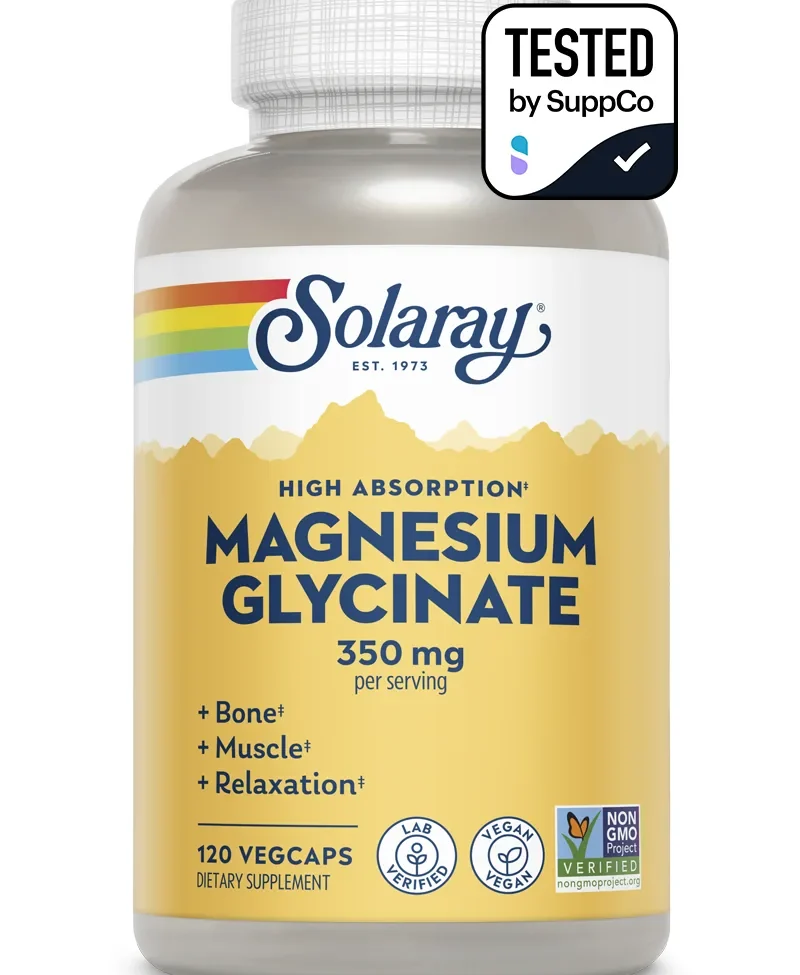
Here is the part I did not expect, quoted from the product listing: the product is “TESTED by SuppCo certified. Anonymously purchased and independently tested in ISO 17025 accredited labs — verified to contain exactly what our label claims.”
Read that carefully, because the phrasing does something almost no supplement brand does. Anonymously purchased means the tested bottles were bought off the shelf like a customer’s, not hand-picked from a production run and couriered to a friendly lab. ISO 17025 accredited is the international standard for laboratory competence. Together, those two words close the loophole that makes most “third-party tested” claims close to meaningless.
I have made this criticism repeatedly, most recently in my Qunol magnesium glycinate review, where I noted the absence of any batch-specific certificate of analysis. Solaray does the thing I said that brand should do. It deserves the credit, and it is the single strongest reason to choose this product over a cheaper one.
So: is Solaray third-party tested? Yes, and by a stricter method than the phrase normally implies.
What is actually in the bottle
The complete ingredient list is short and fully disclosed:
Magnesium (from Magnesium Bisglycinate), BioPerine® Black Pepper Extract (Piper nigrum) (fruit), Vegetable Cellulose Capsule, Magnesium Stearate, Cellulose and Silica.
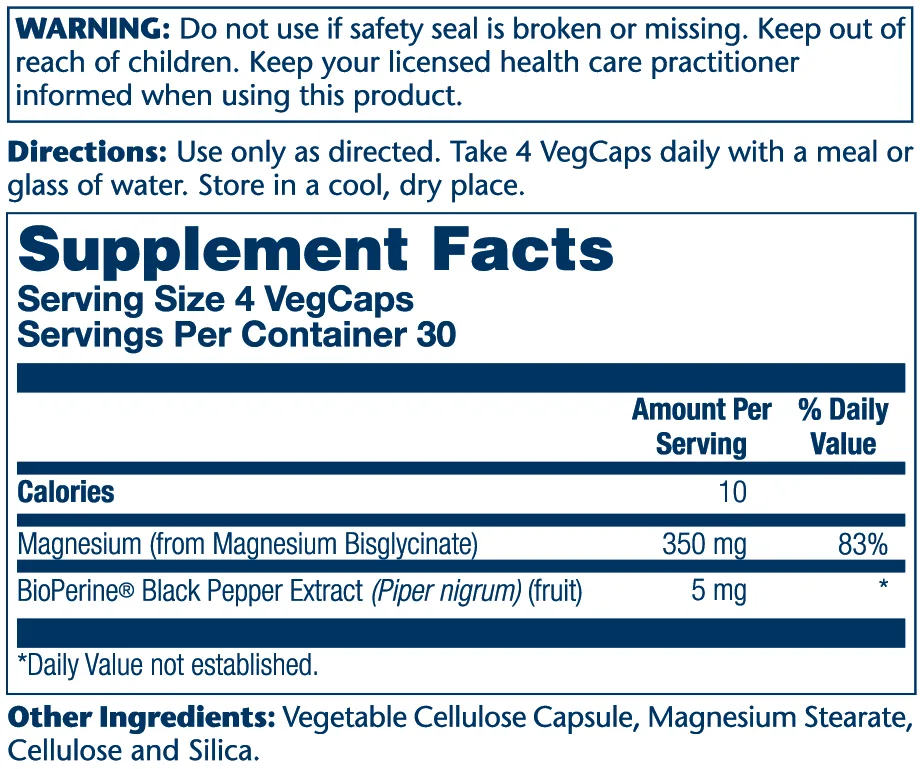
Three things in that list are worth pulling out.
1. It is bisglycinate, which is the form you want
The bottle says “Magnesium Glycinate”; the ingredient list says magnesium bisglycinate. That is not marketing drift — bisglycinate is the fully chelated form, in which each magnesium atom is bound to two glycine molecules. That chelation is what gives this form its two practical advantages: it is absorbed through amino acid transport pathways rather than competing with other minerals, and it is markedly gentler on the gut than magnesium oxide or citrate, which draw water into the bowel and cause the loose stools people associate with magnesium.
Solaray also states the chelation is done through its own in-house process rather than bought in. For a mineral where the quality of the chelate determines whether you get the tolerability benefit at all, making it yourself is a meaningful claim.
2. Four capsules per serving — the detail that catches people out
This is the most important practical fact in the review, and it is the reason so many people are confused by their first bottle. The 350 mg on the front is delivered in four vegetarian capsules, not one. That works out to roughly 87.5 mg of magnesium per capsule.
The consequences are concrete:
- A 120-count bottle is 30 servings — one month, not four.
- A 240-count bottle is 60 servings — two months.
- If you are someone who struggles with capsules, four a day is a real barrier, and the honest thing to say is that this product will not suit you.
Is it a flaw? Not exactly. Magnesium bisglycinate is bulky precisely because the chelate carries two glycine molecules alongside the magnesium — the very thing that makes it well tolerated also makes it heavy. Any brand delivering 350 mg of elemental magnesium in this form needs either several capsules or very large tablets. Solaray chose several capsules; the review of a product I looked at earlier chose large tablets, and the most frequent complaint about it was that they were hard to swallow. There is no free option here.
What I would fault is not the formulation but the shelf presentation. “350mg” and “120ct” on the same label reads to most shoppers as a long supply, and it is one month. If you want a smaller daily dose, taking two capsules gives you 175 mg, which is a perfectly reasonable intake and doubles the life of the bottle.
3. Black pepper extract deserves a caution the label does not give
The formula includes 5 mg of BioPerine black pepper extract, which Solaray includes “to aid in gentle digestion.”
Piperine, the active compound in black pepper extract, is a well-documented bioavailability enhancer. It works by inhibiting the CYP3A4 enzyme system and P-glycoprotein — the same machinery your body uses to metabolise and clear a great many prescription medicines. That is why it is added to turmeric products, and it works.
But the mechanism cuts both ways. If you take medication metabolised through CYP3A4 — which includes many statins, some blood thinners, certain immunosuppressants, some anti-epileptics and a range of others — a bioavailability enhancer can raise the blood level of that drug. The amount here is small, and for most people taking no medication this is a non-issue. If you take prescription medication regularly, this is worth thirty seconds with your pharmacist before you start, and the product page does not raise it.
The list also contains magnesium stearate, a flow agent used to stop powder sticking to manufacturing equipment. The weight of evidence does not support the claims made against it at the quantities used in capsules, but a number of buyers specifically avoid it and are entitled to know it is there. It is on the label, plainly, which is more than some “clean” brands manage. If you want it gone altogether, Pure Encapsulations excludes magnesium stearate by name and lists only two other ingredients — though it costs 32% to 64% more per 100 mg and documents its finished-product testing less precisely than Solaray does.
What it costs
Direct prices, with the arithmetic done at 350 mg of elemental magnesium per four-capsule serving:
- 120 count (30 servings) — $18.39. That is 61 cents a serving, or about 17.5 cents per 100 mg of elemental magnesium.
- 240 count (60 servings) — $31.99. That is 53 cents a serving, or about 15.2 cents per 100 mg.
The larger bottle saves about 13% per serving, which is a modest but real discount — nothing like the 22 to 23% gaps I found between brand stores and retailers in other categories. For a product with this level of verification behind it, both prices are reasonable. You are paying a premium over a supermarket magnesium oxide, and you are getting a different form with documented purity testing for it.
One practical note: if you halve the dose to two capsules and 175 mg — a sensible intake for general use or sleep support — the 240-count bottle becomes a four-month supply at around 27 cents a day.
So, is Solaray a good brand?
On the evidence available, yes — and specifically on the criteria that are hardest to fake.
Fifty-plus years of trading, an owned laboratory rather than an outsourced one, in-house raw material verification rather than trust in supplier paperwork, a stated testing volume, a contaminant reporting limit given as a number, NSF facility certification described accurately rather than inflated, and finished products anonymously bought and tested in accredited laboratories. Very few supplement companies can point to that combination, and I have reviewed several this month that cannot point to any of it.
The brand also won Best Single Mineral supplement at the Vitamin Retailer 2025 Vity Awards for this product. Industry awards are a weak signal compared with laboratory data, so treat it as decoration rather than evidence — the testing is the real argument.
Who it is for
This is a strong buy if verified purity matters more to you than convenience; you want magnesium bisglycinate specifically for sleep, relaxation or muscle support without the gut effects of citrate; you can comfortably take four capsules, or you are happy taking two for a 175 mg dose; or you have been burned by a brand whose testing claims turned out to be unverifiable.
Look elsewhere if you want your full dose in one or two capsules; you avoid magnesium stearate on principle; you take prescription medication and would rather not add a bioavailability enhancer; or you are buying magnesium purely as a laxative, in which case citrate is cheaper and better suited.
The verdict
This is the best-verified product I have assessed. Every claim I wanted to check was already answered somewhere on Solaray’s own materials, in specific numbers rather than adjectives, and the anonymous-purchase testing closes the exact loophole that makes most third-party claims worthless. After a run of brands that publish assurances without evidence, it is a noticeable change of register.
What keeps it at 8.5 rather than higher is entirely practical. Four capsules is a genuine daily burden, and a bottle labelled “350mg” and “120ct” reads as a four-month supply to almost everyone who picks it up for the first time. The black pepper extract is a sensible formulation choice that carries an interaction caveat the product page should mention and does not. Neither is a quality failure; both cost the buyer something.
Buy the 240-count bottle. Start at two capsules rather than four unless you have a reason to need the full dose, and check the black pepper extract with your pharmacist if you take anything on prescription.
Where to buy
The 240-count is the size I recommend, and it is the better value per 100 mg — check which counts are listed before you pick one.
Check current prices and sizes on AmazonOutside the US? Canada: search Amazon.caAs an Amazon Associate I earn from qualifying purchases. This never changes a score, a ranking or a verdict — those are decided before any commercial link is considered.
Common questions
Is Solaray a good brand?
Yes, on the criteria that matter most. It has traded since 1973, runs its own NSF-certified facility and laboratory in Ogden, Utah, states that it performs up to 15,000 tests per month, verifies raw materials in-house, and has finished products anonymously purchased and independently tested in ISO 17025 accredited laboratories.
Is Solaray third-party tested?
Yes. Products are anonymously purchased and independently tested in ISO 17025 accredited labs to verify they contain what the label claims. The manufacturing facility is separately NSF certified — note that facility certification is not the same as NSF Certified for Sport batch certification.
How many capsules is a serving of Solaray Magnesium Glycinate?
Four vegetarian capsules, delivering 350 mg of elemental magnesium — about 87.5 mg per capsule. A 120-count bottle is therefore a 30-day supply and a 240-count bottle is 60 days.
Is it magnesium glycinate or bisglycinate?
The ingredient list specifies magnesium bisglycinate, the fully chelated form in which magnesium is bound to two glycine molecules. That is the form associated with good absorption and gentle digestion.
Why does it contain black pepper extract?
Solaray includes 5 mg of BioPerine black pepper extract to aid gentle digestion. Piperine also inhibits CYP3A4 and P-glycoprotein, which can raise blood levels of some prescription medicines — worth checking with a pharmacist if you take medication regularly.
Does Solaray Magnesium Glycinate contain magnesium stearate?
Yes, as a flow agent, and it is listed on the label. The evidence does not support the health claims made against it at capsule-level quantities, but if you avoid it on principle, this product contains it.
Sources
Everything above was read from these pages. Links are provided so you can check the claims for yourself; none of them is an affiliate link.
- Solaray — Magnesium Glycinate 350 mg — ingredient list, the anonymous-purchase testing claim, and both bottle prices.
Prices, formulations and availability were checked in September 2026 and can change without notice — always read the label on the product you receive. This review is for general information and is not medical advice. If you are pregnant or breastfeeding, take prescription medication, or have a diagnosed condition including kidney or liver disease, speak to a qualified professional before adding a supplement.

Roy Douele founded inareview and writes every review on the site. He is not a medical professional: he sources and buys the products himself, tests them over a meaningful period, and checks each claim against published research before assigning a score out of 10. Brands cannot pay for a review or influence a score.
View All Articles