Phosphatidylserine vs Ashwagandha for Cortisol: Which One, and When

Disclosure & independence
No brand pays for coverage on inareview, and no brand sees an article before it is published. Products are assessed against published criteria, not against what a company would like to read.
At the time of publication, this article contains no affiliate links. If any are added later they will be clearly marked, they will never cost you anything extra, and they cannot change a score: verdicts are decided before any commercial link is considered.
Full details in my affiliate disclosure, editorial policy and testing methodology.
Phosphatidylserine vs ashwagandha: they are not rivals, because the trials measured two different things. Ashwagandha has been tested on everyday cortisol levels in chronically stressed adults over two months. Phosphatidylserine has been tested on the cortisol spike that follows a single stressful event, such as hard exercise or a public-speaking test. Which one fits depends on which of those is your problem.
Most pages comparing the two line up their percentages side by side, as if a 28% fall and a 39% fall were the same measurement. They are not, and once you see what each number describes, the choice becomes much clearer.
The short version
- Ashwagandha lowered resting blood cortisol by 27.9% over 60 days in 64 chronically stressed adults, against 7.9% on placebo. It is the better-studied choice for ongoing, everyday stress.
- Phosphatidylserine blunted the rise in cortisol caused by an acute stressor: hard cycling in one small trial, a staged public-speaking test in others. It has not been shown to lower your baseline cortisol on an ordinary day.
- More phosphatidylserine was not better. In one trial, 400 mg a day worked and 600 mg and 800 mg did not.
- Both evidence bases are small, and several phosphatidylserine trials were funded by companies that make it.
- Ashwagandha carries more safety caveats: rare liver injury, thyroid effects, and it is not for pregnancy, breastfeeding, autoimmune or thyroid disease. Denmark banned it from food supplements in 2023.
How this article was done
I have not taken either supplement, and there is no test panel, because there was none. I read the main human trials behind each one, including who funded them, and the safety guidance from the US National Center for Complementary and Integrative Health. Where a trial measured something different from what it is usually quoted for, I say so. This is general information, not medical advice, and it follows the approach in my methodology.
Two different kinds of cortisol problem
Cortisol is not a single number that is either high or low. Two separate things get called “high cortisol”, and these two supplements were tested on different ones.
Resting cortisol is the level in your blood on an ordinary day. In people under long-running stress it can sit higher than it should. This is what the ashwagandha trials measured.
Cortisol reactivity is how sharply cortisol rises in response to a specific stressor, such as an intense workout or a stressful test, and how quickly it comes back down. This is what the phosphatidylserine trials measured.
A supplement that blunts a spike has not been shown to lower your baseline, and a supplement that lowers your baseline has not necessarily been tested on spikes. Keep that distinction in mind and every number below makes more sense.
Side by side
| Ashwagandha | Phosphatidylserine | |
|---|---|---|
| What it is | Root extract of Withania somnifera, an Ayurvedic herb | A phospholipid found in cell membranes, usually made from soy |
| What the trials measured | Resting serum cortisol over weeks | The cortisol rise after an acute stressor |
| Best-known trial | 64 stressed adults, 300 mg twice a day, 60 days: cortisol −27.9% vs −7.9% on placebo | 10 men, 600 mg a day, 10 days: peak cortisol after cycling 39% lower than on placebo |
| Dose in the trials | Usually 240–600 mg a day of standardised extract | 400 mg (with phosphatidic acid) to 600 mg a day |
| Time studied | Up to about 3 months | 10 days to 6 weeks |
| Main safety cautions | Rare liver injury; thyroid; pregnancy, breastfeeding, surgery, autoimmune disease; several drug interactions | Generally well tolerated; usually soy-derived |
Ashwagandha: the evidence on everyday cortisol
The trial most often quoted was published in the Indian Journal of Psychological Medicine in 2012. Sixty-four adults with a history of chronic stress took either a placebo or 300 mg of a full-spectrum ashwagandha root extract, standardised to at least 5% withanolides, twice a day for 60 days. Serum cortisol fell by 27.9% in the ashwagandha group and by 7.9% on placebo, and scores on every stress questionnaire improved significantly more on ashwagandha.
That is a clear result, and other trials have pointed the same way at doses between about 240 mg and 600 mg a day. Two limits are worth knowing. The trials are small and mostly short, and the effect depends on using a standardised extract: raw root powder with no stated withanolide content cannot be compared with what was tested. I go through the dose and extract question in my guide to the best supplement to lower cortisol.

Phosphatidylserine: the evidence on stress spikes
After exercise
A 2008 trial in the Journal of the International Society of Sports Nutrition gave 10 healthy men either 600 mg of phosphatidylserine a day or a placebo for 10 days, in a crossover design, then put them through a hard cycling protocol. After phosphatidylserine, their peak cortisol was 39% lower and their total cortisol response 35% lower than after placebo. Ten men is a very small sample, and two of the five authors worked for a consultancy in the supplement sector. Other exercise studies, including one in resistance-trained men at 400 mg a day for 14 days, found no difference in cortisol.
After psychological stress
A 2004 trial in the journal Stress gave four groups of 20 people 400 mg, 600 mg or 800 mg a day of a soy phosphatidylserine and phosphatidic acid complex, or a placebo, for three weeks, then exposed them to the Trier Social Stress Test, a standard laboratory test built around public speaking and mental arithmetic. The 400 mg dose blunted the cortisol and ACTH response. The higher doses did not.
A 2014 follow-up in 75 men found that 400 mg of phosphatidylserine with 400 mg of phosphatidic acid a day for six weeks normalised the cortisol response to the same test, but only in men who were chronically highly stressed; in the low-stress group, and at half the dose, there was no effect. That study was funded by two companies that make the ingredient.
So the phosphatidylserine story is real but narrow: a blunted cortisol spike, at one particular dose, in small and partly industry-funded trials, with no evidence that it lowers your ordinary daily cortisol.
Safety: where they differ most
Ashwagandha has the longer list. The US National Center for Complementary and Integrative Health says it may be safe in the short term, up to three months, and that there is not enough information on long-term safety. It notes rare cases of liver injury, advises avoiding it in pregnancy and breastfeeding, and does not recommend it before surgery or for people with autoimmune or thyroid disorders. The thyroid question is covered in ashwagandha and thyroid. It lists possible interactions with medicines for diabetes and high blood pressure, immunosuppressants, sedatives, anti-seizure medicines and thyroid hormone. In 2023 Denmark banned ashwagandha from food supplements on safety grounds, a decision some researchers have criticised as poorly evidenced.
Phosphatidylserine has been generally well tolerated in its trials. Most products are now made from soy, which matters if you are allergic; older research used phosphatidylserine taken from cow brain, which is no longer how supplements are made.
Whichever you consider, speak to a doctor or pharmacist first if you take prescription medicines, are pregnant or breastfeeding, or have a thyroid, liver or autoimmune condition.
Which one should you choose?
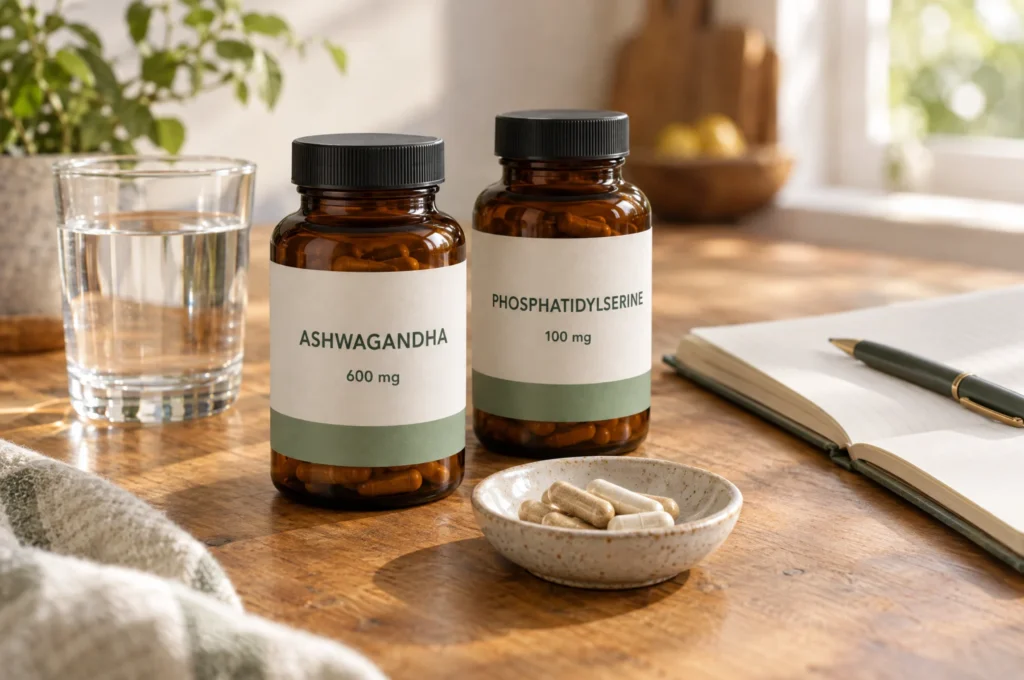
- You feel stressed most days, over weeks or months: ashwagandha has the more relevant evidence, as long as none of its cautions apply to you. Use a standardised extract (my picks are in the best ashwagandha supplements) and give it six to eight weeks (see how long ashwagandha takes to work).
- You train hard or face predictable stressful events (competition, exams, presentations): phosphatidylserine is the one tested on stress spikes. The evidence is small, so treat it as an experiment, and note that 400 mg outperformed higher doses.
- You are pregnant, breastfeeding, have a thyroid or autoimmune condition, or take thyroid medication or sedatives: not ashwagandha.
- You want both: no trial has tested them together, so there is no evidence that combining them works better than either alone. If you try, start one at a time so you can tell what, if anything, is helping.
Neither replaces the basics with the best evidence for stress: sleep, regular exercise and, where stress has become an anxiety problem, talking therapies. For the wider picture, see the best supplements for stress.
Common questions
Is phosphatidylserine or ashwagandha better for cortisol?
It depends on the problem. Ashwagandha has better evidence for lowering everyday cortisol in chronically stressed adults. Phosphatidylserine has evidence for blunting the cortisol spike after an acute stressor such as hard exercise or a stressful test.
Can you take phosphatidylserine and ashwagandha together?
No trial has tested the combination, so there is no evidence it works better than either alone, and no known interaction between them either. Start one at a time, and check with a pharmacist if you take any prescription medicine.
How much phosphatidylserine should I take for cortisol?
The trials used 400 mg to 600 mg a day. In the psychological-stress trials, 400 mg worked and higher doses did not, so more is not better.
How long does ashwagandha take to lower cortisol?
The main trial measured the effect at 60 days. Most studies run six to eight weeks, so judge it over that period rather than days.
Is ashwagandha safe?
For most healthy adults it appears safe for up to about three months, according to the NIH’s complementary health centre, but there are rare reports of liver injury and it should be avoided in pregnancy, breastfeeding, before surgery, and with autoimmune or thyroid conditions.
Does phosphatidylserine lower cortisol at rest?
That has not been shown. The trials measured the rise in cortisol after a stressor, not baseline levels on an ordinary day.
Sources
- Chandrasekhar K, Kapoor J, Anishetty S. A prospective, randomized double-blind, placebo-controlled study of safety and efficacy of a high-concentration full-spectrum extract of ashwagandha root in reducing stress and anxiety in adults. Indian Journal of Psychological Medicine. 2012 — the 60-day cortisol trial.
- Starks MA et al. The effects of phosphatidylserine on endocrine response to moderate intensity exercise. Journal of the International Society of Sports Nutrition. 2008 — the cycling trial.
- Hellhammer J et al. Effects of soy lecithin phosphatidic acid and phosphatidylserine complex (PAS) on the endocrine and psychological responses to mental stress. Stress. 2004 — the 400, 600 and 800 mg comparison.
- Hellhammer J et al. A soy-based phosphatidylserine/phosphatidic acid complex (PAS) normalizes the stress reactivity of hypothalamus-pituitary-adrenal-axis in chronically stressed male subjects. Lipids in Health and Disease. 2014 — the 75-man trial and its funding.
- US National Center for Complementary and Integrative Health — Ashwagandha — safety, cautions and interactions.
- Danish ban on Ashwagandha: truth, evidence, ethics, and regulations. 2024 — the 2023 Danish decision and the criticism of it.

Roy Douele founded inareview and writes every review on the site. He is not a medical professional. Each review is built from the product's label, the brand's own testing documents, public certification registers and the published clinical research, then scored out of 10. Brands cannot pay for a review or influence a score.
View All Articles