Best Supplements for Stress (2026): 7 Options Ranked by the Evidence

Disclosure & independence
No brand pays for coverage on inareview, and no brand sees an article before it is published. Products are assessed against published criteria, not against what a company would like to read.
At the time of publication, this article contains no affiliate links. If any are added later they will be clearly marked, they will never cost you anything extra, and they cannot change a score: verdicts are decided before any commercial link is considered.
Full details in my affiliate disclosure, editorial policy and testing methodology.
What is the best supplement for stress? On the evidence, ashwagandha for ongoing stress, and L-theanine for stressful moments. Ashwagandha has the most placebo-controlled trials showing lower stress scores and cortisol, though it takes about eight weeks. L-theanine works within an hour but its effect is small. Lavender oil capsules, saffron and omega-3 have promising data for anxiety, magnesium and rhodiola have weaker data, and some popular options, such as GABA and kava, are either unproven or carry real risks.
“Stress supplement” is a crowded shelf. Below, each option is ranked by the strength of the human trials behind it, not by how often it appears in a blend. Each one gets the dose the research used, how long it took and who should avoid it.
The short version
| Supplement | Best for | Dose in trials | Time to effect | Evidence |
|---|---|---|---|---|
| Ashwagandha | Ongoing stress, cortisol | 240–600 mg extract a day | About 8 weeks | Strongest |
| Lavender oil (Silexan) | Persistent anxiety | 80–160 mg a day | About 6 weeks | Good, mostly maker-funded |
| Saffron | Anxiety with low mood | Usually 30 mg a day | Several weeks | Promising, small trials |
| Omega-3 | Anxiety symptoms | 2,000 mg or more a day | Weeks to months | Moderate |
| L-theanine | Stressful moments | 200 mg | Under an hour | Small effect |
| Rhodiola | Stress-related fatigue | 400–576 mg a day | 2–4 weeks | Limited |
| Magnesium | Mild stress if magnesium is low | 200–300 mg elemental | Weeks | Weak |
How this ranking was done
I have not taken these supplements for this article, and there is no test panel. I ranked each one on the human evidence: how many placebo-controlled trials exist, how large and consistent the effects were, whether the results were measured or only self-reported, and who funded the work. Where I have written a detailed review of one supplement, it is linked so you can see every study. This is general information, not medical advice, and it follows my methodology.
1. Ashwagandha: the strongest evidence for ongoing stress
Ashwagandha is the most studied herbal option for chronic stress. In a 2012 trial in chronically stressed adults, 300 mg twice a day for 60 days lowered serum cortisol by 27.9%, against 7.9% on placebo. A 2019 trial at 240 mg a day found cortisol fell by about 23%, although it was funded by the extract’s maker. Across trials, the clear effects on stress scores appeared at about eight weeks, not four, and 500–600 mg a day did better than lower doses.
Who should avoid it: people who are pregnant or breastfeeding, people with thyroid conditions or autoimmune disease, and anyone on sedatives, thyroid medicine or immunosuppressants without medical advice. Why the thyroid matters is explained in ashwagandha and thyroid. Long-term safety beyond about three months is not well established.
Which product to buy: the best ashwagandha supplement. Full details: how long ashwagandha takes to work and the best supplement to lower cortisol.
2. Lavender oil capsules (Silexan): good data for persistent anxiety
This is not lavender tea or aromatherapy. Silexan is a specific oral lavender oil extract, sold in the US under brand names such as CalmAid. In a 2014 double-blind trial of 539 adults with generalised anxiety disorder, 80 mg or 160 mg a day for ten weeks reduced anxiety scores more than placebo (p < 0.01). The comparison drug, the antidepressant paroxetine, only showed a trend in the same trial. Side effects were no more frequent than on placebo, the most common being burping.
The catch: nearly all of the Silexan trials were funded by its manufacturer, Dr. Willmar Schwabe, and the results apply to that extract, not to any lavender product.
3. Saffron: promising for anxiety with low mood
A 2019 meta-analysis in Nutrition Reviews pooled the randomised trials of saffron and found a large effect compared with placebo on both depressive symptoms (g = 0.99) and anxiety symptoms (g = 0.95). Most trials used about 30 mg of saffron extract a day. The effect sizes look impressive, but the trials were mostly small and short, so the real effect is likely smaller. Saffron is worth a look if stress comes with low mood.
Who should avoid it: anyone pregnant, since high doses of saffron are considered unsafe in pregnancy. Ask a doctor first if you take an antidepressant.
4. Omega-3: moderate evidence at higher doses
A 2018 meta-analysis in JAMA Network Open pooled 19 clinical trials with 2,240 participants and found that omega-3 fatty acids were associated with less severe anxiety symptoms compared with controls. The association was stronger at 2,000 mg or more a day. Omega-3 is slow and modest, but it has other health benefits and a long safety record.
Who should be careful: people on blood thinners, since high doses can increase bleeding risk.
5. L-theanine: fast, but a small effect
L-theanine, an amino acid from tea, is the only option here that works within an hour. In small trials, 200 mg taken before a stressful task reduced the rise in heart rate and a salivary stress marker. A 2020 systematic review of nine trials concluded that 200–400 mg a day may help people under stressful conditions. But in the one trial in people with diagnosed generalised anxiety disorder, it did no better than placebo. Side effects are rare.
Which product to buy: the best L-theanine supplement. Full details: L-theanine for anxiety and L-theanine side effects.
6. Rhodiola: limited evidence, mainly for stress-related fatigue
In a 2009 trial in 60 adults with stress-related fatigue, a rhodiola extract at 576 mg a day for 28 days improved fatigue and reduced the cortisol response on waking compared with placebo. Another small trial at 400 mg a day for 14 days reported better stress, anxiety and mood scores, but it compared rhodiola with no treatment rather than a placebo. At least one randomised trial found no hormonal change. Rhodiola is a reasonable option for exhaustion from stress, with modest expectations.
Who should be careful: people with bipolar disorder and anyone taking antidepressants, without medical advice.
7. Magnesium: helpful mainly if you are low
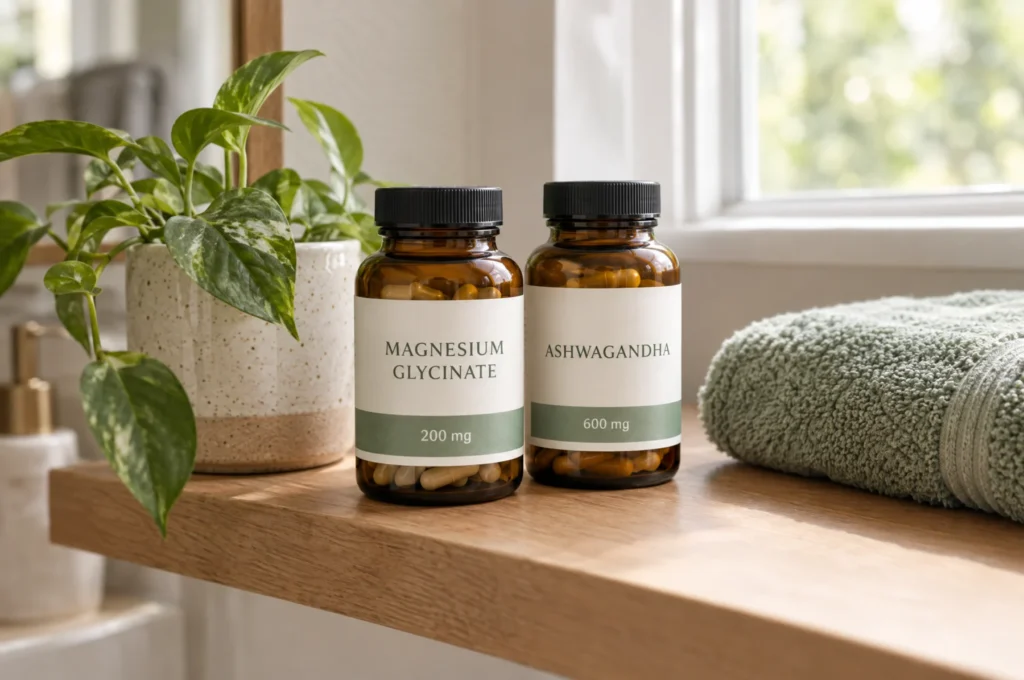
Magnesium is the most popular stress supplement, but a systematic review of the anxiety trials rated the evidence as poor quality. It may help a little with mild stress, mainly in people with low magnesium intake. Glycinate is the gentlest form on the stomach. It is cheap and safe at normal doses, which makes it a sensible first step, not a strong treatment.
Full details: magnesium for anxiety and the best magnesium glycinate brands.

Popular, but not recommended
- GABA: widely sold as a calming supplement, but there are few good human trials, and it is unclear how much oral GABA reaches the brain.
- Kava: it does have some evidence for anxiety, but the US Food and Drug Administration issued a consumer advisory in 2002 about rare but serious liver injury linked to kava products. The risk is not worth it when safer options exist.
- “Stress complex” blends: many contain ashwagandha, rhodiola or L-theanine at doses far below those tested in trials. Check the milligrams of each ingredient against the doses above.
How to choose
- Stress that has lasted for weeks or months: ashwagandha, given eight weeks at a steady dose.
- Anxiety that is persistent and affects daily life: see a doctor first. Silexan has the best supplement data here, but it is not a substitute for proper treatment.
- Short, predictable stress (a presentation, an exam): L-theanine, 30 to 60 minutes beforehand.
- Stress with low mood: saffron, with a doctor’s advice if you take an antidepressant.
- Stress with exhaustion: rhodiola, for a few weeks.
- A gentle first step: magnesium glycinate, especially if your diet is low in leafy greens, nuts and whole grains.
Whatever you choose, look for third-party testing (USP, NSF or a published certificate of analysis) and an exact dose per ingredient on the label. Combining several calming supplements, or adding them to sedatives, anti-anxiety medicine or antidepressants, should be discussed with a doctor or pharmacist.
Common questions
What is the most effective supplement for stress?
Ashwagandha has the strongest evidence for ongoing stress, with trials showing lower stress scores and cortisol after about eight weeks at 240–600 mg a day.
What supplement helps with stress fast?
L-theanine. Blood levels peak about 50 minutes after a 200 mg dose, and trials measured a calmer stress response within one to two hours. The effect is small.
What are the best supplements for stress and anxiety?
For persistent anxiety, the lavender oil extract Silexan has the best trial data among supplements, followed by saffron and omega-3. For everyday stress, ashwagandha and L-theanine lead.
Do vitamins help with stress?
B vitamins and vitamin D are often marketed for stress, but the evidence that they help people who are not deficient is weak. A blood test is a better guide than a guess.
Can I take ashwagandha and magnesium together?
They are often combined, and no harmful interaction between them is known, but they have not been tested together in good trials. Ask a pharmacist if you take any medication. Dose, timing and who should not combine them are covered in magnesium and ashwagandha.
Are stress supplements safe to take every day?
Most of these have safety data for a few weeks to a few months, not years. Ashwagandha in particular has limited safety data beyond about three months.
Sources
- Chandrasekhar K et al. A prospective, randomized double-blind, placebo-controlled study of safety and efficacy of a high-concentration full-spectrum extract of ashwagandha root in reducing stress and anxiety in adults. Indian Journal of Psychological Medicine. 2012
- Lopresti AL et al. An investigation into the stress-relieving and pharmacological actions of an ashwagandha extract. Medicine. 2019
- Kasper S et al. Lavender oil preparation Silexan is effective in generalized anxiety disorder: a randomized, double-blind comparison to placebo and paroxetine. International Journal of Neuropsychopharmacology. 2014
- Marx W et al. Effect of saffron supplementation on symptoms of depression and anxiety: a systematic review and meta-analysis. Nutrition Reviews. 2019
- Su KP et al. Association of Use of Omega-3 Polyunsaturated Fatty Acids With Changes in Severity of Anxiety Symptoms. JAMA Network Open. 2018
- Williams JL et al. The Effects of Green Tea Amino Acid L-Theanine Consumption on the Ability to Manage Stress and Anxiety Levels: a Systematic Review. Plant Foods for Human Nutrition. 2020
- Olsson EM et al. A randomised, double-blind, placebo-controlled, parallel-group study of the standardised extract SHR-5 of the roots of Rhodiola rosea in the treatment of subjects with stress-related fatigue. Planta Medica. 2009
- NIH Office of Dietary Supplements — Ashwagandha fact sheet — dose, timeline and safety.

Roy Douele founded inareview and writes every review on the site. He is not a medical professional. Each review is built from the product's label, the brand's own testing documents, public certification registers and the published clinical research, then scored out of 10. Brands cannot pay for a review or influence a score.
View All Articles