Doctor’s Best Magnesium Glycinate Review (2026): The Cheapest, With a Catch

Disclosure & independence
Doctor's Best did not pay for this review, did not supply the product, and did not see the article before publication. No brand is given approval over what is written here.
This article contains affiliate links. If you buy through one I may earn a commission, at no additional cost to you. A commission never changes a score, a ranking or a verdict: those are decided before any commercial link is considered.
Full details in my affiliate disclosure, editorial policy and testing methodology.
Around 2,900 people a month search for Doctor’s Best magnesium glycinate, and the first thing worth saying is that the company does not sell one. What it sells is magnesium lysinate glycinate — a different chelate — and Amazon’s own listing title papers over the difference.
The second thing worth saying is that at 10.0¢ per 100 mg of magnesium, the tablets are the cheapest magnesium I have priced anywhere, by a third. Both facts matter, and they pull in opposite directions.
Comparing brands? This one now sits alongside the others in my comparison of the best magnesium glycinate brands.
The verdict in short
7.5 / 10. Unbeatable on price, built on Albion TRAACS — a branded chelate with real published research behind it — and unusually honest about how much of the compound is actual magnesium. Buy the 240 tablets.
But it is not bisglycinate, its verification is the weakest of the six brands I have assessed, and two of the four badges under its “Certifications” heading are marketing graphics the company made itself.
How this Doctor’s Best magnesium glycinate review was done
I have not taken this product. No test panel, no trial, no “our testers” — there were none. What follows is a documentary assessment: the Supplement Facts panels for three formats, the company’s published quality statements, the prices on its own store, and the arithmetic.
One methodological note that turned into a finding. I first searched the quality pages for the words GMP, NSF, USP, ISO and “third-party” and found none of them. Before concluding anything I checked the page source, and discovered the certification badges are published as images with empty alt text. Two of them are real claims. Two are not certifications at all. More on that below, because the detail matters.
It is lysinate glycinate, not bisglycinate
This is the single most important thing to understand before you buy, and almost nothing written about this product explains it.
The chelate here is magnesium lysinate glycinate (Albion TRAACS): magnesium bound to both lysine and glycine. Magnesium bisglycinate, the form most people mean when they say “magnesium glycinate”, is magnesium bound to two glycine molecules and nothing else.
They are cousins, not twins. Both are amino acid chelates, both are absorbed through amino acid transport pathways rather than competing with other minerals, and both are far gentler on the gut than oxide or citrate. If gut tolerance is why you want glycinate, this will do the job.
But they are not the same compound, and if you specifically want bisglycinate — because that is what the sleep research actually used, or because you want the glycine itself — this is not it. Solaray names bisglycinate explicitly on its label. Doctor’s Best names lysinate glycinate explicitly on its own site, to its credit.
The confusion is not the brand’s fault on its own website. It is baked into the retail listing: Amazon’s title for this product reads “Doctor’s Best High Absorption Magnesium Glycinate”, dropping the lysinate. That is where 2,900 monthly searches come from, and it is why so many buyers think they have bought something they have not.
What is actually in the tablets
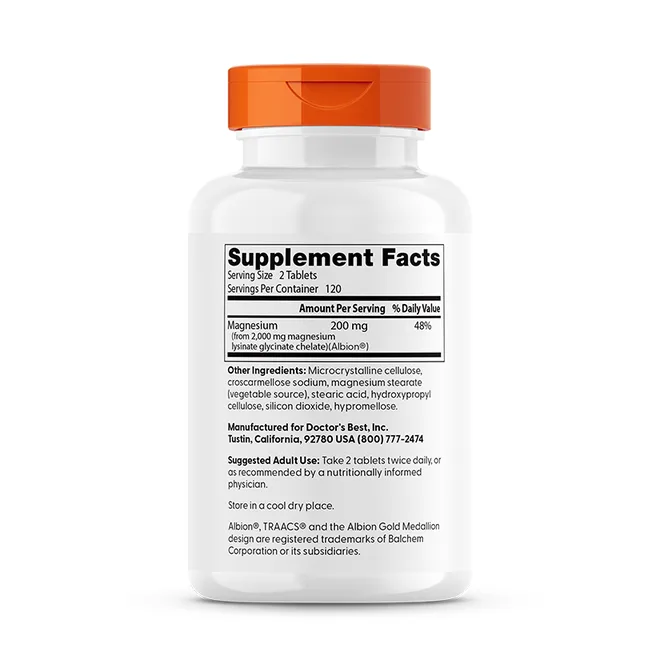
The panel, verified on the 240-tablet bottle:
- Serving size: 2 tablets. 120 servings per container.
- Magnesium (from 2,000 mg magnesium lysinate glycinate chelate, Albion) — 200 mg, 48% of the Daily Value.
- Other ingredients: microcrystalline cellulose, croscarmellose sodium, magnesium stearate (vegetable source), stearic acid, hydroxypropyl cellulose, silicon dioxide, hypromellose.
- Suggested use: 2 tablets twice daily, so 400 mg a day and a 60-day bottle.
Two observations, one good and one less so.
The good one is genuine transparency about elemental content. That panel tells you 2,000 mg of chelate yields 200 mg of magnesium — 10% elemental. Most brands print only the elemental figure and let you assume the rest, or print only the compound weight and let you overestimate. Showing both is the honest way to do it, and it is rarer than it should be.
The less good one is the excipient list. Seven other ingredients including magnesium stearate and stearic acid. That makes it the least clean formulation of the four magnesiums I have assessed, against Pure Encapsulations‘ two. None of these excipients is a safety concern at capsule-level quantities, and the tablet format requires binders and disintegrants that capsules do not. But if a short ingredient list is what you are shopping for, this is not the product.
The capsule version is cleaner — hypromellose, calcium stearate, microcrystalline cellulose, silicon dioxide, four in total — which brings us to the strangest thing about this range.
What it costs, and the trap inside the brand’s own range
Prices on Doctor’s Best’s own store, with the arithmetic done per 100 mg of elemental magnesium:
- 240 tablets — $23.99. 120 servings at 200 mg. That is 10.0¢ per 100 mg.
- 240 veggie capsules — $24.99. 120 servings at only 105 mg. That is 19.8¢ per 100 mg.
- 120 veggie capsules — $15.99. 60 servings at 105 mg. That is 25.4¢ per 100 mg.
Read those three lines again, because this is the finding that should decide your purchase. The capsules cost 98% more per 100 mg of magnesium than the tablets, and the small capsule bottle costs 154% more. Same brand. Same Albion chelate. Nearly the same price on the shelf — $24.99 against $23.99 — for half the magnesium.
The two bottles look almost identical in a search listing, both say 240, and both say “High Absorption Magnesium”. One is the best value in the category and the other is mid-priced. Nothing on the storefront flags the difference, because the difference only appears once you divide 105 into 200.
Against everything else I have priced per 100 mg of elemental magnesium:
- Doctor’s Best, 240 tablets — 10.0¢
- Solaray, 240 count — 15.2¢
- Solaray, 120 count — 17.5¢
- Doctor’s Best, 240 capsules — 19.8¢
- Pure Encapsulations, 360 count — 20.1¢
- Pure Encapsulations, 180 count — 21.5¢
- Doctor’s Best, 120 capsules — 25.4¢
- Pure Encapsulations, 30 count — 34.7¢
So the tablets undercut the previous cheapest by 34%. With one honest qualification: Solaray remains the cheapest true bisglycinate. Doctor’s Best is cheaper still, but it is a different chelate, so this is not quite a like-for-like win.
The “Certifications” problem
Here is where I have to be critical, and precise about why.
Doctor’s Best publishes a section headed Certifications. It contains four badges. Judging by the image filenames the company uses for them, they are:
- cGMP — a real manufacturing standard.
- Third party — a real category of claim.
- “Clinically Proven” — not a certification. No body awards this.
- “Proven Potency” — not a certification either. The company made this graphic.
Putting two self-awarded marketing badges under a heading that says “Certifications”, beside two that refer to real standards, blurs a line that should not be blurred. A shopper scanning that row sees four seals and reasonably concludes four independent bodies have signed off. Two have not.
And the two real ones are undermined by how they are presented. They appear only as images, with empty alt text and no accompanying words. Searching the page text for GMP, NSF, USP, ISO or “third party” returns nothing at all. That means:
- No certifying body is named. cGMP compliance is normally audited by someone; the badge does not say who.
- No laboratory is named, and no accreditation standard such as ISO 17025 is given.
- No batch certificate of analysis is offered, so you cannot look up your bottle.
- Anyone using a screen reader gets nothing, because the alt attributes are empty. The claims are invisible to them.
Compare that with Solaray, which states that finished products are anonymously purchased and independently tested in ISO 17025 accredited laboratories, names its own laboratory, gives a contaminant reporting limit as a number, and describes its NSF position accurately. That is what a checkable claim looks like.
One more structural point. Doctor’s Best states that it partners with co-manufacturers around the globe. It does not own the plant. Solaray, Pure Encapsulations and Revolution Nutrition all manufacture in facilities they control. Outsourcing is normal and not disqualifying — but combined with no named auditor and no published certificate, there is less for a sceptical buyer to hold on to.
What the brand does well on transparency
To be fair, because fairness is the point of doing this properly: the elemental-versus-chelate disclosure on the panel is better than most of the category. The product page publishes a downloadable family fact sheet with a document reference number. The branded ingredient is named, not hidden behind “proprietary chelate”. And Albion TRAACS is a genuinely well-researched chelate rather than a marketing label — it is the reason this product has been recommended for two decades.
The “up to 6× better absorbed than other forms of magnesium” claim on the page carries an asterisk, as it should. Treat it as the directional claim it is: chelates absorb better than oxide, which is well supported; a specific multiple against unspecified “other forms” is marketing.
Who owns and runs this storefront
A small observation, reported precisely because I can only report what I observed. The product identifiers on doctorsbest.com match iHerb’s product numbers exactly — this tablet bottle is item 16567 on both — and the site’s own footer carries an iHerb Terms of Sale page alongside its own terms.
I am not going to reconstruct a corporate structure from a footer link and a matching SKU. But if you assumed you were buying direct from an independent manufacturer’s own shop, the plumbing suggests something more entangled than that, and it is worth knowing.
Who it is for
This is a strong buy if cost per 100 mg is your main criterion, and nothing else comes close; you want a branded, well-researched chelate rather than an unnamed one; you are happy taking tablets; or you want gut-friendly magnesium for sleep or cramps and are not attached to bisglycinate specifically.
Look elsewhere if you specifically want magnesium bisglycinate, in which case Solaray names it on the label; you want the shortest possible excipient list, where Pure Encapsulations wins decisively with two; you avoid magnesium stearate on principle; you want verification you can actually check, with a named laboratory and a batch certificate; or you compete in drug-tested sport, where Thorne is the only product I have assessed that is certified at batch level.
The verdict
Score: 7.5 out of 10.
On value this is not a close contest. Ten cents per 100 mg of elemental magnesium, from a named Albion chelate with real research behind it, with the elemental content disclosed honestly on the panel, is the best price-to-substance ratio I have found in this category. If your goal is simply to correct a magnesium shortfall cheaply and tolerably, buy the 240 tablets and stop reading.
What holds it at 7.5 is everything around the product rather than the product. It is not bisglycinate, and the retail listings actively obscure that. The verification is the thinnest of the six brands I have assessed: no named auditor, no named laboratory, no certificate, claims published only as images a screen reader cannot see. And two of the four badges filed under “Certifications” are graphics the company awarded itself, which is the kind of thing I cannot let pass however good the price is.
Buy the 240 tablets at $23.99. Do not buy the 240 capsules thinking they are the same thing more comfortably packaged — they are half the dose for a dollar more.
Where to buy
Check which format and count you are adding to the basket. On this brand it matters more than on any other I have assessed: the wrong bottle costs you twice as much per milligram.
Check current prices and formats on AmazonOutside the US? Canada: search Amazon.caAs an Amazon Associate I earn from qualifying purchases. This never changes a score, a ranking or a verdict — those are decided before any commercial link is considered.
Common questions
Is Doctor’s Best magnesium glycinate actually glycinate?
Not exactly. It is magnesium lysinate glycinate (Albion TRAACS), a chelate of magnesium with both lysine and glycine. Magnesium bisglycinate is magnesium with two glycine molecules only. Both are well-absorbed amino acid chelates that are gentle on the gut, but they are different compounds. Amazon’s listing title omits the word lysinate, which is where most of the confusion starts.
How much magnesium is in a serving?
The tablets deliver 200 mg of elemental magnesium per 2-tablet serving, from 2,000 mg of chelate — 48% of the Daily Value. The veggie capsules deliver only 105 mg per 2-capsule serving. Check which one you are buying.
Which Doctor’s Best magnesium is best value?
The 240 tablets at $23.99, which works out to 10.0¢ per 100 mg of elemental magnesium. The 240 capsules at $24.99 are 19.8¢ — 98% more for the same magnesium from the same chelate. The 120 capsules at $15.99 are 25.4¢.
Is Doctor’s Best third-party tested?
The brand displays a third-party badge and a cGMP badge in a “Certifications” row, but as images with empty alt text and no supporting words. No certifying body, laboratory or accreditation standard is named anywhere in the page text, and no batch certificate of analysis is published. Two of the four badges in that row — “Clinically Proven” and “Proven Potency” — are not certifications at all.
Does it contain magnesium stearate?
Yes, in the tablets, along with stearic acid and five other excipients. The veggie capsule version uses calcium stearate instead and has four other ingredients in total.
Is it made by Doctor’s Best?
The company states that it partners with co-manufacturers around the globe. It does not claim to own its manufacturing facility, unlike Solaray, Pure Encapsulations or Revolution Nutrition.
Sources
Everything above was read from these pages. Links are provided so you can check the claims for yourself.
- Doctor’s Best — High Absorption Magnesium, 100 mg, 240 Tablets — the Supplement Facts panel, price and suggested use.
- Doctor’s Best — Magnesium Lysinate Glycinate, 240 Veggie Caps — the 105 mg panel used in the cost comparison.
- Doctor’s Best — Science — the quality statements, the co-manufacturer disclosure and the “Certifications” row discussed above.
- NSF Certified for Sport — what an independently audited certification actually involves, for contrast.
- Predicting and Testing Bioavailability of Magnesium Supplements — on the absorption of chelated forms.
Prices, formulations and availability were checked in September 2026 and can change without notice — always read the label on the product you receive. This review is for general information and is not medical advice. If you are pregnant or breastfeeding, take prescription medication, or have a diagnosed condition including kidney or liver disease, speak to a qualified professional before adding a supplement.

Roy Douele founded inareview and writes every review on the site. He is not a medical professional: he sources and buys the products himself, tests them over a meaningful period, and checks each claim against published research before assigning a score out of 10. Brands cannot pay for a review or influence a score.
View All Articles