Magnesium Glycinate for Sleep: What the Evidence Actually Shows


Disclosure & independence
No brand pays for coverage on inareview, and no brand sees an article before it is published. Products are assessed against published criteria, not against what a company would like to read.
This article contains affiliate links. If you buy through one I may earn a commission, at no additional cost to you. A commission never changes a score, a ranking or a verdict: those are decided before any commercial link is considered.
Full details in my affiliate disclosure, editorial policy and testing methodology.
About 368,000 people a month type magnesium glycinate for sleep into Google. For most of the time that phrase has been popular, the clinical evidence behind it came from a single trial of 46 elderly people that used a different form of magnesium at twice the dose.
That changed in August 2025, when a university in Germany finally tested the thing people actually buy. It works. The honest description of how well is “modestly”, and the most useful result in the whole paper is not the headline.
The short version
Yes, but modestly. In a 155-person randomised trial, 250 mg of elemental magnesium as bisglycinate cut insomnia severity scores by 3.9 points in four weeks. Placebo cut them by 2.3. The difference was 1.6 points, and it scraped statistical significance at p = 0.049.
The dose that was tested is 250 mg of elemental magnesium — not 250 mg of the compound. On most labels that is two to three capsules or tablets, not one.
It appears to work best if you are short of magnesium to begin with. That is the finding that should change what you do, and it reframes the question from “does this make me sleepy” to “am I actually deficient”.
At the tested dose, a year of nightly magnesium costs between about $91 and $395 depending only on which bottle you pick. Same mineral, same dose.
How this article was done
I have not taken any of these products, and there is no test panel, no trial and no “our testers”, because there were none. What follows is a reading of the published evidence and of the labels, with the arithmetic done.
I opened every study I cite. Where a trial used a different form or a different dose from the product you are likely to buy, I say so, because that difference turns out to be the whole story. Prices come from my own reviews of six magnesium brands and were checked in September 2026.
This is general information, not medical advice. Magnesium interacts with several classes of prescription medicine, and there is a section on that below.
What magnesium actually does at night
The mechanism is real and reasonably well described, which is why the claim was plausible long before anyone tested it properly.
Magnesium potentiates the activity of GABA-A receptors. GABA is the main inhibitory neurotransmitter in the central nervous system — the brake pedal. Enhancing its signalling reduces neuronal excitability, which is the pharmacological direction of travel for almost everything that makes people sleepy, including benzodiazepines and alcohol. Magnesium is nowhere near as potent as either, but it is pushing on the same lever.
Separately, magnesium regulates calcium movement in muscle fibres, promoting the calcium uptake that allows a muscle to relax. If your experience of not sleeping involves a body that will not settle rather than a mind that will not stop, that is the more relevant half.
There is also a detail specific to bisglycinate that most articles skip. The chelate is magnesium bound to two glycine molecules, so when you swallow it you are also taking glycine — itself an inhibitory neurotransmitter with its own small sleep literature. The authors of the 2025 trial raise this explicitly: magnesium is presumed to be the main actor, but glycine may be contributing, and their study cannot separate the two.
The study everyone cites used a different form, and twice the dose
For over a decade, nearly every “magnesium helps you sleep” article traced back to one paper: Abbasi and colleagues, 2012, published in the Journal of Research in Medical Sciences.
It is a decent small trial. Double-blind, placebo-controlled, 46 elderly subjects with primary insomnia, eight weeks. The magnesium group improved on sleep time, sleep efficiency, insomnia severity index and sleep onset latency, with higher serum melatonin and renin and lower serum cortisol. Those are good results.
Now read the methods, which is where it stops supporting the thing it is used to support:
“Magnesium was administered as magnesium oxide tablets twice a day (each tablet containing 414 mg magnesium oxide as 250 mg elemental magnesium) for 8 weeks.”
Three things follow, and all three matter.
- It was magnesium oxide, not glycinate. The words “glycinate” and “bisglycinate” do not appear anywhere in the paper. Oxide is the cheap, poorly absorbed form that glycinate is specifically marketed against.
- The dose was 500 mg of elemental magnesium a day — two tablets of 250 mg. That is roughly double what a standard serving of most glycinate products delivers, and it is above the safety ceiling for supplemental magnesium, which I come back to below.
- The population was elderly people with diagnosed primary insomnia, not a healthy adult who sleeps badly during a stressful week.
None of that makes the trial bad. It makes it a trial of something other than what is being sold. A 2024 literature review in Sleep Medicine Research summarising the field lists magnesium’s clinical support as, in its own words, one “small RCT”, and closes by saying that further research is needed to establish the optimal dose and formulation. That word was doing a lot of work.
In 2025, somebody finally tested bisglycinate
The gap was closed in August 2025 by a randomised, double-blind, placebo-controlled trial out of the Institute of Food and One Health at Leibniz University Hannover, pre-registered in the German clinical trials register as DRKS00031494.
The design answers the obvious objections to Abbasi:
- 155 adults, aged 18 to 65, with self-reported poor sleep quality — ordinary bad sleepers, not a geriatric insomnia clinic.
- Magnesium bisglycinate, the actual form on the shelf.
- 250 mg of elemental magnesium daily, a dose a normal person might really take.
- Insomnia Severity Index as the primary outcome, with mixed models adjusted for baseline ISI, age, sex, BMI and occupation.
And it was funded by the university itself, as an internal academic project, with study design, data collection, analysis and write-up done by the authors. That is worth pausing on. Most supplement evidence that reaches consumers is produced by people selling the supplement — I spent a whole review working through a study NOW Foods ran on its own competitors. This one is not that. One of the authors does disclose that he runs a contract research organisation which takes funding from nutraceutical companies; the others declare no conflicts. Disclosed, partial, and a different order of problem from a manufacturer testing its own product.
Here is what they found, at week four:
- Magnesium bisglycinate group: ISI fell by 3.9 points (95% CI −5.8 to −2.0).
- Placebo group: ISI fell by 2.3 points (95% CI −4.1 to −0.4).
- p = 0.049. Cohen’s d = 0.2.
- No significant differences on the other psychological outcomes they measured.
Their own one-word summary is “modestly”. I think that is right, and the next section explains why.
What “a small effect” actually means for your night
Three numbers deserve to be read properly rather than skipped.
p = 0.049. The conventional threshold for calling a result statistically significant is 0.05. This came in at 0.049. It is on the right side of the line by a hair. That does not make it false — it makes it a result that would benefit from being replicated before anyone builds a life around it.
Cohen’s d = 0.2. This is the standard measure of effect size, and 0.2 is the textbook definition of small. For comparison, a moderate effect is 0.5 and a large one is 0.8.
The gap was 1.6 points on the ISI. This is the one that puts it in perspective. The Insomnia Severity Index runs from 0 to 28. The placebo group improved by 2.3 points on its own — which is what happens when people enrol in a sleep study, pay attention to their sleep, and swallow something at bedtime. Magnesium bought an extra 1.6 points on top of that.
The confidence intervals also overlap across a fair stretch of their range, which is the statistical way of saying the true difference could be smaller than the headline suggests.
So: real, positive, honestly reported, and not a sleeping pill. If you are expecting the difference between lying awake and not lying awake, this is not that. If you are expecting to shave the edge off a mildly bad sleeper’s week, that is about the size of what was demonstrated.
The finding that matters most: it works best if you are short
Buried in the exploratory analyses is the result that should actually change what you do.
Participants who reported lower dietary magnesium intake at baseline improved notably more. The authors flag them as a possible “subgroup of high responders”, and say the next step is to characterise those people properly using dietary recall and laboratory markers rather than a questionnaire.
Treat that with the caution an exploratory finding deserves — it was not what the study set out to test. But it is mechanistically coherent, and it reframes the entire question.
Magnesium is not a sedative that works on everyone. It is a nutrient, and the plausible reading of all of this is that correcting a shortfall improves sleep, and topping up someone who was never short does much less. That fits the mechanism, it fits why the effect is small when averaged across a mixed group, and it fits the wider observation that magnesium intake is genuinely low in a lot of modern diets.
Which gives you a far better question than “will this make me sleep”. The question is: am I actually getting enough magnesium from food? The NIH’s recommended intakes are 400–420 mg a day for adult men and 310–320 mg for adult women, from everything combined. Good sources are green leafy vegetables, legumes, nuts, seeds and whole grains. If your diet has essentially none of those, you are a plausible responder. If you eat a bag of almonds and a plate of spinach most days, expect less.
How much you need, and what your bottle actually delivers
This is where most people go wrong, and it is a labelling problem rather than a comprehension problem.
The tested dose is 250 mg of elemental magnesium. That is the metal itself, not the weight of the compound. Albion’s magnesium bisglycinate chelate powder is only about 10% elemental magnesium, so it takes roughly 2,000 mg of chelate to deliver 200 mg of magnesium. A front label shouting “1,330 mg of magnesium glycinate” may be delivering 240 mg of actual magnesium, or considerably less.
Always read the Supplement Facts panel, where the elemental figure has to be declared. Here is what 250 mg looks like across the six brands I have reviewed in full:
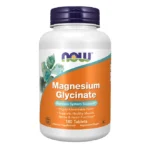
- NOW Foods — 100 mg per tablet. Two to three tablets. The label serving of two gives 200 mg.
- Thorne — 200 mg per scoop of powder. One and a quarter scoops, which is one of the few products here where the dose is genuinely adjustable.
- Solaray — 350 mg per four-capsule serving, so about 87.5 mg each. Three capsules.
- Pure Encapsulations — 120 mg per capsule. Two capsules gets you to 240 mg.
- Doctor’s Best — 100 mg per tablet, so two to three. But note: this is magnesium lysinate glycinate, a different chelate from the bisglycinate that was tested.
- Qunol — 300 mg per serving, so a single serving overshoots slightly. Check whether your retailer lists that serving as one tablet or two; at least one lists it as two.
The practical point: on most of these labels, one capsule is not a dose. If you have been taking a single capsule at bedtime and concluding that magnesium does nothing, you have been taking between a third and a half of what the trial used.
What a night at the tested dose actually costs
Nobody publishes this table, because it requires converting every product to the same unit. Cost of 250 mg of elemental magnesium, one night, using each brand’s own best price:
- Doctor’s Best, 240 tablets — about 25¢ a night. Roughly $91 a year. The cheapest, and the asterisk is that it is a different chelate.
- NOW Foods, 180 tablets on sale — about 36¢ a night. Roughly $130 a year. At the 90-count’s regular price it is nearer 50¢.
- Solaray, 240 count — about 38¢ a night. Roughly $139 a year.
- Pure Encapsulations, 360 count — about 50¢ a night. Roughly $184 a year.
- Thorne, 60 scoops — about $1.08 a night. Roughly $395 a year.
Same mineral. Same dose. A spread of more than four to one, and $304 a year between the cheapest and the dearest.
That does not automatically make Thorne a bad buy — it is the only one of the six carrying batch-level NSF Certified for Sport certification, which matters enormously if you are drug-tested and not at all if you are not. But if you are buying magnesium to sleep slightly better, paying $395 a year for a 1.6-point ISI improvement is a decision worth making deliberately rather than by accident. The full arithmetic for every bottle size is in my comparison of the six brands.
The safety limit almost nobody mentions
There is a ceiling on supplemental magnesium, and the trial everyone quotes went through it.
The US National Institutes of Health Office of Dietary Supplements sets the upper limit for magnesium from dietary supplements and medications at 350 mg a day for adults. Crucially, that limit covers supplements and medicines only — it deliberately excludes magnesium occurring naturally in food, which is why it looks lower than the recommended daily intake of 310–420 mg. You are meant to get most of your magnesium from eating, and the supplement ceiling sits below the dietary target.
- The 2025 bisglycinate trial used 250 mg — comfortably under the limit.
- The 2012 oxide trial used 500 mg — about 43% over it, in elderly participants, under supervision.
So if you read somewhere that “the research used 500 mg”, do not simply copy that number. The research that used 500 mg was testing a different compound, in a monitored setting, above the recommended supplemental ceiling.
The NIH lists the common consequences of overdoing it as diarrhoea, nausea and abdominal cramping, and notes that extremely high intakes can cause irregular heartbeat and cardiac arrest. Glycinate is the gentlest of the common forms on the gut, which is a genuine advantage, but gentleness is not a licence to escalate.
Do not start magnesium without asking a pharmacist or doctor if you have reduced kidney function, since impaired clearance is where magnesium becomes genuinely dangerous; or if you take antibiotics, bisphosphonates, diuretics or proton pump inhibitors, all of which magnesium can interact with.
Melatonin or magnesium glycinate?
This is the most common question in the category and it is usually answered badly, because the two are not competitors. They address different problems.
Melatonin is a chronobiotic, not a sedative. It shifts the timing of your body clock. The evidence supports it most clearly where the clock itself is misaligned — jet lag, delayed sleep phase, some shift patterns — and much more weakly for ordinary chronic adult insomnia. It also tends to be sold at doses far above what the timing effect requires. I set that out in detail in my review of the melatonin evidence.
Magnesium bisglycinate is a nutrient correction with a mild calming effect. It does not move your clock. It slightly reduces insomnia severity, most plausibly in people who were low to begin with.
So the honest decision rule:
- Your sleep is at the wrong time — you cannot fall asleep until 3am, or you have flown across time zones, or your shifts rotate. That is a timing problem. Melatonin, at a low dose, at the right hour.
- Your sleep is at the right time but poor quality, you feel wound up at bedtime, and your diet is short on greens, nuts and legumes. That is the magnesium case.
- Neither, if you have had insomnia for months. Chronic insomnia has a first-line treatment with far better evidence than either of these, and it is not a supplement. It is cognitive behavioural therapy for insomnia, CBT-I. Every guideline puts it ahead of medication, let alone minerals.
And if you want the whole category ranked by strength of evidence — valerian, tart cherry, L-theanine, zinc and the rest, with the ones to avoid — that is my guide to the best sleep supplements.
What magnesium glycinate will not do
Being clear about the limits is the only way the rest of the page is worth anything.
- It will not knock you out. Nothing in the evidence describes a sedative effect. If a product page implies one, that is marketing.
- It will not fix chronic insomnia. A 1.6-point ISI advantage over placebo at four weeks is not a treatment for a clinical disorder.
- It will not work well if you already get plenty of magnesium. That is what the responder analysis implies, and it is the most likely reason people report nothing at all.
- It is not the right product if you want a laxative. Citrate is cheaper and better suited; glycinate is chosen specifically to avoid that effect.
- It will not beat sleeping in a dark, cool, quiet room at a consistent hour. The placebo group in that trial improved by 2.3 points, and part of what the placebo group was doing was paying attention.
Who should try it, and who should not
Worth trying if your diet is genuinely low in green vegetables, nuts, seeds, legumes and whole grains; if your bad nights involve physical restlessness or a wound-up feeling at bedtime; if you have tried and disliked melatonin; or if you want the gentlest-on-the-gut form of a mineral you probably ought to be getting more of anyway. Give it four weeks at the tested dose, which is what the trial ran, and judge honestly.
Not worth it if you already eat well and sleep badly for other reasons; if you are expecting a sleeping pill; if your problem is timing rather than quality; or if you have had insomnia for more than three months, in which case CBT-I is the better use of your effort.
Ask a professional first if you have any degree of kidney impairment, or take antibiotics, bisphosphonates, diuretics or proton pump inhibitors.
And if you decide to try it, the choice of bottle is worth two minutes: it is the difference between $91 and $395 a year for the same 250 mg. My six full reviews and the cost table are in the brand comparison.
Where to buy
Check the elemental figure on the Supplement Facts panel, and check how many capsules or tablets make up a serving — those two numbers decide what you actually pay per night.
- NOW Foods — see current sizes and prices on AmazonOutside the US? Canada: search Amazon.ca
- Solaray — see current sizes and prices on AmazonOutside the US? Canada: search Amazon.ca
- Doctor’s Best — see current sizes and prices on AmazonOutside the US? Canada: search Amazon.ca
- Thorne — see current sizes and prices on AmazonOutside the US? Canada: search Amazon.ca
As an Amazon Associate I earn from qualifying purchases. This never changes a score, a ranking or a verdict — those are decided before any commercial link is considered.
Common questions
Does magnesium glycinate actually help you sleep?
Modestly, on the current evidence. A 155-person randomised placebo-controlled trial published in 2025 found that 250 mg of elemental magnesium as bisglycinate reduced Insomnia Severity Index scores by 3.9 points in four weeks against 2.3 points for placebo — a 1.6-point advantage, with a small effect size and a p-value of 0.049. It is a real result, not a dramatic one, and it appears to be larger in people whose dietary magnesium intake was low to start with.
How much magnesium glycinate should I take for sleep?
The dose that has actually been tested is 250 mg of elemental magnesium daily. Read the Supplement Facts panel for the elemental figure rather than the compound weight on the front of the bottle — on most labels that means two to three capsules or tablets, not one. Stay within the NIH upper limit of 350 mg a day from supplements, and take it in the evening.
How long does magnesium take to work for sleep?
The 2025 trial measured its primary outcome at four weeks, so that is the sensible window to judge by. This is not a substance with an obvious same-night effect, and anyone promising one is overselling it. Give it a month at the tested dose before deciding.
Is magnesium glycinate or melatonin better for sleep?
They solve different problems. Melatonin shifts the timing of your body clock and has its best evidence in jet lag and delayed sleep phase, not in ordinary insomnia. Magnesium bisglycinate slightly reduces insomnia severity and appears to work best in people who are short of magnesium. If you cannot fall asleep until very late or you have crossed time zones, that is a melatonin question. If you sleep at a normal hour but badly, and eat few greens, nuts and legumes, that is the magnesium case. For insomnia lasting more than three months, CBT-I has far better evidence than either.
Why do I feel nothing from magnesium glycinate?
Two likely reasons. The first is dose: one capsule is typically 87 to 120 mg of elemental magnesium, which is between a third and a half of the amount that was tested. The second is that you may not have been short of magnesium in the first place — the trial’s responder analysis suggests the benefit concentrates in people with low dietary intake, which would mean a well-fed person should expect very little.
Can you take magnesium glycinate every night?
The trials ran for four and eight weeks of nightly use without notable safety problems, and magnesium bisglycinate is the gentlest common form on the digestive system. Stay under the 350 mg daily supplemental ceiling set by the NIH, and speak to a pharmacist or doctor first if you have any kidney impairment or take antibiotics, bisphosphonates, diuretics or proton pump inhibitors, all of which magnesium can interact with.
Is magnesium oxide as good as glycinate for sleep?
Awkwardly, the older and larger sleep result was obtained with oxide — the 2012 trial that is cited everywhere used 500 mg of elemental magnesium as magnesium oxide. But oxide is poorly absorbed and considerably harsher on the gut, and the dose used exceeded the supplemental upper limit. Bisglycinate is the form that has now been tested at a sensible dose in ordinary adults, and it is the one most people will tolerate nightly.
Sources
Everything above was read from these pages, and I have noted where a study tested something other than what is being sold.
- Magnesium Bisglycinate Supplementation in Healthy Adults Reporting Poor Sleep: A Randomized, Placebo-Controlled Trial (2025) — the 155-person trial: design, the ISI results, the p-value and effect size, the responder analysis, and the funding statement.
- The effect of magnesium supplementation on primary insomnia in elderly: a double-blind placebo-controlled clinical trial (Abbasi et al., 2012) — the older trial, and the methods section confirming magnesium oxide at 500 mg elemental daily.
- Herbal and Natural Supplements for Improving Sleep: A Literature Review — the wider evidence picture across valerian, hops, chamomile, tryptophan, theanine, melatonin, magnesium and zinc, and the statement that the optimal magnesium dose and formulation remain unestablished.
- NIH Office of Dietary Supplements — Magnesium fact sheet — the 350 mg supplemental upper limit, the recommended intakes, food sources, side effects and drug interactions.
Prices and formulations were checked in September 2026 and can change without notice. This page is for general information and is not medical advice. If you are pregnant or breastfeeding, take prescription medication, or have a diagnosed condition including kidney or liver disease, speak to a qualified professional before adding a supplement. If you have had trouble sleeping for more than three months, see a doctor rather than a supplement aisle.

Roy Douele founded inareview and writes every review on the site. He is not a medical professional: he sources and buys the products himself, tests them over a meaningful period, and checks each claim against published research before assigning a score out of 10. Brands cannot pay for a review or influence a score.
View All Articles