How to Start Working Out at Home: A Beginner’s Guide

Disclosure & independence
No brand pays for coverage on inareview, and no brand sees an article before it is published. Products are assessed against published criteria, not against what a company would like to read.
At the time of publication, this article contains no affiliate links. If any are added later they will be clearly marked, they will never cost you anything extra, and they cannot change a score: verdicts are decided before any commercial link is considered.
Full details in my affiliate disclosure, editorial policy and testing methodology.
Starting to exercise at home can feel intimidating, but it does not have to be. You do not need a gym, fancy equipment, or hours of free time. You need a simple plan you can actually stick to. Here is how to begin, the sensible way.
This guide is deliberately conservative. Most beginner programmes fail not because they are too easy but because they are too hard in week one, and the research on exercise adherence keeps pointing at the same culprits: too much volume too soon, no clear progression, and no plan for the week you inevitably miss. Everything below is built to avoid those three traps.
What you actually need to begin
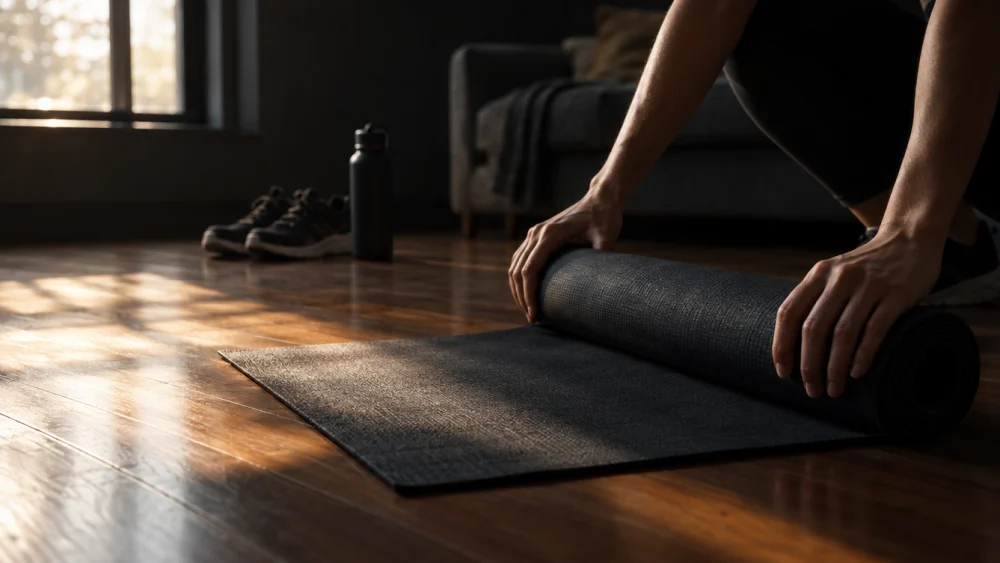
Almost nothing. A patch of floor roughly the size of a bath towel, something to hold on to for balance (a chair or a wall), and clothes you can move in. Shoes are optional indoors; bare feet or grippy socks are fine for bodyweight work. You do not need a mat, dumbbells, bands or an app to start, and buying them first is one of the most reliable ways to delay starting.
What matters far more is a fixed slot in your week. Pick the two or three times you will train before you pick the exercises. A workout without a scheduled time is a wish, not a plan.
Want to walk at home while you work? I compared five under-desk treadmills on specs, warranty and safety in the best walking pad.
Start smaller than you think
The biggest mistake beginners make is doing too much on day one, feeling sore for a week, and quitting. Start with 15 to 20 minutes, two or three times a week. A short workout you repeat beats a long one you dread.
A useful rule for the first month: finish every session feeling like you could have done one more round. That feeling is not wasted effort, it is what makes you willing to come back on Thursday. Intensity is easy to add later; a broken habit is hard to rebuild.
A simple starter routine
- Bodyweight squats: 2 sets of 10
- Knee or wall push-ups: 2 sets of 8
- A short plank hold: 2 rounds of 15 to 20 seconds
- A brisk 10-minute walk to finish
Rest for 45 to 60 seconds between sets. The whole thing takes about 20 minutes including the walk. Do it two or three times a week, on non-consecutive days.
How to warm up in five minutes
Skip the static stretching before training; save that for the end. Instead, spend five minutes raising your temperature and moving the joints you are about to use: one minute marching on the spot, ten slow arm circles each way, ten shoulder rolls, ten hip circles each way, and five very slow bodyweight squats going only as deep as feels easy. That is enough. A warm-up is meant to prepare you, not to become the session.
A four-week progression
This is the part most free routines leave out, and it is the reason they stop working after a fortnight. The body adapts quickly: a session that was hard in week one is usually comfortable by week three. Progress one variable at a time.
- Week 1: the routine as written, twice this week.
- Week 2: same routine, three times this week. Nothing else changes.
- Week 3: add one set to the squats and push-ups (3 sets instead of 2), and hold the plank for 25 to 30 seconds.
- Week 4: keep the extra set and cut the rest between sets to 30 to 45 seconds. If knee push-ups have become easy, move to push-ups with your hands on a chair or the edge of a sofa.
Never add volume and intensity in the same week. Adding a set and cutting rest and changing the exercise at once is how beginners end up too sore to train again, which brings the whole thing back to zero. If you do overdo it, here is what actually helps sore muscles.
How often, and for how long
Two to three sessions a week is a genuine starting point, not a compromise. Health authorities including the World Health Organization put the general target at 150 to 300 minutes of moderate activity per week for adults, plus muscle-strengthening work on two or more days. If that sounds like a lot, it is worth knowing that roughly 31% of adults worldwide — about 1.8 billion people — do not manage even the lower figure, so starting anywhere above zero puts you ahead of a third of the planet. Walking counts towards the first number, and the routine above counts towards the second.
Read that target as a destination rather than an entry requirement. Three 20-minute sessions plus two 30-minute walks is already 120 minutes a week, and that is a very respectable place to be in month one.
Focus on form, not intensity
Slow, controlled movements with good form build strength and protect your joints far better than rushing. If something hurts (sharp pain, not normal effort), stop. Quality always beats quantity at the start.
Three cues cover most of what goes wrong early on. In a squat, push your knees out over your toes rather than letting them collapse inward, and stop at the depth where your lower back stays neutral. In a push-up, keep your body in one line from head to knees, elbows angled back at roughly 45 degrees rather than flared straight out. In a plank, squeeze your glutes and tuck your ribs down; if your hips sag or your lower back aches, the hold has gone on too long, so stop and add the seconds next week instead.
Normal soreness versus a real problem
Delayed onset muscle soreness is dull, spread across the whole muscle, appears 12 to 48 hours after training and eases as you move around. That is normal, especially in the first two weeks, and it is not a measure of how good the session was.
Joint pain is different: sharp, localised to a knee, shoulder, elbow or lower back, often felt during the movement rather than the next day, and it does not warm up and fade. Treat that as a stop signal, not something to push through. If it persists for more than a few days, or if it came on suddenly during a specific movement, see a professional rather than searching for a workaround.
The real secret: consistency
Fitness is built on showing up regularly, not on perfect sessions. Put your workouts in your calendar, lay out your clothes the night before, and treat two solid workouts a week as a win. Add a little each week as it gets easier. The same principle applies to eating well and to your daily habits: small and repeatable beats ambitious and abandoned.
What to do when you miss a week
You will miss a week. Illness, work, travel, a bad run of sleep. The only decision that matters is what you do next, and the wrong answer is to try to make up for it with a punishing catch-up session.
Go back one step instead. After one missed week, repeat the last week you completed. After two or three, drop back to the week-one version for a single session, then carry on as normal. You lose very little strength in a fortnight, and restarting gently is what keeps the restart from becoming another quit.
Three mistakes that end most home routines
- Copying an advanced session from social media. A 45-minute circuit filmed by someone who trains daily is not a beginner workout, however approachable it looks.
- Training for a deadline instead of a habit. Six weeks before an event is a plan with a built-in stopping point. Build something you would be happy to still be doing next year.
- Measuring the wrong thing. The scale moves slowly and for many reasons. In the first two months, track sessions completed, reps, and how the movements feel. Those respond to your effort; body weight often does not.
Common questions
Can I lose weight with home workouts alone?
Training helps, but weight loss is driven mainly by overall energy balance, and exercise is easier to out-eat than most people expect. Bodyweight work does something important though: it signals to the body that muscle is worth keeping, which steers the loss towards fat. Pair it with sensible eating rather than expecting the sessions to do the whole job.
Is it better to train in the morning or the evening?
Whichever one you will actually do. The performance differences between times of day are small and inconsistent in the research; the difference between a session done and a session skipped is total.
How long before I see a difference?
Strength and coordination improve first, often within two to four weeks, largely through better recruitment of the muscle you already have. Visible changes take longer and depend heavily on nutrition and starting point. If the reps are getting easier, the programme is working, whatever the mirror says at week three.
Do I need supplements to get started?
No. Nothing in this guide requires a supplement, and no product substitutes for consistent training and reasonable food. If you are considering one anyway, read how to choose a supplement that is actually worth it first.
Note: this guide is for general information and is not medical advice. If you are new to exercise or have a health condition, check with your doctor before starting.
Sources
The activity targets quoted above come from these pages, so you can check them rather than take my word for it.
- World Health Organization — Physical activity recommendations — the 150 minutes of moderate activity a week for adults aged 18 to 64, the 300-minute figure for additional benefit, and muscle-strengthening work on two or more days.
- World Health Organization — Physical activity fact sheet — the finding that 31% of adults and 80% of adolescents fall short of those levels, and what inactivity is associated with.

Roy Douele founded inareview and writes every review on the site. He is not a medical professional. Each review is built from the product's label, the brand's own testing documents, public certification registers and the published clinical research, then scored out of 10. Brands cannot pay for a review or influence a score.
View All Articles
One thought on “How to Start Working Out at Home: A Beginner’s Guide”