5 Simple Nutrition Habits That Actually Last

Disclosure & independence
No brand pays for coverage on inareview, and no brand sees an article before it is published. Products are assessed against published criteria, not against what a company would like to read.
At the time of publication, this article contains no affiliate links. If any are added later they will be clearly marked, they will never cost you anything extra, and they cannot change a score: verdicts are decided before any commercial link is considered.
Full details in my affiliate disclosure, editorial policy and testing methodology.
Good nutrition is not about strict diets or cutting out everything you enjoy. It is about a few simple habits, repeated often enough that they become automatic. Here are five that genuinely last. And if you are wondering whether a supplement belongs alongside them, read how to choose one that is actually worth it.
Why restrictive diets keep failing
When researchers compare popular diets head to head, the striking finding is not that one wins. It is that the differences between them are small, and that the results within any single diet vary enormously from person to person. The variable that predicts the outcome is adherence: how much of the plan a person was still following months later.
That reframes the question. The useful thing to ask about an eating pattern is not whether it works in a twelve-week trial, but whether you can picture yourself doing it in two years without white-knuckling it. Rules that require constant vigilance are borrowing from a finite account. Habits that run on autopilot are not.
The five habits below are chosen for exactly that reason. Each one is small, each one reduces the number of decisions you have to make, and none of them requires you to track anything.
1. Build meals around protein and vegetables
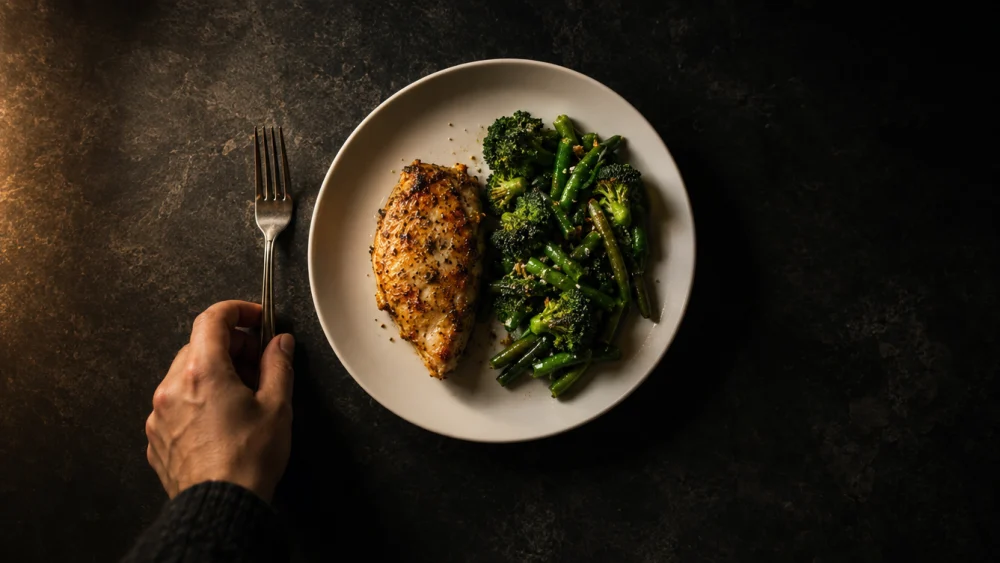
Make protein (eggs, beans, fish, chicken, tofu) and vegetables the base of most meals. They keep you full and satisfied, which naturally reduces mindless snacking without you having to count anything.
The mechanism is not mysterious. Protein is the most satiating of the three macronutrients and it has the highest thermic effect, meaning a slightly larger share of its calories is spent on digestion. Vegetables add volume and fibre for very few calories, so the plate fills the stomach before it fills the daily budget. Put the two together and appetite regulation starts doing work that willpower was doing before.
How to start this week: do not redesign every meal. Pick the one meal you eat most predictably, usually breakfast or lunch, and make sure it contains a palm-sized portion of protein and something green. Leave the rest of your eating exactly as it is for now.
2. Drink water before you reach for a snack
Thirst is often mistaken for hunger. A glass of water and a five-minute pause frequently settles a craving. Keep a bottle within reach during the day.
The pause is doing as much work here as the water. Cravings are not a steady state; they rise and fall in waves, and most pass within a few minutes if nothing feeds them. Putting a small, neutral action between the impulse and the cupboard breaks the automatic loop and hands the decision back to you.
How to start this week: fill a bottle each morning and leave it where you work. When you notice the urge to snack outside a meal, drink first and wait five minutes. If you are still hungry after that, eat, and eat without guilt. Genuine hunger is information, not a failure.
3. Slow down and notice fullness
Eating quickly makes it easy to overshoot. Put your fork down between bites, and check in halfway through your plate. Eating slowly helps you enjoy food more and stop when you are comfortably satisfied.
Fullness signals take time to arrive. The gut hormones that tell your brain you have eaten enough need roughly fifteen to twenty minutes to register, which means a meal finished in eight minutes is over before the feedback lands. Slowing down is not a discipline trick; it is simply giving the system long enough to report back.
How to start this week: eat one meal a day away from a screen. That single change slows most people down more than any conscious effort to chew more, because distracted eating is what speeds it up in the first place.
4. Prep one thing ahead
You do not need to meal-prep your whole week. Just prepare one thing in advance, such as a batch of cooked grains or chopped vegetables. Having something ready makes the healthy choice the easy choice when you are tired.
Most poor food decisions are not made in a supermarket aisle with time to think. They are made at half past seven in the evening, tired, with nothing ready and forty minutes of cooking standing between you and dinner. Preparing one component in advance removes the friction at precisely the moment your judgement is weakest.
How to start this week: cook one batch of something that keeps for three or four days. Rice, lentils, roasted vegetables, hard-boiled eggs. One item, not a week of meals in containers, which is the version of this habit that almost everyone abandons by the third Sunday.
5. Aim for consistency, not perfection
One indulgent meal will not undo your progress, and one salad will not fix everything. What matters is the overall pattern. Aim to eat well most of the time, and let the rest be part of a balanced life. The same approach works for training at home and for your daily routine.
The damage from a single large meal is rarely the meal. It is the reasoning that follows it: the day is ruined, so the week may as well be, and the restart gets pushed to Monday. Treating each meal as independent removes the all-or-nothing spiral that undoes far more progress than dessert ever has.
What about calories?
Energy balance still governs body weight. Nothing in these habits repeals it. The difference is that they change intake indirectly, by adjusting satiety and friction rather than by asking you to run a daily ledger.
That suits most people better over the long term, but tracking is a legitimate tool, particularly if you have a specific goal and a deadline, or if you genuinely do not know where your intake sits. Used for a couple of weeks as a measurement exercise rather than a permanent regime, it can be informative. It becomes a problem when the tracking itself turns into the habit you are trying to sustain.
The habits that are not worth your time
- Detox and slimming teas. Most work through a laxative or diuretic effect, which moves water and stool, not fat. My All Day Slimming Tea review goes through what the ingredients actually do.
- Cutting entire food groups without a reason. Unless you have a diagnosed intolerance, allergy or medical instruction, removing a whole category mostly adds difficulty and reduces the variety of your diet.
- Eating windows treated as magic. Intermittent fasting works for some people because it makes eating less easier to organise, not because the clock has a metabolic effect of its own. If skipping breakfast makes you ravenous by three in the afternoon, it is not the right tool for you.
- Fat burners and metabolism boosters. The effects reported in the literature are small, short-lived, and routinely oversold on labels.
Common questions
How long does a habit take to stick?
Longer than the twenty-one days the internet promises, and the honest answer is that it varies a great deal between people and between habits. A 2024 systematic review and meta-analysis of twenty studies covering 2,601 people put the median time to form a health habit at 59 to 66 days, with means between 106 and 154 days and individual results running from a few days to well over a year. So: two months is a fair rule of thumb, and the honest version is that the spread is enormous and the review itself rates most of the underlying studies as at high risk of bias. Simple habits attached to an existing routine form fastest, which is the main argument for starting with one rather than five.
Should I start all five at once?
No. Pick one, keep it for two weeks until it stops requiring thought, then add the next. Five simultaneous changes is a diet by another name, and it fails the same way.
Do I need a multivitamin if I eat like this?
A varied diet built on protein, vegetables, whole grains and fruit covers most requirements for most people. Specific circumstances change that, including pregnancy, some restrictive diets, limited sun exposure and certain medical conditions. That is a conversation for a doctor or a dietitian who knows your situation, not for a product label.
Note: this guide is for general information and is not medical or dietary advice. For personalised guidance, speak with a qualified professional.
Sources
The claims above about how habits actually form come from these papers.
- Time to Form a Habit: A Systematic Review and Meta-Analysis of Health Behaviour Habit Formation and Its Determinants (2024) — twenty studies, 2,601 participants, and the median and mean times to reach automaticity.
- Making health habitual: the psychology of habit-formation and general practice — on why repetition in a consistent context matters more than motivation.

Roy Douele founded inareview and writes every review on the site. He is not a medical professional. Each review is built from the product's label, the brand's own testing documents, public certification registers and the published clinical research, then scored out of 10. Brands cannot pay for a review or influence a score.
View All Articles