Good Protein Powder Review (2026): Is Canada’s Vegan All-in-One Worth It?

Good Protein is one of the few Canadian supplement brands that has gone from a 2019 start-up to Costco shelves without ever being seriously picked apart by anyone independent. Search its name and you get the brand’s own site, Amazon, Trustpilot, a Reddit thread and one media piece — but no Good Protein powder review written by anyone with nothing to sell. So here is the version nobody is paid to write: what is actually in the tub, what the label supports, what the marketing overstates, and whether the price makes sense.
Disclosure & independence
Good Protein did not pay for this review, did not supply the product, and did not see the article before publication. No brand is given approval over what is written here.
At the time of publication, this article contains no affiliate links. If any are added later they will be clearly marked, they will never cost you anything extra, and they cannot change a score: verdicts are decided before any commercial link is considered.
Full details in my affiliate disclosure, editorial policy and testing methodology.
inareview verdict
7.5/10
A genuinely transparent Canadian product that is priced as nutrition support, not as protein. The ingredient list is published in full, the sweetener is the good one, every batch is third-party tested for heavy metals, and the fibre content is real. The catch is that the All-in-One Shake costs about 15 cents per gram of protein — roughly 45% more than the brand’s own high-protein line — and the “superfood” blend sits so far down the ingredient list that its contribution is small.
Buy it if you want a daily nutrition-support shake with fibre, vitamins and probiotics built in. Skip it if you only want protein grams — buy the 32 g line instead, or a plain isolate.
How this Good Protein powder review was done
I want to be straight about the method, because it changes how you should read what follows.
This is a label, formulation, pricing and disclosure analysis. I have not drunk this shake. Everything below comes from primary sources I can point you to: Good Protein’s published ingredient lists, its nutrition and allergen statements, its heavy-metal testing page, its FAQ, its current direct prices, and its own aggregated customer ratings. Where I describe taste or texture, I am reporting what the brand’s customers say and labelling it as such — not passing off someone else’s experience as mine.
That is a weaker basis than a 30-day trial and I would rather say so than dress it up. What it is good for is the part most reviews skip entirely: reading the label properly, doing the arithmetic on price, and checking whether the claims on the front of the pouch survive the back of it.
What Good Protein actually is
Good Protein is a Canadian company founded in 2019 by Edward, who by the brand’s own account started it after finding existing shakes gritty, bloating and narrow. The brand now reports more than five years of trading, 75 million shakes sold, over 30,000 verified customer reviews and more than 13 flavours. Its products are made in Canada, and beyond its own bilingual store it is stocked by Amazon.ca, Walmart Canada, Costco and independent health retailers.
The range breaks into four parts:
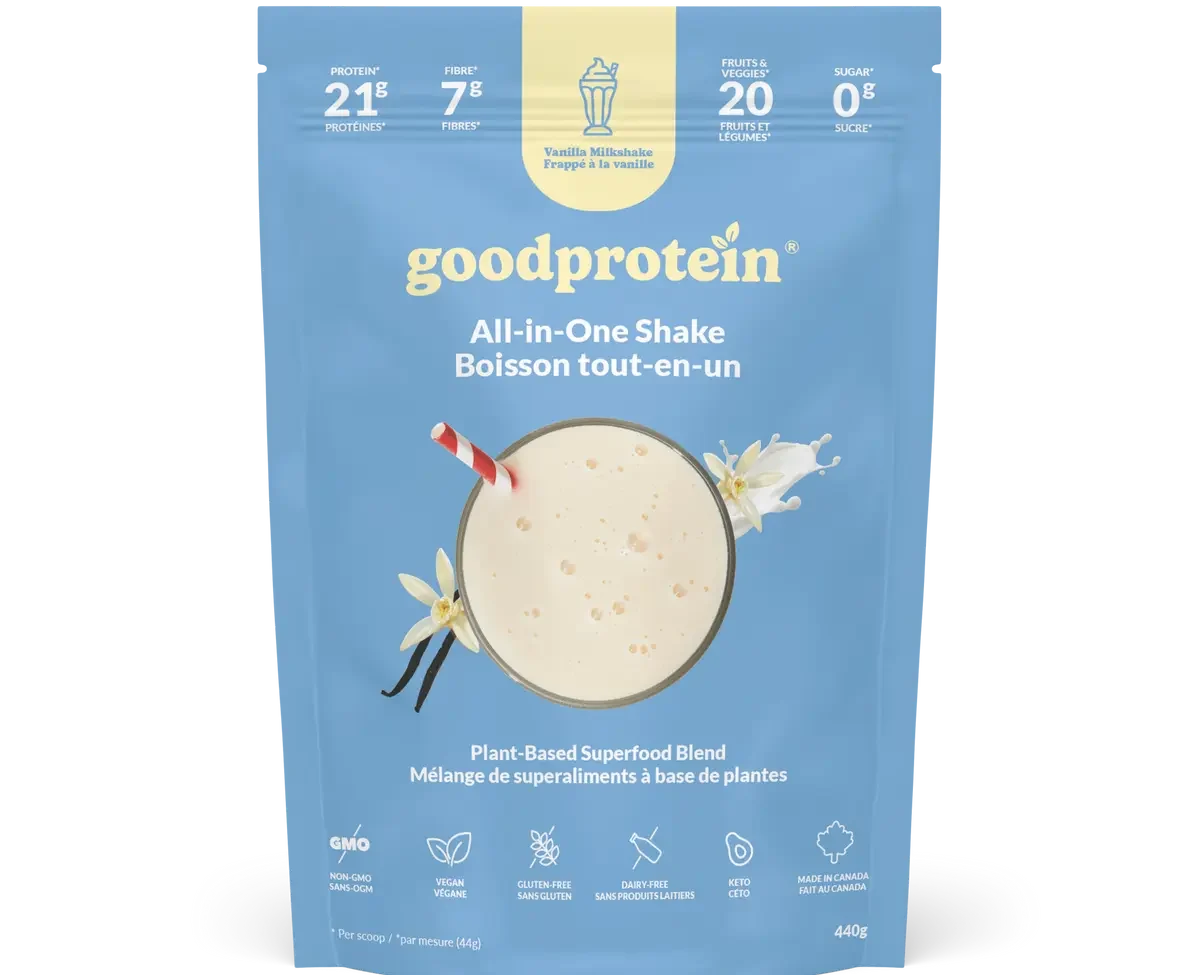
- All-in-One Shake — the flagship. 14 flavours, 21 g of plant protein, 7 g of fibre, 20-plus vitamins and minerals, probiotics and digestive enzymes, no added sugar.
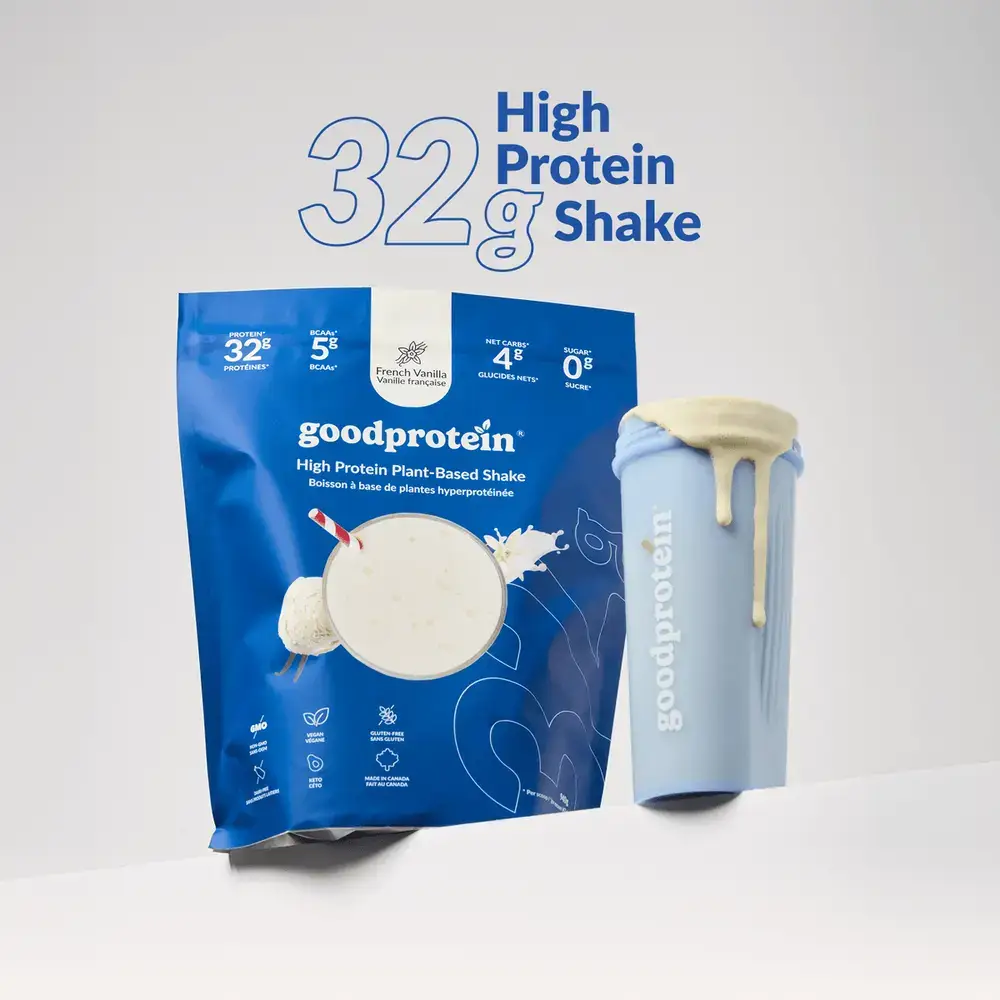
- 32 g High Protein Shake — the sports-facing line. 32 g of protein, 5 g of BCAAs, low carbohydrate, in French Vanilla, Chocolate Milk and Peanut Butter & Jelly.
- Clear Protein + Electrolytes — a lighter, juice-style format in Pink Lemonade, Peach Rings and Watermelon Candy.
- Functional extras — Superfood Juices, a plant-based collagen booster, a turmeric latte, and ready-to-drink bottles.
Everything is vegan, dairy-free, gluten-free, GMO-free and sweetened without sugar. That positioning is consistent across the range, which is more than many brands manage.
What is actually in the All-in-One Shake
Good Protein publishes the complete ingredient list rather than hiding behind a proprietary blend, which deserves credit and makes a proper review possible. Here it is, in the order it appears on the pouch:
Protein blend (pea protein, milled golden flaxseed), natural flavours, soluble tapioca fibres, coconut milk powder, medium chain triglycerides from coconut oil, guar gum, acacia gum, xanthan gum, a fruits/vegetables/mushrooms blend (broccoli, spinach, kale, pumpkin, sweet potato, sunflower seed, cranberry, chlorella, maitake mushroom, shiitake mushroom, pomegranate, acai, goji, grape, amla, aronia, sea buckthorn, camu camu, acerola), salt, Rebaudioside M, and a bacterial culture and enzyme blend (rice maltodextrin, Bacillus subtilis, amylase, protease).
Four things in that list are worth pulling out.
The protein is pea and flaxseed — and nothing else
Good Protein describes the shake as “complete protein with all 9 essential amino acids,” which is technically accurate: pea protein does contain all nine. But pea protein is limiting in methionine, meaning that amino acid is present in a lower proportion than the body ideally uses. Most plant blends solve this by adding rice protein, which is methionine-rich and pairs with pea almost perfectly. That is why you see pea-and-rice on so many labels.
Good Protein uses pea plus milled golden flaxseed instead. Flaxseed contributes some methionine along with omega-3 and fibre, so the blend is not a naked pea isolate — but it is a less complementary pairing than pea-and-rice, and the brand does not publish an amino acid profile to show where it lands.
How much does this matter? For most people, very little. If you eat a varied diet across the day, the amino acid arithmetic sorts itself out. It matters at the margin if this shake is a large share of your daily protein, or if you are training hard and counting on it for recovery. In that case a rice-blended plant powder, or the brand’s own 32 g line, is the more efficient choice.
The fibre is real, and so are the gums
Seven grams of fibre per serving is a genuinely useful number — most protein powders give you one or two. It comes mainly from the soluble tapioca fibre and the flaxseed, helped along by guar, acacia and xanthan gum, which also do the work of making a plant shake feel creamy rather than chalky.
This is the formulation’s biggest strength and its main risk at the same time. Soluble fibres and gums are exactly the compounds that cause bloating and wind in people sensitive to fermentable carbohydrates — the FODMAP-sensitive and those with IBS. Good Protein markets the shake as “easy to digest” and adds digestive enzymes and Bacillus subtilis to support that claim, which is a reasonable formulation response. But no enzyme blend makes 7 g of soluble fibre disappear. If gums and inulin-type fibres normally trouble you, start with half a serving rather than assuming the enzymes have solved it for you.
The superfood blend is further down the list than the marketing suggests
The fruit, vegetable and mushroom blend is the brand’s headline story — 19 ingredients, from kale to camu camu. It is also listed after three gums and before salt. Ingredients appear in descending order by weight, so the entire 19-ingredient blend weighs less than the coconut milk powder and roughly as much as the thickeners. Split 19 ways, each individual “superfood” is present in a very small amount, and the brand does not disclose the quantities.
This is not a scandal; it is how almost every greens-in-a-shake product is built. But it should reset your expectation. You are buying a protein-and-fibre base with a decorative nutritional garnish, not a serving of vegetables. The vitamins and minerals are a separate, added fortification and those are quantified on the panel — they are the part of the “25+ nutrients” claim that actually holds up.
The sweetener is the right one
Rebaudioside M — Reb M — is a stevia glycoside, and it is the one to want. It is the least bitter and least liquorice-like of the stevia fraction, without the cooling mouthfeel of erythritol or the aftertaste of cheaper Reb A. There are no sugar alcohols, no sucralose, no acesulfame potassium. For a no-added-sugar product, this is close to a best-case sweetener choice, and it is a large part of why the taste ratings are as high as they are.
The 32 g High Protein Shake is the better buy for most people
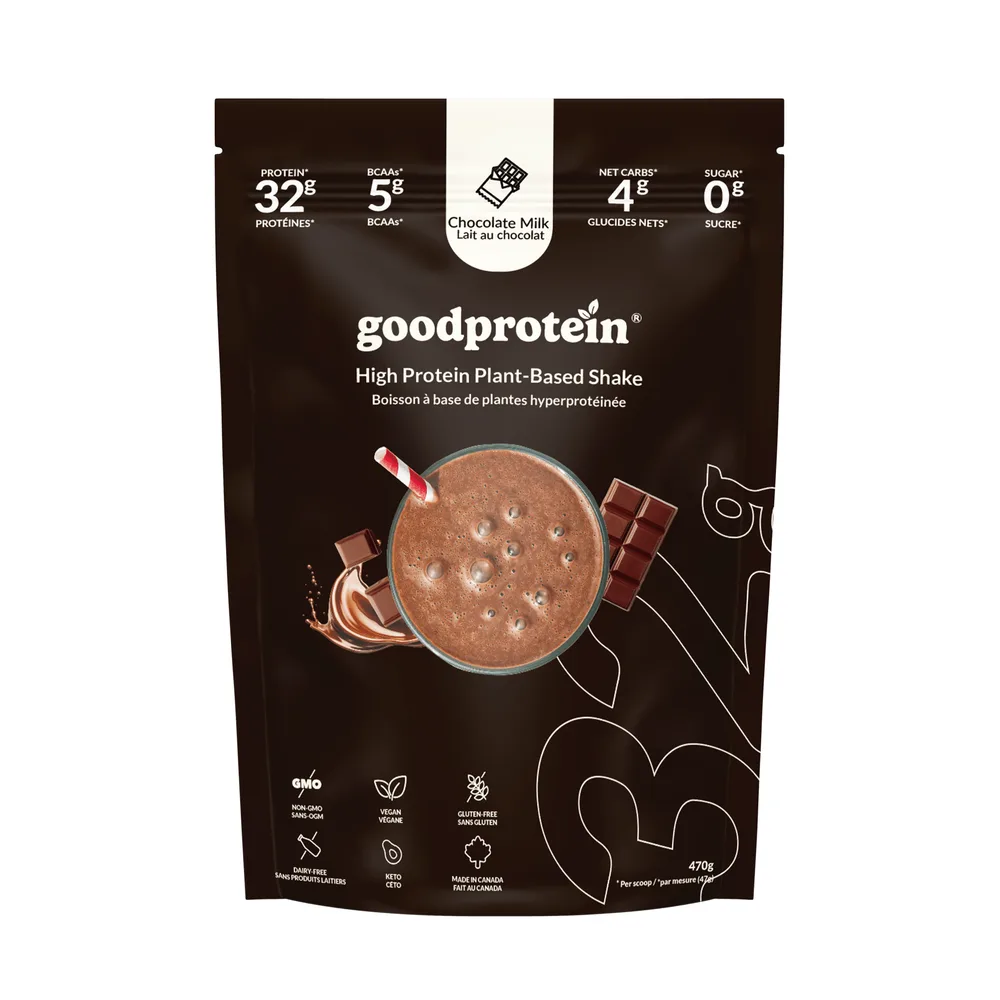
If what you actually want is protein, the All-in-One is the wrong product in the range. The 32 g line gives you half again as much protein per serving for a dollar more per serving, with 5 g of BCAAs, low carbohydrate, and zero sugar in the French Vanilla and Chocolate Milk versions. The Peanut Butter & Jelly flavour carries 1 g of sugar, which the brand attributes to the peanut flour rather than added sugar — a claim that is consistent with the ingredient list.
Think of it as two different products for two different jobs: the All-in-One is a nutrition-support snack, the 32 g is a protein shake. Buying the All-in-One and wishing it had more protein is the most common way to be disappointed by this brand.
What it costs, and what that works out to
Direct prices in Canadian dollars, with the arithmetic done:
- All-in-One, 440 g / 10 servings — $37.99. That is $3.80 a serving and about 18.1 cents per gram of protein.
- All-in-One, 880 g / 20 servings — $61.99. $3.10 a serving, about 14.8 cents per gram of protein.
- 32 g High Protein, 470 g / 10 servings — $39.99. $4.00 a serving, about 12.5 cents per gram.
- 32 g High Protein, 940 g / 20 servings — $64.99. $3.25 a serving, about 10.2 cents per gram.
- Clear Protein + Electrolytes, 10 servings — $29.99. $3.00 a serving.
- Sample pack — $29.99, which is the sensible way in if flavour is your worry.
Shipping is free above $55, which effectively pushes you toward the large pouches — and the large pouches are where the value is. Buying the 440 g All-in-One repeatedly is the single most expensive way to use this brand: you pay 22% more per gram of protein than on the 880 g, and more than three-quarters more than on the large 32 g pouch. The brand also advertises a 60-day satisfaction guarantee, which meaningfully lowers the risk of committing to a large pouch before you know whether the texture agrees with you.
Against the wider market, 15 cents per gram of protein is expensive for a plant powder and reasonable for a fortified daily shake. Whether it is good value depends entirely on whether you would otherwise be buying a separate fibre supplement, multivitamin and probiotic — which is precisely the trade the brand is proposing.
Heavy metals: good practice, incomplete disclosure
Good Protein maintains a dedicated heavy-metals page, which by itself puts it ahead of most of the category. It states that every batch of All-in-One Shakes is independently tested by accredited third-party laboratories, that results sit within Health Canada standards, and — correctly — that trace heavy metals are unavoidable in anything grown in soil. All of that is sound, and plant proteins genuinely do warrant this attention, as I set out in my guide to choosing a protein powder.
Two things stop me giving full marks. First, the brand publishes the assurance but not the numbers. A company testing every batch is sitting on exactly the data that would settle the question, and no certificate of analysis is offered. “Well within the limits” is a claim; a lead figure in micrograms per serving is evidence.
Second, the page’s response to a Consumer Reports article is a deflection rather than an answer. It argues that Consumer Reports applied American standards, including California’s Proposition 65, while Good Protein is assessed under Health Canada’s. That is factually true and also beside the point: a reader wants to know how the product performs against the stricter benchmark, not to be told the stricter benchmark does not apply. Publishing the results would end the argument in the brand’s favour if the numbers are as good as implied.
“Complete nutrition” versus what the brand tells the regulator
The All-in-One Shake is marketed under the line “Complete Nutrition, in One Shake.” Its own FAQ says something more precise: the shake is not officially recognised as a meal replacement by government agencies in Canada, and the brand suggests using it as a snack, in smoothies or in baking.
I am glad that answer is on the site — plenty of brands would not put it there. But the gap between the two statements is the single most important thing for a buyer to understand. A regulated meal replacement in Canada has to clear the thresholds written into section B.24.200 of the Food and Drug Regulations: at least 225 kcal per serving, between 15 and 40 per cent of its energy from protein, and a defined list of vitamins and minerals. This product is a food, not a meal replacement, and it is not intended to be the thing you eat instead of lunch. Treat it as a fortified snack that happens to be filling, and it will do what it says. Treat it as a meal, and you are under-eating without noticing.
Allergens, and who should not buy it
The label is clear: the shake may contain soybeans, peanuts, tree nuts and sesame, and is produced in a facility that also processes wheat, milk, eggs and fish. The brand states that it follows strict allergen management protocols across its manufacturing sites.
For most people this is routine. If you have a diagnosed severe allergy to any of those — particularly peanut, tree nut or sesame — a shared-facility product is not the right choice regardless of how careful the protocols are, and that includes the coeliac reader who is drawn in by the gluten-free claim but needs to see the wheat handling addressed specifically.
What customers say, and how much to trust it
The ratings are strong and there are a lot of them. On Good Protein’s own store, Vanilla Milkshake sits at 4.75 out of 5 from 4,871 reviews, Chocolate Fudge at 4.77 from 3,642, and Piña Colada at 4.6 from 1,187. The brand reports more than 30,000 verified reviews overall.
Two caveats. These are first-party, displayed on the seller’s own site under its own moderation, so they run warmer than independent samples — that is true of every brand, not a specific accusation. And volume is not the same as scrutiny: a 4.75 average across nearly five thousand ratings tells you the product reliably tastes good and rarely arrives faulty. It tells you nothing about whether the formulation is worth the money, which is the question this review exists to answer.
What the consistency does establish, and I think fairly, is that the texture-and-taste problem Good Protein set out to solve is solved. Gritty plant shakes with a bitter finish do not hold a 4.7-plus average across thousands of ratings. If you have been put off plant protein by texture before, this is a reasonable place to try again.
Who it is for
Good Protein’s All-in-One Shake is a good fit if you want one daily shake that covers protein, fibre, vitamins and probiotics together; you are vegan or dairy-free; texture and aftertaste have defeated you before; you prefer buying Canadian; or you want a no-added-sugar product without sugar alcohols.
Look elsewhere if your goal is protein per dollar — a plain pea or whey isolate is half the price per gram; you are training hard and want a high-methionine, rice-blended plant protein or a full amino acid profile published; fermentable fibres and gums upset your stomach; you have a severe peanut, tree nut, sesame or soy allergy; or you expected a meal replacement, because this is explicitly not one.
The verdict
Good Protein does the difficult, unglamorous things well. The full ingredient list is public. The sweetener is the best available choice rather than the cheapest. Heavy-metal testing happens on every batch. The FAQ corrects the brand’s own marketing on the meal-replacement question. Made in Canada is a real claim, not a maple leaf on a sticker, and the retail footprint backs it up.
What holds it at 7.5 is value and disclosure. The All-in-One is priced as a multi-supplement replacement, which is defensible, but it is easy to buy it thinking you are buying protein and then pay 45% more per gram than the brand’s own alternative. The superfood blend carries more marketing weight than mass. And a company that already tests every batch should simply publish the results.
Buy the 880 g pouch, or the 32 g line if protein is the point. Buy the sample pack first if you are unsure. And do not buy the 440 g pouch twice.
Common questions
Is Good Protein a Canadian company?
Yes. It was founded in Canada in 2019, its products are made in Canada, and it sells through Canadian retail including Costco, Walmart Canada and Amazon.ca alongside its own bilingual store. For the other end of the Canadian market, see my Revolution Nutrition review and my Diesel protein powder review.
How much protein is in the All-in-One Shake?
21 grams per serving, from pea protein and milled golden flaxseed, alongside 7 grams of fibre. The separate 32 g High Protein Shake provides 32 grams per serving with 5 grams of BCAAs.
Can I use it as a meal replacement?
No. Good Protein’s own FAQ states the All-in-One Shake is not officially recognised as a meal replacement by Canadian government agencies, and recommends it as a snack or an addition to smoothies and baking.
Does Good Protein contain artificial sweeteners?
No. It is sweetened with Rebaudioside M, a stevia-derived sweetener, with no sugar alcohols, sucralose or acesulfame potassium, and no added sugar.
Is it safe if I have a nut allergy?
The label states it may contain soybeans, peanuts, tree nuts and sesame, and is produced in a facility that also handles wheat, milk, eggs and fish. If you have a diagnosed severe allergy to any of these, this is not a suitable product.
Is it tested for heavy metals?
Yes. Good Protein states that every batch of All-in-One Shakes is independently tested by accredited third-party laboratories and that results fall within Health Canada standards. The actual test results and certificates of analysis are not published.
Prices, formulations and availability were checked in September 2026 and can change without notice — always read the label on the product you receive. This review is for general information and is not medical advice. If you are pregnant or breastfeeding, take prescription medication, or have a diagnosed condition including kidney or liver disease, speak to a qualified professional before adding a supplement.
For how this compares with the mainstream US options on price, see my ranking of six protein powders by cost per gram of protein.
Sources
This is a label, formulation, pricing and disclosure analysis, so every factual claim above traces back to a page you can open yourself.
- Good Protein — Ingredients — the published ingredient lists and nutrition panels for the All-in-One Shake and the 32 g High Protein Shake.
- Good Protein — Heavy metals testing and safety — the third-party testing statement, and the absence of published results or certificates of analysis behind it.
- Good Protein — FAQ — the allergen and shared-facility statement, and the brand’s own answer that the shake is not officially recognised as a meal replacement in Canada.
- Food and Drug Regulations (C.R.C., c. 870), section B.24.200 — what Canadian law actually requires of a product sold as a meal replacement: the 225 kcal minimum and the 15 to 40 per cent protein-energy range.
- Canadian Food Inspection Agency — Labelling requirements for foods for special dietary use — how meal replacements and nutritional supplements differ from ordinary foods on a Canadian label.

Roy Douele founded inareview and writes every review on the site. He is not a medical professional: he sources and buys the products himself, tests them over a meaningful period, and checks each claim against published research before assigning a score out of 10. Brands cannot pay for a review or influence a score.
View All Articles