Diesel Protein Powder Review (2026): Is PERFECT Sports’ NZ Whey Isolate Worth It?

Disclosure & independence
PERFECT Sports did not pay for this review, did not supply the product, and did not see the article before publication. No brand is given approval over what is written here.
At the time of publication, this article contains no affiliate links. If any are added later they will be clearly marked, they will never cost you anything extra, and they cannot change a score: verdicts are decided before any commercial link is considered.
Full details in my affiliate disclosure, editorial policy and testing methodology.
Diesel protein powder is one of the few supplements in Canada that is easier to find on a Shoppers Drug Mart shelf than in an honest review. Search the name and you get the brand’s own store, Walmart, Supplement King, Herc’s, Superstore — and almost nothing written by anyone without a till. So here is the version nobody is paid to write: what is actually in the tub, what the label supports, where the price stops making sense, and who should buy something else.
inareview verdict
8.0/10
One of the cleanest whey isolates sold in Canada, sold at a price that punishes you for buying small. New Zealand grass-fed isolate at 90% protein concentration, sweetened with stevia alone, made in the company’s own Health Canada-audited facility under an NPN licence, and third-party tested for banned substances. The catch is entirely about size and where you buy: the 360 g tub costs roughly 62% more per gram of protein than a discounted 5 lb bag of the identical powder.
Buy it if you want a genuinely clean isolate, you avoid artificial sweeteners, or you are drug-tested in sport. Skip it if you want the cheapest protein per gram, you need a plant-based option, or you were about to buy the small tub at full price.
How this review was done
I want to be straight about the method, because it changes how you should read what follows. This is a label, formulation, pricing and disclosure analysis, not a hands-on trial. I have not drunk this shake.
What I have done is read PERFECT Sports’ published specifications and manufacturing claims, check the regulatory position against how Health Canada’s natural product licensing actually works, collect the current price of every size directly from the brand’s Canadian store, and compare those against what independent Canadian retailers are charging for the identical product. The price arithmetic further down is mine, and it is the part of this review I would pay most attention to if I were buying.
That is a weaker basis than a month of use and I would rather say so than dress it up. Where I describe taste or texture, I am flagging it as reported rather than passing off someone else’s experience as my own.
What Diesel actually is
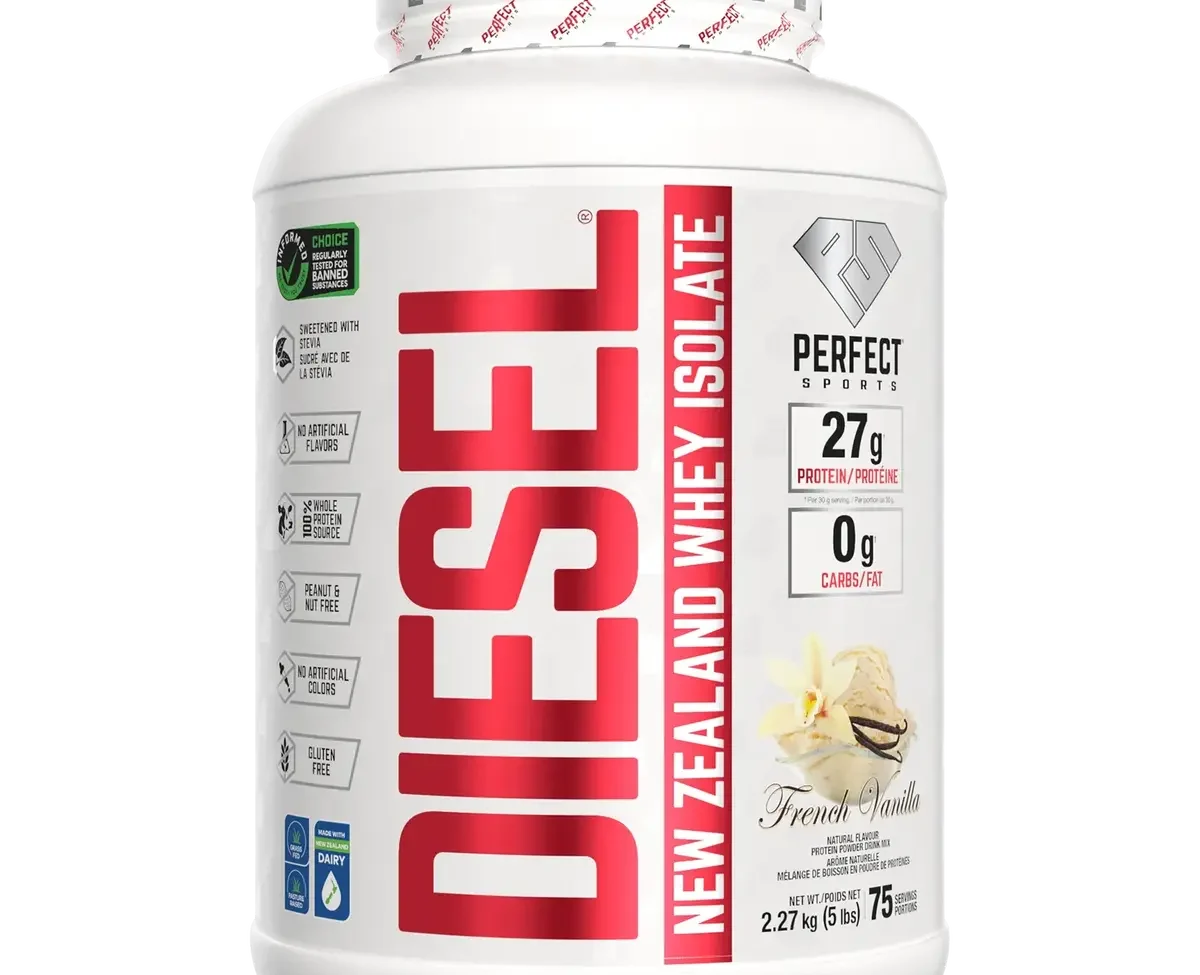
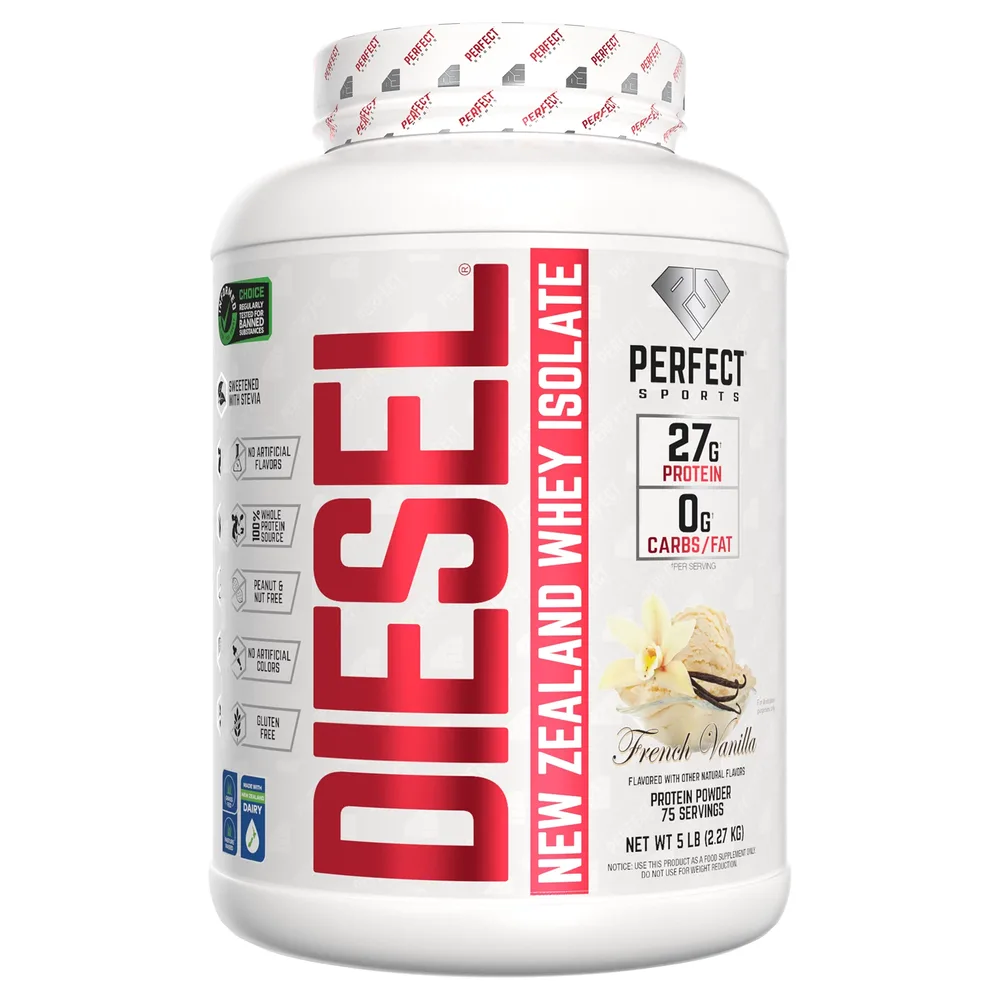
Diesel is made by PERFECT Sports, a Canadian company operating since 2003. The full product name is DIESEL New Zealand Whey Protein Isolate, and each part of that name is doing work:
- New Zealand — the whey is sourced from New Zealand dairy, from grass-fed, pasture-raised herds, with no artificial growth hormones (rBST, rBGH).
- Whey protein isolate — not concentrate, not a blend. The brand states 90% protein concentration, and that almost all lactose is removed during purification.
- The numbers — a 30 g scoop delivers 26 to 27 g of protein at around 110 calories, with zero grams of sugar.
Add to that: sweetened exclusively with stevia, all-natural flavours, nut-free, gluten-free, and third-party tested for banned substances. There are more than fifteen flavours across the range, from the expected Milk Chocolate, French Vanilla and Strawberry through to Salted Caramel, Mocha Latte Cappuccino, Pineapple Mango and Honeydew Melon Bubble Milk Tea, plus rotating limited editions.
The spec that matters most: 90% protein concentration
That figure is the one to hold on to. A 30 g scoop yielding 26 to 27 g of protein means roughly 88 to 90% of what you tip into the shaker is protein. For comparison, a typical whey concentrate runs 70 to 80%, and the remaining mass is lactose, fat and moisture.
This is what you are paying for, and it has two practical consequences. First, the calorie load per gram of protein is very low — about 4 calories per gram of protein, which is close to the theoretical floor. If you are eating in a deficit, that efficiency is the whole point of buying isolate over concentrate. Second, with most of the lactose stripped out, the usual complaint about whey — bloating and loose stools an hour later — largely goes away. That is the same tolerability argument I made for glycinate over citrate in my Qunol magnesium review: the form you tolerate is the form you actually keep taking.
Stevia only, and what that costs you
Diesel is sweetened with stevia and nothing else. No sucralose, no acesulfame potassium, no aspartame, no sugar alcohols. Among mainstream whey isolates sold in Canada this is genuinely unusual — the category overwhelmingly runs on sucralose, often paired with acesulfame K, because it is cheap and it tastes closer to sugar.
If artificial sweeteners are the reason you have been avoiding protein powder, this is the specification that should bring you back. But be realistic about the trade-off rather than disappointed by it later: stevia-only products taste cleaner and less dessert-like than sucralose-sweetened ones, and stevia carries a faint liquorice note that some people notice and some do not. A brand that sweetens with stevia alone is making a deliberate choice to be less candy-like. If your benchmark is a chocolate milkshake, budget for a period of adjustment.
Where it is made, and why the NPN matters
PERFECT Sports manufactures in its own 100% Canadian facility, which it describes as cGMP, peanut-free and nut-free, Health Canada-audited and site-licensed. Its products carry an NPN — a Natural Product Number issued by Health Canada.
This is worth more than it sounds, and it is the single biggest structural advantage Diesel has over imported American competitors. In the United States, supplements reach the shelf without any pre-market assessment of safety or effectiveness. In Canada, a natural health product requires a licence before it can be sold, which means Health Canada has reviewed the formulation, the claims and the manufacturing site. It is not a guarantee that a product works. It is a guarantee that somebody official looked before it went on sale, and that is more than most of this category can say.
Owning the factory matters too. A brand that manufactures its own product controls the supply chain that most supplement companies outsource and then describe vaguely. The nut-free designation is not marketing filler either — for anyone with a severe nut allergy, a dedicated nut-free facility is a materially different proposition from the “produced in a facility that also processes tree nuts” line that appears on most protein labels, including the Canadian plant-based brand I reviewed recently.
What it costs, and the mistake most buyers make
Here are the current direct prices from PERFECT Sports Canada, with the arithmetic done. I have calculated cost per gram of protein using 26.5 g per 30 g scoop:
- 360 g, about 12 servings — $49.99. That is $4.17 a serving and about 15.7 cents per gram of protein.
- 2 lb (907 g), about 30 servings — $119.99. $3.97 a serving, about 15.0 cents per gram.
- 4 lb (1.81 kg), about 60 servings — $219.99. $3.64 a serving, about 13.7 cents per gram.
- 5 lb (2.27 kg), about 75 servings — $249.99. $3.31 a serving, about 12.5 cents per gram.
Two things fall out of that table. The first is ordinary: bigger is cheaper. The second is the one worth acting on — the 360 g tub is a bad buy at full price. You pay 26% more per gram of protein than on the 5 lb bag for exactly the same powder. As a way to try three flavours before committing, it is reasonable. As a repeat purchase, it is the most expensive way to use this brand.
Do not buy it from the brand
This is the finding I did not expect. Diesel’s direct prices are not the prices Canadians actually pay.
SupplementSource.ca currently lists the 5 lb bag at $194.97 against the brand’s own $249.99 — a saving of $55, or 22%, on an identical product. At that price the cost per gram of protein drops to about 9.7 cents, which changes the value verdict entirely.
It is not a universal rule, which is why it is worth checking rather than assuming: Herc’s lists the 2 lb at $119.99, exactly matching the brand. Diesel is also stocked by Walmart Canada, Shoppers Drug Mart, Real Canadian Superstore, Loblaws, Voila, Amazon.ca, Supplement King, Healthy Planet and Vitamart. With that many competing sellers of one SKU, the spread between the cheapest and the dearest is large enough to be worth ten minutes of your time — and paying the manufacturer’s full list price is, more often than not, the worst available option.
How that compares
At 12.5 cents per gram direct, Diesel is expensive for a whey isolate. At 9.7 cents discounted, it is competitive with the better plant-based options — the 32 g line from Good Protein works out at about 10.2 cents per gram — while delivering the higher-quality protein source of the two. A concentrate-led blend such as LEANFIT runs closer to 5 cents at Costco, but at roughly 75% protein rather than 90%. Against commodity whey concentrate it remains dearer, as it should be: concentrate is a different product with a different protein concentration, and comparing them on price alone is the mistake the whole category encourages.
Third-party testing: the right idea, half disclosed
PERFECT Sports states that Diesel is third-party tested for banned substances. For anyone competing in drug-tested sport, that claim is the difference between a usable product and an unusable one, because contaminated supplements remain a genuine route to a failed test.
Here is my reservation, and it is the same one I had with the Canadian plant-based brand I looked at last week: the brand publishes the assurance but not the programme. Banned-substance testing is not a single standard. Informed Sport and NSF Certified for Sport are the two recognised certifications, both maintain public searchable databases of certified batches, and both are what a national federation will expect to see. “Third-party tested” without naming the certifier, and without a batch you can look up, is a weaker claim than it appears — and a brand that is already paying for the testing is leaving the credibility on the table by not naming it.
If you are subject to testing, contact PERFECT Sports and ask which programme certifies the batch you are buying before you use it. Do not rely on the phrase alone. For everyone else this matters far less, and the NPN licence plus an audited facility already puts Diesel ahead of most imported alternatives on manufacturing quality.
One smaller transparency point: the nutrition panel is published on the product page as an image rather than as text. It is legible, so this is a quibble rather than a complaint, but it does mean the full macro breakdown cannot be read by a screen reader or compared automatically against another label — and there is no reason for a brand this confident in its numbers to make them harder to check.
Who it is for
Diesel is a strong fit if you want a true isolate rather than a concentrate or a blend; artificial sweeteners are a dealbreaker; you are lactose-sensitive but not dairy-avoidant; you have a nut allergy and want a dedicated nut-free facility; you prefer a Canadian-made, Health Canada-licensed product; or you are drug-tested and need banned-substance screening as a baseline.
Look elsewhere if protein per dollar is your only criterion — commodity whey concentrate is substantially cheaper and perfectly adequate if you tolerate lactose; you are vegan or dairy-free, in which case a pea-and-rice blend is the category to shop; you want a thick, dessert-like shake, because stevia-only will read as clean rather than indulgent; or you were about to buy the 360 g tub as your regular purchase.
The verdict
Diesel does the hard things properly. The protein source is high quality and specified precisely rather than hidden behind “premium blend”. The 90% concentration is a real number with real consequences for your calorie budget. The sweetener choice costs the brand money and taste-test points, and it made that choice anyway. The manufacturing is owned, audited and licensed rather than outsourced and described vaguely. For a Canadian buyer, that combination is genuinely hard to match.
What keeps it at 8.0 rather than higher is price behaviour and disclosure. The small tub is poor value at list, the brand’s own store is frequently the most expensive place to buy its own product, the banned-substance programme is unnamed, and the nutrition panel is a picture. None of those are formulation problems. All of them are fixable, and until they are fixed they cost the buyer money or certainty.
Buy the largest size you will realistically get through, buy it from a discounting retailer rather than the brand, and check the price across two or three sellers first. Do that and this is close to the best whey isolate available in Canada. Buy the small tub at full price from the brand’s own store and you will pay roughly 62% more per gram for the identical powder.
Common questions
Who makes Diesel protein powder?
PERFECT Sports, a Canadian company operating since 2003. It manufactures in its own Canadian cGMP facility, which it describes as nut-free, Health Canada-audited and site-licensed.
How much protein is in a serving of Diesel?
26 to 27 grams of protein per 30 g scoop, at around 110 calories and zero grams of sugar. That works out to roughly 90% protein concentration.
Is Diesel a whey isolate or a concentrate?
A 100% whey protein isolate, sourced from grass-fed, pasture-raised New Zealand dairy. Isolate is more filtered than concentrate, which is why the protein concentration is higher and most of the lactose is removed.
Does Diesel contain artificial sweeteners?
No. It is sweetened exclusively with stevia, with all-natural flavours, no sucralose, no acesulfame potassium and no sugar alcohols.
Is Diesel safe if I am lactose intolerant?
The brand states that almost all lactose is removed during purification, which is typical of isolates and is why many lactose-sensitive people tolerate them. It is still a dairy product, so it is not suitable if you have a milk allergy or avoid dairy entirely.
Is Diesel tested for banned substances?
PERFECT Sports states that it is third-party tested for banned substances, but does not name the certification programme. If you compete in drug-tested sport, ask the company which programme certifies your specific batch before using it.
Where is the cheapest place to buy Diesel in Canada?
Prices vary widely between retailers, and the brand’s own store is often not the cheapest. At the time of writing SupplementSource.ca listed the 5 lb bag at $194.97 against $249.99 direct. Check two or three Canadian sellers before buying — the spread on a single size can exceed $50.
For the US market, my cost-per-gram ranking of six protein powders covers the mainstream alternatives.
Sources
Everything above was read from these pages. Links are provided so you can check the claims for yourself; none of them is an affiliate link.
- PERFECT Sports — DIESEL New Zealand Whey Protein Isolate — the brand’s own product page: ingredient list, formulation and protein-per-scoop figures.
- SupplementSource.ca — DIESEL 5 lb listing — the Canadian retailer price used in the cost comparison ($194.97 at the time of writing).
Prices, formulations and availability were checked in September 2026 and can change without notice — always read the label on the product you receive. This review is for general information and is not medical advice. If you are pregnant or breastfeeding, take prescription medication, or have a diagnosed condition including kidney or liver disease, speak to a qualified professional before adding a supplement.

Roy Douele founded inareview and writes every review on the site. He is not a medical professional: he sources and buys the products himself, tests them over a meaningful period, and checks each claim against published research before assigning a score out of 10. Brands cannot pay for a review or influence a score.
View All Articles