NOW Foods Magnesium Glycinate Review (2026): The Brand That Tested Its Rivals

Disclosure & independence
NOW Foods did not pay for this review, did not supply the product, and did not see the article before publication. No brand is given approval over what is written here.
This article contains affiliate links. If you buy through one I may earn a commission, at no additional cost to you. A commission never changes a score, a ranking or a verdict: those are decided before any commercial link is considered.
Full details in my affiliate disclosure, editorial policy and testing methodology.
In December 2022, NOW Foods bought sixteen magnesium glycinate products on Amazon, sent them to a laboratory, and published what it found. Almost none of them contained the chelated magnesium their labels claimed. The only ones that did were NOW’s own.
That is either the most useful piece of consumer testing in this category or an advertisement with a spectrometer attached, and working out which is most of this review.
The short version
Score: 8.5 out of 10 — level with Solaray and Thorne, and for most buyers the easiest of the three to recommend.
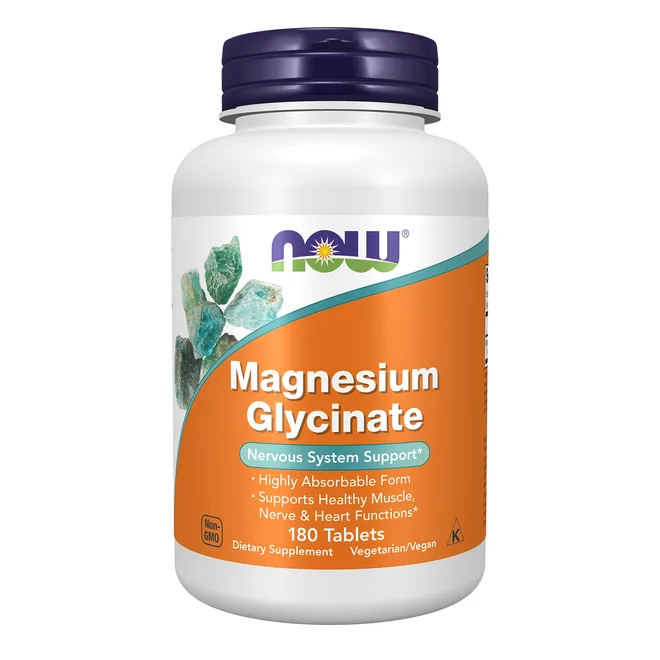
200 mg of elemental magnesium in two tablets, from Albion magnesium bisglycinate. A real, fully reacted chelate, named on the label, with both the compound weight and the elemental weight disclosed.
This is the only product in my comparison whose chelation has been measured by an outside laboratory and published. Eurofins found 101–111 mg of soluble magnesium per tablet against a 100 mg claim.
14.2¢ to 20.0¢ per 100 mg depending on size and on whether it is on sale, which it usually is. Buy the 180-count. Skip it if you want the shortest possible excipient list, or if you are drug-tested.
Comparing brands? This is the sixth magnesium I have taken apart. The cost arithmetic for all of them, side by side, is in my comparison of the best magnesium glycinate brands.
How this review was done
I have not taken this product. There is no test panel, no trial and no “our testers”, because there were none. What follows is a documentary review: NOW’s own Supplement Facts panel and prices read from its website, its published testing programme, the full results of the Amazon study it ran, and a check of what I could and could not confirm independently.
One thing I want to flag before anything else, because it shapes the whole piece. The most striking evidence in favour of this product was produced by the company that sells it. I have not treated that as disqualifying, and I have not treated it as proof either. I have tried to work out exactly what the study can and cannot support, which turns out to be a more interesting question than whether to believe it.
Prices and formulations were checked in September 2026 and change without notice — and in this case they change often. Always read the label on the bottle you receive.
What is actually in a tablet
The panel is short and, unusually, it does the arithmetic for you.
- Serving size: 2 tablets, taken one to two times daily with food.
- Magnesium (elemental), from Magnesium Bisglycinate (Albion™): 200 mg per serving, 48% of the Daily Value. That is 100 mg per tablet.
- Other ingredients: citric acid, hydroxypropyl cellulose, stearic acid (vegetable source), silicon dioxide, and a vegetarian coating made of hypromellose, stearic acid, sunflower lecithin, triethyl citrate and sunflower oil.
- Two sizes: 90 tablets (45 servings, SKU 1286, UPC 733739012869) and 180 tablets (90 servings, SKU 1289, UPC 733739012890).
- Not manufactured with wheat, gluten, soy, milk, egg, fish, shellfish, tree nuts or sesame, though the facility handles them.
Two points matter here, and the second is the one that separates this product from most of what is sold under the same words.
First, the label says bisglycinate, and it names Albion as the source. Albion, now part of Balchem, is the supplier that also makes the lysinate glycinate chelate in Doctor’s Best. Of the six brands I have read, only Solaray, Thorne and NOW name a specific chelate on the ingredient line.
Second, and this is the useful part: NOW’s own published explanation of that label is itself a consumer education. Albion’s magnesium bisglycinate chelate powder is roughly 10% elemental magnesium. So it takes about 2,000 mg of the chelate to yield 200 mg of magnesium. Any product claiming a much higher elemental percentage from “magnesium glycinate” is, by simple chemistry, either buffered with something else or not fully reacted. Hold on to that number: it is the key that unlocks the rest of this review.
The cost table, and a warning about the sale price
Ninety tablets is 9,000 mg of elemental magnesium. One hundred and eighty is 18,000 mg. On NOW’s own site in September 2026:
- 90 tablets — $14.39 on sale, $17.99 regular. That is 16.0¢ per 100 mg on sale, 20.0¢ at the regular price.
- 180 tablets — $25.59 on sale. That is 14.2¢ per 100 mg.
I could not read the regular price for the 180-count; the page showed only the 90-count’s. The 90-count’s sale price is exactly 20% off its regular price, so if the same discount applies, the 180-count’s regular price would be $31.99 and its cost per 100 mg about 17.8¢. Treat that as my arithmetic, not as a figure I read.
Against the rest of the comparison, cheapest first:
- Doctor’s Best, 240 tablets — 10.0¢ (but a different chelate)
- NOW, 180 tablets on sale — 14.2¢
- Solaray, 240 count — 15.2¢
- NOW, 90 tablets at the regular price — 20.0¢
- Pure Encapsulations, 360 count — 20.1¢
- Thorne, 60 scoops — 43.3¢
So whether NOW is cheaper than Solaray depends on the day you shop, and the gap between its own two sizes at their own two prices is 41%. This is the same lesson as every other article in this series, arriving by a new route: the format and the timing move the price per milligram more than the brand does. Buy the 180-count, and buy it on sale.
The study NOW ran on its competitors
Now the part that makes this brand unusual.
NOW bought sixteen magnesium glycinate products on Amazon — fourteen from other companies and two of its own — and had them analysed twice over. Once in its own laboratory, and once at Eurofins, an independent contract laboratory, with both sets of numbers published side by side.
The method is the clever part, and it is worth understanding because it explains why ordinary testing misses the problem.
- Total magnesium was measured by inductively coupled plasma optical emission spectrometry (ICP-OES) after acid digestion. Acid dissolves everything, so this tells you how much magnesium is in the capsule in any form at all.
- Soluble magnesium was measured the same way, but with a gentle water extraction instead of acid. Chelated magnesium bisglycinate dissolves in water. Magnesium oxide and magnesium carbonate largely do not.
The difference between those two numbers is the test. A product can hit its label claim on total magnesium while containing almost no chelate at all.
The results: twelve of the sixteen met their label claim on total magnesium. Only NOW’s products met it on soluble magnesium. Glycine was detected in every sample, but the solubility figures indicate it was not bound to the magnesium — consistent with cheap oxide or carbonate simply blended with loose glycine and sold as “magnesium glycinate”.
Some individual findings are worth repeating because they are checkable against any label:
- Deal Supplement claimed 750 mg of “magnesium glycinate” per capsule — that is the compound weight presented where the elemental dose belongs. NOW names Innate Vitality, Naturebell, Terranics and ZYY Nutrition as labelling the same way.
- Toniiq claimed 20% elemental magnesium, which, given Albion’s chelate is about 10%, is only achievable if the magnesium and glycine are not fully reacted.
- NaturaLife Labs declares 18% elemental with Albion as the source — accurate on the side panel, because it lists magnesium oxide there too, but the front panel says only “magnesium glycinate”.
- Horbaach states 240 mg of magnesium from 1,330 mg of a chelate-and-oxide blend on the side panel, while the front of the bottle advertises the 1,330.
Whatever you think of who paid for this work, that last set of observations requires no laboratory at all. You can verify them by reading the two panels on a bottle and noticing that they disagree.
What the study does not show
Here is the limitation, and to NOW’s credit the company states it plainly in its own write-up rather than leaving a reader to find it.
NOW deliberately did not test most brands that source from Albion, on the stated grounds that those are known to be high quality. Read that again in the context of the headline. The conclusion “only NOW passed” was drawn from a sample from which NOW had removed, in advance, the competitors most likely to pass.
And look at who was actually in the sample: Deal Supplement, Doublewood, Dr. Martin’s Nutrition, Horbaach, Innate Vitality, Nature’s Branch, NaturaLife Labs, Natures Craft, Naturebell, Purely Holistic, Terranics, Toniiq, Whollium, ZYY Nutrition. These are Amazon-native brands. Solaray, Thorne, Pure Encapsulations and Doctor’s Best are not in the table. None of the products I have rated 7.5 or above was tested.
So the study supports one conclusion firmly and another not at all:
- Well supported: a large share of inexpensive “magnesium glycinate” sold on Amazon by unfamiliar brands is not meaningfully chelated, and its labelling is frequently misleading. That is a genuinely valuable public finding, and it is the reason I would steer anyone away from an unknown magnesium brand on price alone.
- Not supported: that NOW’s chelate is better than Solaray’s, Thorne’s or Pure Encapsulations’. Those were never in the room.
One more thing to keep in proportion: the testing was done in December 2022. It is nearly four years old. Formulations and suppliers change, and some of the brands named may have reformulated since.
What Eurofins actually measured in this product
Strip away the competitive framing and one fact remains that applies to nobody else in my comparison.
The exact SKU reviewed here — NOW Magnesium Glycinate, 180 tablets, 100 mg per tablet, lot 3258879 — was bought at retail and measured by an outside laboratory, and the numbers were published:
- Total magnesium: 111 mg per tablet (NOW’s lab), 110 mg (Eurofins), against a 100 mg claim.
- Soluble — that is, actually chelated — magnesium: 111 mg (NOW’s lab), 101 mg (Eurofins).
Two things follow. The product contains slightly more magnesium than it promises, and essentially all of it is in the chelated form, confirmed by a laboratory NOW does not own, on a sample bought the way a customer would buy it.
That is a different class of evidence from “we test our products”, and it is close to what I have been asking every brand in this series for. Solaray’s anonymous-purchase ISO 17025 testing is the same idea, but Solaray publishes the policy rather than the numbers. Here the numbers are on the page, with the lot number attached.
It is not the strongest possible form of the claim. It is one lot, from one date, in a study the manufacturer designed. But it is more than anyone else in this comparison has put on the table.
How NOW tests everything else
These are NOW’s own claims about its wider programme. I am reporting them as claims.
- Over 31,000 tests a month in its in-house laboratories, across 68 categories of testing daily — identity, purity, potency, heavy metals, pesticides and agricultural chemicals, microbiology, and adulterants including pharmaceuticals.
- A2LA accreditation for its analytical and microbiological laboratories. A2LA accredits to ISO/IEC 17025, the same laboratory-competence standard Solaray names.
- Outside laboratories used for specialised work, duplicate testing and certifications.
- In June 2021 the programme won the NutraIngredients-USA Editors Award for Industry Initiative of the Year, specifically for exposing quality problems in supplements sold on Amazon — which is outside recognition of the very work described above.
- Family owned since 1968; manufactured in the United States with globally sourced ingredients.
One honest gap. I tried to confirm the A2LA accreditation in A2LA’s own public directory, the way I confirmed Thorne’s certification in NSF’s register. I could not retrieve a usable record. That does not mean the accreditation is not real — directory searches fail for all sorts of dull reasons — but I am not going to describe as verified something I did not manage to verify. Treat it as NOW’s statement.
And one distinction that matters if you compete. NOW does hold Informed Sport certification, under which every production run is tested for banned substances by LGC. It applies to the NOW Sports range — forty-eight products, all sports nutrition. This magnesium is not among them. That is the same shape of distinction I drew for Solaray’s facility-level NSF certification: real, but not covering the bottle in question.
The BioPerine version is a different decision
NOW also sells Magnesium Glycinate with BioPerine® Veg Capsules, at $14.99 for 60 and $29.99 for 180. Do not buy it by accident.
BioPerine is a black pepper extract standardised for piperine, added to improve absorption. Piperine inhibits CYP3A4 and P-glycoprotein, the machinery your body uses to clear a great many prescription medicines, so it can raise blood levels of some of them. The amounts involved are small and irrelevant for most people. If you take prescription medication regularly, it is worth thirty seconds with a pharmacist.
I raised exactly this about Solaray, which includes 5 mg of BioPerine in its standard product with no mention of the interaction on its page. NOW’s advantage here is structural: it sells the piperine as a separate SKU. The plain tablets reviewed on this page contain none, so the decision is yours to make rather than one made for you. That is the better arrangement, and it is worth a point.
How it compares with the other brands I have reviewed
- Against Solaray (8.5). Very close. Solaray wins on verification policy — anonymous purchase, named ISO 17025 laboratories — and is cheaper than NOW at regular prices. NOW wins on published numbers for its actual chelate, on dose (two tablets against four capsules), and on not putting black pepper extract in the standard product. Genuinely a tie, decided by what you weigh.
- Against Thorne (8.5). Thorne has the stronger certification by a distance: batch-level NSF Certified for Sport, which I confirmed in NSF’s own register. NOW costs about a third as much. If you are drug-tested, that settles it; if you are not, NOW is the better value by a wide margin.
- Against Pure Encapsulations (8.0). NOW is cheaper and better evidenced. Pure Encapsulations keeps the advantage on excipients — two other ingredients against NOW’s four plus a five-component coating — and on flexible single-capsule dosing.
- Against Doctor’s Best (7.5). Doctor’s Best is cheaper still, at 10.0¢, and shares the same chelate supplier. But it sells lysinate glycinate rather than bisglycinate, and its testing badges name no certifying body at all. NOW is the better product; Doctor’s Best is the cheaper one.
- Against Qunol (7.0). Not close. Qunol is widely stocked and well tolerated, but I could find no batch documentation for its magnesium at all, and its tablets are large. NOW costs less and shows its working.
Who should buy this, and who should not
Buy it if you want the most product for your money without giving up evidence. This is the default recommendation on this page for an ordinary buyer: a real Albion bisglycinate, independently measured, at 14–20¢ per 100 mg, in a two-tablet dose. Get the 180-count.
Buy it if you take prescription medication and want bisglycinate without a bioavailability enhancer you did not ask for. Just make sure you are buying the plain tablets and not the BioPerine capsules.
Skip it if excipients are your main concern. Four other ingredients plus a five-part coating is the longest list among the well-evidenced products here. Thorne’s powder has two ingredients and no capsule; Pure Encapsulations has two.
Skip it if you are drug-tested. Informed Sport does not cover this product. Thorne does.
And skip all of these if you want magnesium as a laxative. Citrate is cheaper and better suited. Bisglycinate is what you buy for tolerability or sleep support — the reason it turns up in my guide to what the evidence actually says about magnesium glycinate for sleep.
The verdict
Score: 8.5 out of 10.
I came to this expecting to mark a company down for grading its own homework, and the homework turned out to be mostly real. The study is compromised by who funded it and by a sample deliberately cleared of the strongest competitors, and NOW says so itself. What survives that discount is still substantial: an independent laboratory measured this exact product, from a retail purchase, and found essentially all of its magnesium in the chelated form.
What keeps it from scoring higher is the excipient list, the absence of banned-substance certification on this SKU, and an accreditation I could not confirm at source. What keeps it at the top is that almost nothing here requires you to take the company’s word for it, and the price is among the lowest in the category.
If you want one sentence: Solaray has the better testing policy, Thorne has the better certification, and NOW has the better published evidence about the tablet actually in the bottle. All three are worth buying. This is the one I would put in a cupboard.
Where to buy
One warning specific to this product. NOW’s own store sells 90 and 180 tablets. Amazon also lists a 240-tablet size that does not appear on NOW’s website, which may be a bundle or a retailer-specific pack. Check the count and the price per tablet before you add it to the basket — as the cost table above shows, that single check is worth more than the choice of brand.
Check the current size and price on AmazonOutside the US? Canada: search Amazon.caAs an Amazon Associate I earn from qualifying purchases. This never changes a score, a ranking or a verdict — those are decided before any commercial link is considered.
Common questions
Is NOW Foods magnesium glycinate real chelated magnesium?
Yes, and it is the only product in my comparison for which an outside laboratory has published a measurement. Eurofins found 101 mg of water-soluble — that is, chelated — magnesium per tablet against a 100 mg label claim, on a sample bought at retail. The ingredient is Albion magnesium bisglycinate, named on the label, with both the compound weight and the elemental weight disclosed.
What did NOW’s magnesium glycinate test of 16 brands actually find?
That twelve of sixteen products met their label claim for total magnesium, but only NOW’s met it for the soluble, chelated form — suggesting the others used cheap magnesium oxide or carbonate blended with loose glycine. The important caveat is NOW’s own: it deliberately excluded most competitors that source chelate from Albion, so the brands most likely to pass were never tested. The finding applies to inexpensive Amazon-native brands, not to the premium brands in this comparison.
How much magnesium is in a NOW magnesium glycinate tablet?
100 mg of elemental magnesium per tablet, so 200 mg in the two-tablet serving, which is 48% of the Daily Value. A 90-tablet bottle is 45 servings and a 180-tablet bottle is 90 servings. The suggested use is two tablets once or twice daily with food.
Is NOW magnesium glycinate NSF Certified for Sport?
No. NOW holds Informed Sport certification, under which LGC tests every production run for banned substances, but that applies to the forty-eight products in the NOW Sports range and this magnesium is not one of them. If you compete under anti-doping rules, Thorne’s magnesium bisglycinate is the product on this site that carries batch-level certification.
Which NOW magnesium glycinate should I buy?
The 180-tablet plain tablets, on sale. At $25.59 that is 14.2¢ per 100 mg against 16.0¢ for the 90-count and 20.0¢ for the 90-count at its regular price. Avoid buying the BioPerine capsules unintentionally — they are a separate product containing black pepper extract, which interacts with a number of prescription medicines.
Does it contain magnesium oxide?
No. The ingredient line names magnesium bisglycinate from Albion, and the published solubility testing on this SKU is consistent with that: if oxide had been blended in, the soluble figure would have fallen well below the total, which is exactly the pattern NOW found in the brands it tested against.
Sources
Everything above was read from these pages. Links are provided so you can check the claims yourself, including the ones I have reported as the company’s own.
- NOW Foods — Magnesium Glycinate Tablets — the Supplement Facts panel, the ingredient list, both bottle sizes, the SKUs and UPCs, and the sale and regular prices.
- NOW Foods — Magnesium Glycinate Brands on Amazon — the sixteen-sample study: method, the full results table with lot numbers, the NOW and Eurofins columns, the named mislabelling examples, and the stated decision not to test most Albion-sourcing brands.
- NOW Foods — Comprehensive Testing — the 31,000 tests a month, the 68 testing categories, the A2LA accreditation claim and the NutraIngredients-USA award.
- NOW Foods — Informed Sport — the list of products the LGC batch testing actually covers, which is where I established that this magnesium is not one of them.
- Balchem — Albion Minerals — the chelate supplier behind both this product and Doctor’s Best.
- Predicting and Testing Bioavailability of Magnesium Supplements — on the absorption of chelated forms.
Prices, formulations and availability were checked in September 2026 and can change without notice — always read the label on the product you receive. This page is for general information and is not medical advice. If you are pregnant or breastfeeding, take prescription medication, or have a diagnosed condition including kidney or liver disease, speak to a qualified professional before adding a supplement.

Roy Douele founded inareview and writes every review on the site. He is not a medical professional: he sources and buys the products himself, tests them over a meaningful period, and checks each claim against published research before assigning a score out of 10. Brands cannot pay for a review or influence a score.
View All Articles