Thorne Magnesium Bisglycinate Review (2026): Proof at a Price

Disclosure & independence
Thorne did not pay for this review, did not supply the product, and did not see the article before publication. No brand is given approval over what is written here.
This article contains affiliate links. If you buy through one I may earn a commission, at no additional cost to you. A commission never changes a score, a ranking or a verdict: those are decided before any commercial link is considered.
Full details in my affiliate disclosure, editorial policy and testing methodology.
Thorne’s magnesium bisglycinate is the product I expected to dislike. It is a powder, it costs more than any magnesium I have priced, and it is sold with the kind of athlete endorsement that usually signals marketing rather than chemistry.
Then I checked the certification, and it turned out to be the one claim on this site I have been able to verify in an independent public database rather than take a company’s word for. That changes the argument, though not as much as the price tag complicates it.
The short version
Score: 8.5 out of 10 — tied with Solaray, for opposite reasons.
200 mg of magnesium bisglycinate per scoop, 60 scoops, two other ingredients — citric acid and monk fruit. That is the cleanest formula of the six brands I have assessed, and there is no capsule shell at all.
NSF Certified for Sport, confirmed in NSF’s own database — not claimed on a badge, listed by the certifying body. No other brand on this site has this.
But 43.3¢ per 100 mg — 185% more than Solaray and more than four times Doctor’s Best. Buy it if you are drug-tested or you want the shortest ingredient list available. Skip it if you are not, because you are paying a large premium for a guarantee you will never need to use.
Comparing brands? This is the fifth magnesium I have taken apart. The others, and the cost arithmetic for all of them side by side, are in my comparison of the best magnesium glycinate brands.
How this review was done
I have not taken this product. There is no test panel, no trial and no “our testers”, because there were none. What follows is a documentary review: the Supplement Facts panel as retailers publish it, Thorne’s own manufacturing and quality page, NSF’s public register of certified products, and two independent retail prices.
One limitation I should state plainly, because it shaped the work. Thorne’s own product page renders its price and its label in the browser rather than in the HTML, so I could not read either directly from thorne.com. Every figure below therefore comes from retailers who publish the same UPC, and I have used two of them so the numbers corroborate each other rather than resting on one listing. Where I could not verify something, I say so instead of filling the gap.
Prices and formulations were checked in September 2026 and change without notice. Always read the label on the jar you receive.
What is actually in a scoop
The panel is unusually short, and that is the point of the product.
- Serving size: 1 scoop. Servings per container: 60.
- Magnesium (bisglycinate): 200 mg per scoop. That is roughly 48% of the 420 mg Daily Value, by my arithmetic rather than the label’s.
- Other ingredients: citric acid, monk fruit. Two. That is the whole list.
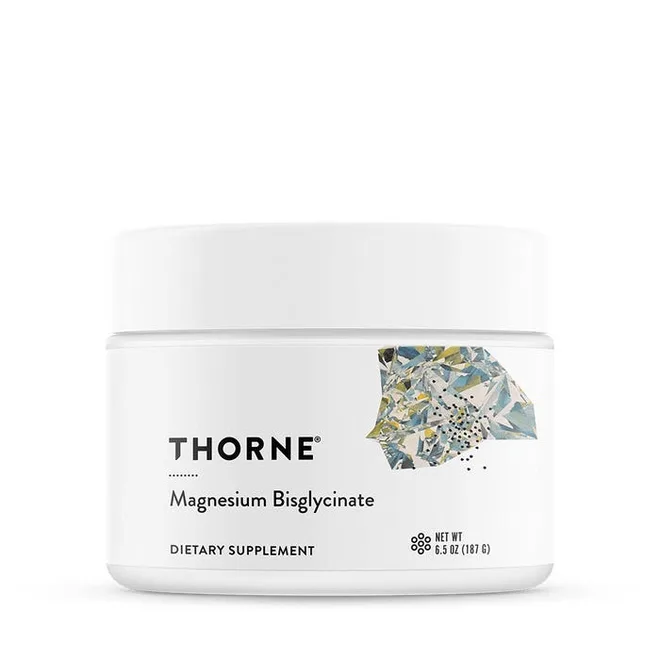
- Sold as a 6.5-ounce (187 g) jar. Manufacturer part M204, UPC 693749006442.
- Gluten free, dairy free and soy free.
Two things follow from that list, and both matter more than they look.
First, the label says bisglycinate, in the ingredient name, not “magnesium glycinate” as a loose category. Of the six brands I have now read, only Solaray, Thorne and NOW Foods are that specific. Pure Encapsulations says only “magnesium glycinate”, and Doctor’s Best is selling a different chelate altogether.
Second, there is no capsule. Every other product in this comparison delivers magnesium inside something — hypromellose, cellulose, magnesium stearate, and in Solaray’s case 5 mg of black pepper extract that interacts with a long list of prescription medicines. Here the only things accompanying the mineral are an acidifier and a sweetener. If your reason for buying bisglycinate in the first place is that you react to fillers, this is the shortest list on the market that I have found.
The cost table: this is the most expensive magnesium I have priced
Now the part that decides most purchases, and the reason this product does not win outright.
Sixty scoops at 200 mg each is 12,000 mg of elemental magnesium per jar. The jar sells for $52.00, a figure I found identically at the Mayo Clinic Store and at The Feed, both listing the same UPC. That works out at 43.3¢ per 100 mg of elemental magnesium.
Here is that number against the four brands I have already taken apart, cheapest first:
- Doctor’s Best, 240 tablets — 10.0¢
- Solaray, 240 count — 15.2¢
- Pure Encapsulations, 360 count — 20.1¢
- Pure Encapsulations, 30 count — 34.7¢ (their worst size, and a size I told people not to buy)
- Thorne, 60 scoops — 43.3¢
Read that last line against the one above it. Thorne’s standard size costs more per milligram than the single worst-value bottle I have found from any other brand. It is 185% more than Solaray’s 240-count and more than four times Doctor’s Best’s tablets.
This also retires a claim I made three weeks ago. When I reviewed Pure Encapsulations I called it “the most expensive magnesium per 100 mg I have priced”, which was true of the four brands I had read at the time and is no longer true. Thorne takes that title by a wide margin, and I have gone back and corrected that review rather than leave a superlative standing that the next article disproves.
So the question this product has to answer is narrow and fair: what does the extra 28 cents per 100 mg buy?
The certification no other brand on this site has
Something real, as it turns out, and this is the section that moved the score.
Across four previous reviews I have made the same complaint: “third-party tested” is close to meaningless as a phrase, because if the manufacturer picks which samples go to the laboratory it controls the result. Solaray answered that by having finished bottles anonymously purchased and tested in ISO 17025 laboratories, which is the best answer I had seen. Doctor’s Best answered it with four badges, two of which were graphics it made for itself.
Thorne’s answer is NSF Certified for Sport, and the distinction that matters is one I have drawn in every one of these reviews. NSF certifies facilities, which is a modest claim. NSF Certified for Sport is a different and much stricter programme: it certifies the individual product, requires batch-level testing against a banned-substances list, and involves the certifying body’s own auditing rather than the manufacturer’s chosen sampling.
In the Solaray review I was careful to note that Solaray has the facility certification and not this one. In the comparison page I wrote that none of the four brands carried Certified for Sport, and that anyone competing in drug-tested sport needed to look elsewhere. This is where they should look.
And I did not take Thorne’s word for it. NSF publishes a searchable register of every product certified under the programme. I queried it for the brand and read the results: Thorne® Magnesium Bisglycinate is listed there by NSF itself, alongside twenty other Thorne products. That is a materially different class of evidence from a badge on a product page, and it is the first claim in this entire series that I have been able to confirm in a register maintained by the certifying body rather than by the company being certified.
I also checked the company’s wider boast, because it looked inflated. Thorne says it makes “more than 40” Certified for Sport products, while a brand-filtered search returns 21. A keyword search of the same database returns 66 rows for Thorne, with duplicates where a product is certified under more than one scope. The claim is consistent with the register once you account for that, so I am not going to present it as an exaggeration. I went looking for one and did not find it.
What Thorne claims about its own factory, and what can be checked
The quality page is unusually specific, which is itself informative: vague pages are vague on purpose. These are Thorne’s claims, and I am reporting them as claims, but each one is the sort that could be falsified.
- It owns the plant. A 735,000-square-foot campus in Summerville, South Carolina. Doctor’s Best, by contrast, states that it partners with co-manufacturers around the globe.
- Two in-house laboratories and four rounds of testing — raw-material identity and purity on arrival, during blending, finished product before shipping, and shelf-life monitoring afterwards.
- An A rating from Australia’s Therapeutic Goods Administration, and the claim that Thorne was the first US supplement company to be fully TGA certified. The TGA is a genuinely demanding regulator, and this is not a certification a company can quietly buy.
- GRMA certification to NSF/ANSI 455-2, the retail-and-manufacturer standard for these products.
- No FDA Form 483 ever issued against its manufacturing, warehousing or shipping facilities. A 483 is what an FDA investigator leaves behind when an inspection finds objectionable conditions, so “never received one” is a concrete, checkable statement rather than an adjective.
- A published “No List” of fillers, additives and allergens the company refuses to use — which is consistent with the two-ingredient panel above rather than contradicted by it.
Thorne links the underlying certificates from that page. I have not audited them, and I am not in a position to confirm an FDA inspection history from public records, so treat the 483 claim as the company’s own. What I will say is that the claims are specific enough to be tested by anyone who wants to, which is more than most of this industry offers.
One thing Thorne does not claim, and Solaray does: that the tested samples were anonymously purchased off the shelf. In Thorne’s case the Certified for Sport programme largely covers that gap, because the sampling is not the manufacturer’s to choose. But it is a difference, and I would rather name it than pretend the two brands answer the question identically.
The travel packs are the worst value in the category
Thorne sells the same formula in single-serve sachets: 30 servings for $47.00, UPC 693749015130.
Thirty servings at 200 mg is 6,000 mg of magnesium. At $47.00 that is 78.3¢ per 100 mg — 81% more than the jar of the identical product, and very nearly eight times what Doctor’s Best charges per milligram.
This is the pattern I keep finding, and it is now the most extreme example in the series: the format you choose changes the price per milligram far more than the brand does. Doctor’s Best’s capsules cost 98% more than its own tablets. Pure Encapsulations’ 30-count costs 72% more than its own 360-count. Thorne’s sachets beat both.
There is a legitimate reason to buy sachets — travel, or a gym bag, where a glass jar of powder is impractical. If that is genuinely your situation, fine. But buy them as a supplement to the jar, not instead of it, and know that you are paying roughly a 45-cent premium per serving for the packaging.
Powder instead of capsules
This is the practical trade, and it cuts both ways.
In its favour. A scoop dissolves in water or juice, so there is nothing to swallow. That matters more than reviewers usually allow: the single most common complaint about magnesium products in this category is pill size and pill count. Solaray needs four capsules for a full serving. Qunol’s tablets are large enough that it is the dominant complaint about the product. Here the question does not arise. And because it is a powder you can take half a scoop for 100 mg without splitting anything, which makes it the most genuinely adjustable dose of the six.
Against it. A powder has to taste of something. Thorne’s answer is citric acid and monk fruit, which means mildly tart and mildly sweet, and monk fruit is not universally liked. I have not tasted it and I am not going to describe a flavour I have not experienced. What I can say is that taste is a real risk with powders in a way it is not with capsules, and it is the one variable in this review you cannot settle by reading a label. If you know you dislike monk fruit, that is a reason to buy capsules from someone else.
A scoop also has to be measured, which introduces a small accuracy question that capsules do not have. Level the scoop rather than heaping it; a generous scoop is a more expensive habit here than almost anywhere else.
How it compares with the other brands I have reviewed
Put plainly, because the price makes this the hardest of the six to place.
- Against Solaray (8.5). Thorne wins on verification, because batch-level Certified for Sport listed in NSF’s register beats anonymous purchase plus ISO 17025, good as that is. Thorne wins on formula, because two ingredients beats a capsule shell plus magnesium stearate plus black pepper extract. Solaray wins on price, at 15.2¢ against 43.3¢, and that is not a close call. Hence the tie.
- Against Pure Encapsulations (8.0). Thorne wins outright. It is a better-verified product with a shorter ingredient list, and Pure Encapsulations’ central weakness was exactly this — a premium price attached to the vaguest finished-product testing claim of the group. Thorne charges more and actually delivers the proof.
- Against Doctor’s Best (7.5). Thorne wins on everything except money, where it loses by a factor of four. Doctor’s Best is also a different chelate. If price is your criterion these two are not really competing.
- Against Qunol (7.0). Not a comparison worth making at length. Qunol’s problem is that I could find no batch documentation at all; Thorne’s is that it costs a great deal.
Who should buy this, and who should not
Buy it if you are drug-tested. If you compete in a sport with anti-doping rules — professional, collegiate, or a federation-sanctioned amateur category — this is the only product of the six that answers the question you actually have to answer. The premium stops being a premium and becomes the price of admission.
Buy it if fillers are your reason for being here. Two other ingredients, no capsule, no stearate, no bioavailability enhancer. If you have reacted to excipients before, or you simply want the shortest list obtainable, this is it, and Pure Encapsulations is no longer the answer to that question.
Buy it if you cannot swallow capsules. A powder solves a problem that no amount of reformulating a capsule can.
Do not buy it to save money, obviously, and do not buy it because of the certification if you are not tested. This is the mistake I most want to head off. NSF Certified for Sport is excellent evidence of what is not in the jar, and if nobody is ever going to test your urine, you are paying 28 cents per 100 mg for a document you will never produce. Solaray’s anonymous-purchase testing already gives an untested buyer most of the assurance at a third of the cost.
Do not buy the travel packs as your main supply. See above.
And do not buy any of these if you want magnesium as a laxative. Citrate is cheaper and better suited. Bisglycinate is what you buy for tolerability or sleep support — the reason it appears in my guide to what the evidence actually says about magnesium glycinate for sleep.
The verdict
Score: 8.5 out of 10.
This is the best-verified magnesium I have assessed and it has the cleanest formula, and it is also the most expensive by a margin that no amount of certification quite justifies for an ordinary buyer. Those two sentences are both true and they pull against each other, which is why it lands level with Solaray rather than above it.
What stopped it going higher is not doubt about the product. It is that value is part of a score, and 43.3¢ per 100 mg against 15.2¢ for a product that also names its chelate and also has independent testing is a real cost for a real but narrow benefit. What stopped it going lower is that when I went looking for the usual gap between marketing and evidence, I could not find one. I checked the certification in the certifying body’s own database and it was there. I checked the inflated-sounding product count and it held up. That happens rarely enough in this category to be worth saying out loud.
If you are tested, buy it and stop reading. If you are not, buy Solaray and spend the difference on something that changes an outcome.
Where to buy
Check which size you are adding to the basket — the jar and the sachets differ by 81% per milligram, as above.
Check the current price on AmazonOutside the US? Canada: search Amazon.caAs an Amazon Associate I earn from qualifying purchases. This never changes a score, a ranking or a verdict — those are decided before any commercial link is considered.
Common questions
Is Thorne magnesium bisglycinate NSF Certified for Sport?
Yes, and unusually for a claim in this category it can be checked without trusting the company. NSF maintains a public register of products certified under the programme, and Thorne® Magnesium Bisglycinate is listed in it. That is batch-level certification against a banned-substances list, which is a stricter thing than the facility-level NSF certification that some other brands hold — Solaray, for instance, has the facility certification and not this one.
How much magnesium is in a scoop of Thorne magnesium bisglycinate?
200 mg of elemental magnesium, as magnesium bisglycinate, in one scoop. There are 60 scoops in the 6.5-ounce jar. By my arithmetic 200 mg is about 48% of the 420 mg Daily Value. You can take half a scoop for 100 mg, which makes the dose more adjustable than any capsule product here.
Why is Thorne magnesium so expensive?
At $52.00 for 60 servings it works out at 43.3¢ per 100 mg of elemental magnesium, against 15.2¢ for Solaray and 10.0¢ for Doctor’s Best. Part of that pays for the NSF Certified for Sport programme, which is genuinely expensive to maintain at batch level, and part of it is brand position. Whether it is worth it depends almost entirely on whether anyone is going to test you: the certification is excellent evidence, and useless to someone who will never be asked for it.
Are the Thorne travel packs worth it?
Only for travel. Thirty sachets at $47.00 is 78.3¢ per 100 mg, which is 81% more than the same formula in the jar and close to eight times what Doctor’s Best charges. Buy them alongside a jar if you need something for a gym bag, not as your regular supply.
Is Thorne bisglycinate better than Solaray?
On proof and on formulation, yes: batch-level certification you can verify in NSF’s register, and two other ingredients against Solaray’s capsule shell, magnesium stearate and black pepper extract. On price, no, and not narrowly — Solaray is a third of the cost. I scored both 8.5. Buy Thorne if you are drug-tested or react to fillers; buy Solaray otherwise.
Does it contain magnesium oxide?
No. The ingredient is named as magnesium bisglycinate and the only other ingredients are citric acid and monk fruit, so there is no room for oxide buffering to hide. That is worth checking on any product sold as “magnesium glycinate”, because a loose label sometimes conceals a partly buffered product with a flattering elemental figure.
Sources
Everything above was read from these pages. Links are provided so you can check the claims yourself, including the ones I have reported as the company’s own.
- NSF Certified for Sport — certified products register — searched by brand and by keyword; this is where I confirmed that Thorne® Magnesium Bisglycinate is certified, rather than taking the badge at face value.
- Thorne — Unparalleled Quality — the four rounds of testing, the two in-house laboratories, the Summerville campus, the TGA A rating, the GRMA certification and the FDA Form 483 claim.
- Mayo Clinic Store — Thorne Magnesium Bisglycinate — price, serving size, servings per container, manufacturer part number and UPC.
- The Feed — Thorne Magnesium Bisglycinate — the Supplement Facts panel, the ingredient list, and the prices for both the jar and the travel packs, with matching UPCs.
- Thorne — Magnesium Bisglycinate product page — the canonical product page. Its price and label load in the browser rather than in the HTML, which is why the figures above are sourced from retailers instead.
- Predicting and Testing Bioavailability of Magnesium Supplements — on the absorption of chelated forms.
Prices, formulations and availability were checked in September 2026 and can change without notice — always read the label on the product you receive. This page is for general information and is not medical advice. If you are pregnant or breastfeeding, take prescription medication, or have a diagnosed condition including kidney or liver disease, speak to a qualified professional before adding a supplement.

Roy Douele founded inareview and writes every review on the site. He is not a medical professional: he sources and buys the products himself, tests them over a meaningful period, and checks each claim against published research before assigning a score out of 10. Brands cannot pay for a review or influence a score.
View All Articles