Best Magnesium Glycinate Brands (2026): Six Compared on Real Data

Disclosure & independence
No brand pays for coverage on inareview, and no brand sees an article before it is published. Products are assessed against published criteria, not against what a company would like to read.
This article contains affiliate links. If you buy through one I may earn a commission, at no additional cost to you. A commission never changes a score, a ranking or a verdict: those are decided before any commercial link is considered.
Full details in my affiliate disclosure, editorial policy and testing methodology.
Most articles about the best magnesium glycinate brands rank a dozen products nobody looked at closely, from affiliate feeds, with a paragraph of praise each. This one does the opposite: six brands, assessed in full against their own published label data and testing policies, with the cost arithmetic done per 100 mg of actual magnesium rather than per bottle.
That arithmetic is the whole point, because it reorders the category. The brand with the best reputation is not the one that verifies its product best, and it is not even the most expensive of the six. The cheapest, meanwhile, is not selling the same chemical as the other five; the dearest is the only one whose certification I could confirm in a register kept by the certifying body; and the one I would actually put in a cupboard is neither.
The ranking
Three products now sit at 8.5/10 for three different reasons. They are ordered here by who should buy them, not by score.
1. NOW Foods — 8.5/10. The default for most people. A real Albion bisglycinate at 14–20¢ per 100 mg, two tablets a serving, no black pepper extract — and the only product here whose chelation an outside laboratory has measured and published.
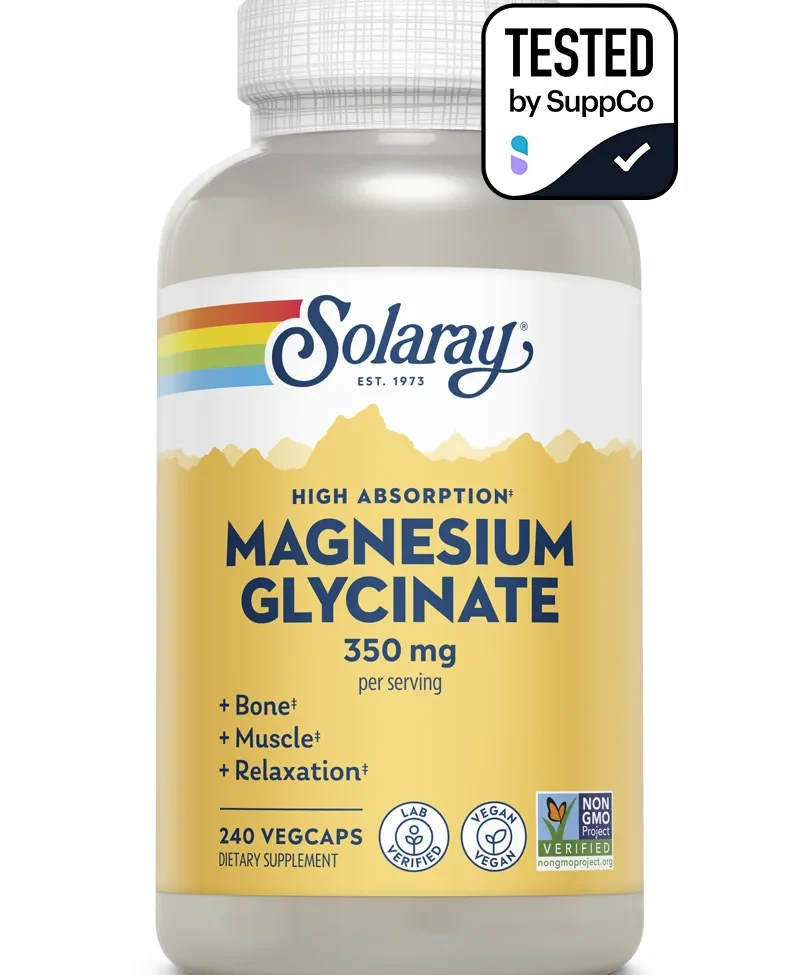
2. Solaray — 8.5/10. The best testing policy: finished bottles anonymously purchased and tested in named ISO 17025 laboratories. Cheapest true bisglycinate at regular prices. Four capsules a serving, and it contains BioPerine.
3. Thorne — 8.5/10. The best certification: batch-level NSF Certified for Sport, which I confirmed in NSF’s own register, and the cleanest formula of the six — but 43.3¢ per 100 mg, three times NOW. Buy it if you are drug-tested.
4. Pure Encapsulations — 8.0/10. The cleanest capsule in the category, two other ingredients, flexible dosing. Expensive, and its finished-product testing claim is the vaguest of the six.
5. Doctor’s Best — 7.5/10. By far the cheapest magnesium on this page at 10.0¢ per 100 mg — but it is a different chelate, the testing badges name nothing, and two of the four badges are marketing graphics.
6. Qunol — 7.0/10. Widely available and well tolerated, but large tablets, a serving-size trap at one major retailer, and no batch-level documentation I could locate.
How this comparison was done
I have not taken any of these products. There is no test panel, no trial and no “our testers”, because there were none. What follows is a documentary comparison: each brand’s own Supplement Facts panel, its published testing policy, its stated prices, and the division the labels invite but never do for you.
Six brands is a deliberate limit rather than a shortcut. Each one took several hours to check properly, and I would rather compare six products I have actually read end to end than list twenty I have not. Each entry below links to the full review, where the working is shown.
Prices and formulations were checked in September 2026 and change without notice. Always read the label on the bottle you receive.
The cost table nobody publishes
This is the part that matters most and appears almost nowhere, because it requires reading the serving size rather than the front of the bottle. A “350 mg” product and a “120 mg” product are not comparable until you convert both to the same unit.
Cost per 100 mg of elemental magnesium, at the brand’s own prices, cheapest first:
- Doctor’s Best, 240 tablets — 10.0¢. The cheapest figure on this page by a wide margin, and the caveat is in the next section: it is magnesium lysinate glycinate, not bisglycinate. Its own 240 veggie caps cost 19.8¢ and the 120-count 25.4¢.
- NOW Foods, 180 tablets — 14.2¢ on sale. Its 90-count is 16.0¢ on sale and 20.0¢ at the regular price, so this one moves with the promotion. NOW discounts often.
- Solaray, 240 count — 15.2¢. The cheapest true bisglycinate at regular prices — NOW undercuts it only while on sale. The 120-count works out at 17.5¢.
- Pure Encapsulations, 360 count — 20.1¢. Its best bulk price is still about 32% above Solaray’s and double Doctor’s Best’s tablets. The 180-count is 21.5¢, the 90-count 25.0¢, and the 30-count a poor 34.7¢.
- Thorne, 60 scoops — 43.3¢. The most expensive magnesium I have priced, by a wide margin, and the only one with batch-level certification to show for it. Its 30-serving travel sachets are a startling 78.3¢.
- Qunol — not stated consistently. Qunol’s price varies substantially between Amazon, CVS, Walgreens, Vitacost and its own site, and the brand does not publish one reference price. I am not going to invent a figure to complete the table.
Two consequences worth absorbing before you shop.
First, the format you pick changes the price per milligram more than the brand does. The clearest demonstration is inside a single brand: Doctor’s Best sells 240 tablets at 10.0¢ and 240 veggie caps at 19.8¢ — the same company, the same shelf, the same nominal product, and the capsules cost 98% more per 100 mg. Pure Encapsulations’ 30-count costs 72% more than its own 360-count. Thorne beats both: its travel sachets cost 81% more per 100 mg than its own jar of the identical powder. And with NOW, the same tablet swings 41% on size and promotion alone. Every one of those gaps is larger than the gap between most of these brands. If you take one thing from this page, take that.
Second, price and proof are only loosely related. One brand here charges a premium and still cannot tell you who tested the bottle; another charges more again and can name the body, the programme and the register. Which brings us to the comparison that really separates these products.
Which of these brands actually proves anything?
Every supplement brand says it is third-party tested. The phrase is close to meaningless on its own, because of one loophole: if the manufacturer chooses which samples go to the laboratory, it controls the result. A bottle hand-picked from a production run and couriered to a friendly lab tests whatever the company wants tested.
Three of these six close it, by three different routes.
Thorne: the only claim I could check in someone else’s database
Thorne’s magnesium bisglycinate is NSF Certified for Sport. That is not the facility-level NSF certification several brands hold; it certifies the individual product, requires batch-level testing against a banned-substances list, and takes the sampling out of the manufacturer’s hands.
What makes it different in kind from every other claim on this page is that I did not have to believe Thorne. NSF publishes a searchable register of certified products, and Thorne® Magnesium Bisglycinate is listed in it by NSF. Every other testing claim here, including Solaray’s good one, ultimately rests on the company’s own description of what it does.
Thorne also owns its plant — a 735,000-square-foot campus in South Carolina — runs two in-house laboratories across four rounds of testing, and holds an A rating from Australia’s TGA. What it does not say, and Solaray does, is that tested samples were anonymously purchased; the Certified for Sport programme largely covers that, but it is a real difference. The catch is the price, and it is a big one. See the full Thorne review.
Solaray: the claim that survives scrutiny
Solaray states that its finished products are anonymously purchased and independently tested in ISO 17025 accredited laboratories. Both halves matter. Anonymously purchased means the tested bottles were bought off the shelf like a customer’s. ISO 17025 is the international standard for laboratory competence, named rather than implied.
It also runs its own laboratory in Ogden, Utah, states a testing volume, gives a contaminant reporting limit as a number, and describes its NSF position accurately — facility certification, not the stricter Certified for Sport batch programme. Getting that distinction right, when blurring it would flatter the brand, is itself a signal.
NOW Foods: the only one that published the numbers
NOW took the third route, and it is the one nobody else here has taken: instead of describing a policy, it published measurements. In a study of sixteen magnesium glycinate products bought on Amazon, its own tablets were analysed both in-house and at Eurofins, an independent contract laboratory, and both columns were printed with the lot numbers attached.
For the exact product I reviewed, Eurofins measured 101 mg of water-soluble — that is, genuinely chelated — magnesium per tablet against a 100 mg claim. Nobody else on this page has put a number like that in public.
The catch is who commissioned it, and NOW is candid about a second problem: it deliberately excluded most competitors that source their chelate from Albion, because those are known to be good. So the headline finding — that only NOW’s product was properly chelated — comes from a sample cleared in advance of the brands most likely to match it. Solaray, Thorne, Pure Encapsulations and Doctor’s Best were never tested. Read the full NOW review for what the study does and does not establish.
Pure Encapsulations: excellent on inputs, vague on outputs
On raw materials the published policy is genuinely specific: identity, potency, microbial contaminants, named heavy metals, 32 solvent residues, allergens, and roughly 70 pesticide compounds on botanicals, all manufactured to cGMP at an FDA-inspected plant. Those are numbers, and most of the industry cannot produce them.
On the bottle that actually reaches you, the claim narrows to products undergoing “testing by accredited and cGMP certified laboratories”. No standard is named. The samples are not described as anonymously purchased. No batch certificate is offered. There is also a category slip in that sentence — cGMP certifies manufacturing, laboratories are accredited — which reads like copy that never went back past the quality team.
To its credit, the company tells you something that costs it money: asked about corn allergens, it states plainly that it does not routinely test for them and therefore cannot guarantee safety for someone with a corn allergy. That candour moved its score up, not down.
Doctor’s Best: four badges, no nouns
The product page carries a row headed “certifications” holding four badges. They are images, and the alt text on all four is empty, so the words never appear in the page’s text at all — I had to read the filenames. Two of them, CGMP and 3rd Party, are real claims: the product is made to current good manufacturing practice and something is tested by an outside party. Neither badge names a certifying body, a laboratory, a standard or a scope. Searching the whole page for “GMP”, “NSF”, “USP”, “ISO” or “third party” as words returns nothing.
The other two badges are “Clinically Proven” and “Proven Potency”. These are not certifications from anyone. They are graphics the brand made for itself, sitting in a row labelled “certifications” next to two claims that are. That placement is the problem, and it is why this brand scores below the two above it despite costing half as much.
One structural fact worth knowing: Doctor’s Best states that it partners with co-manufacturers around the globe. It does not own the plant. That is common and not disqualifying — Solaray’s advantage is not that it manufactures, it is that it says who tests and how the samples are obtained.
Qunol: the documentation gap
ConsumerLab has approved Qunol products, but the approvals I could find cover its CoQ10 and turmeric lines, not this magnesium SKU. I could locate no batch-specific certificate of analysis for this product. Separately, a class action has questioned the brand’s potency claims on other products; I was unable to establish from public records how that case ended, so this page does not claim an outcome either way.
None of that makes the product bad. It makes it unverifiable, which is a different complaint and a fair one at this price level.
The label detail that separates the best magnesium glycinate brands
Here is a reversal that surprised me, and it runs against reputation.
The form you actually want is magnesium bisglycinate — fully chelated, each magnesium atom bound to two glycine molecules. That chelation delivers the two things people buy this form for: absorption through amino acid transport pathways rather than in competition with other minerals, and markedly better gut tolerance than oxide or citrate.
“Magnesium glycinate” as a bare term does not tell you the ratio. Some products sold under that name are partly buffered with magnesium oxide, which changes both the tolerability and the honest elemental figure.
- Solaray specifies Magnesium Bisglycinate on the ingredient list.
- NOW Foods names magnesium bisglycinate and identifies Albion as the source, and it prints both weights — 200 mg of elemental magnesium from the chelate — which is the labelling practice the whole category ought to copy.
- Thorne names magnesium bisglycinate in the ingredient itself, and with only citric acid and monk fruit alongside it there is nowhere for oxide to hide.
- Pure Encapsulations says only magnesium glycinate. Its two-ingredient excipient list leaves oxide nowhere to hide, so there is no indication the figure is inflated — but the label is less precise.
- Doctor’s Best is the odd one out: its label says magnesium lysinate glycinate chelate. That is a real, well-documented Albion TRAACS chelate, but the magnesium is bound to lysine as well as glycine, so it is not bisglycinate and it is not the same molecule as the others on this page. The brand’s Amazon listing title drops the word “lysinate”, which is almost certainly why so many people search for a Doctor’s Best magnesium glycinate that the company does not actually sell.
- Qunol says chelated magnesium glycinate, which sits between the two.
So on the single chemical detail that determines whether this form works as advertised, the cheapest brand on the page is selling something else — and the two brands that name the chelate exactly sit at opposite ends of the price range, the cheapest genuine bisglycinate and the dearest product here.
How many pills, and how big
The practical difference between these products is not absorption. It is what you have to swallow every day, and it is where buyers are most often caught out.
- Thorne: no pill at all. It is a powder — one scoop for 200 mg, stirred into water or juice. If pill size or pill count is what has defeated you before, this removes the problem rather than mitigating it, and half a scoop is a genuine 100 mg dose. The trade is that a powder has to taste of something; here that means citric acid and monk fruit.
- NOW Foods: two tablets. 100 mg per tablet, 200 mg in the serving, so a 180-tablet bottle is three months at one serving a day. The least demanding pill regime of the four capsule-or-tablet products here.
- Solaray: four capsules, fixed. The 350 mg on the front is a four-VegCap serving, roughly 87.5 mg each. A 120-count bottle is therefore 30 days, not four months. Taking two for 175 mg is perfectly reasonable and doubles the bottle’s life, but you are working against the label to do it.
- Pure Encapsulations: one to four, your choice. 120 mg per capsule, and a single capsule is a genuine dose. At one a day a 90-count bottle lasts three months. If you find capsules difficult, this is the best capsule of the six for that — though Thorne’s powder sidesteps the question altogether.
- Doctor’s Best: two tablets, and check which bottle. The 240-tablet bottle delivers 200 mg in two tablets, 120 servings, four months. The 240 veggie caps look identical on the shelf but deliver 105 mg for the same two-unit serving — roughly half the magnesium for more money. The tablets also carry seven other ingredients against the caps’ four, the longest excipient list on this page.
- Qunol: large tablets. The most frequent complaint about this product is pill size, and it is not a nitpick. There is also a labelling trap: at least one major retailer lists the 300 mg as two tablets rather than one. Assume one and you take half the dose you intended.
One more formulation note. Solaray includes 5 mg of BioPerine black pepper extract. Piperine inhibits CYP3A4 and P-glycoprotein, the machinery your body uses to clear a great many prescription medicines, so it can raise blood levels of some of them. The amount is small and irrelevant for most people. If you take prescription medication regularly, it is worth thirty seconds with a pharmacist — and Solaray’s product page never raises it. Pure Encapsulations, by contrast, publishes a searchable drug-nutrient interaction tool, which is the better practice.
Which one should you buy?
Buy Solaray if you want verification you can actually check, the lowest cost per 100 mg among genuine bisglycinates, and a label that names the chelate. Get the 240-count. Skip it if four capsules a day is unrealistic for you, if you avoid magnesium stearate on principle, or if you would rather not add a bioavailability enhancer alongside prescription medication.
Buy NOW Foods if you want the most magnesium for your money without giving up evidence, and especially if you take prescription medication and would rather not add a bioavailability enhancer. Get the 180-count, on sale. Skip it if the excipient list matters most to you — four other ingredients plus a five-part coating is the longest among the well-evidenced products here.
Buy Thorne if you are drug-tested, or fillers are the reason you are reading this, or you cannot swallow capsules. It has the strongest verification here and the shortest ingredient list, and it is the only one of the six that answers an anti-doping question. Skip it if none of those apply to you, because at 43.3¢ per 100 mg you are paying a large premium for a document you will never be asked to produce.
Buy Pure Encapsulations if you react to fillers, want the shortest excipient list available, need a one-capsule dose, or find multi-capsule servings genuinely difficult. Get the 180-count and never the 30-count. Skip it if cost per 100 mg is your main criterion or you want anonymous-purchase verification.
Buy Doctor’s Best if price per milligram is the criterion that decides it and you are content with a lysinate glycinate chelate rather than bisglycinate. Get the 240 tablets, not the veggie caps — that single choice is worth 98% on the unit price. Skip it if you want to know who does the testing, or if you specifically want bisglycinate.
Buy Qunol if you want something stocked in most pharmacies and you are comfortable without batch documentation. Skip it if you struggle with large tablets, or if verifiability matters to you.
And a seventh answer that applies to a lot of people: if you are buying magnesium purely as a laxative, none of these is the right product. Citrate is cheaper and better suited. Glycinate is what you buy when tolerability or sleep support is the goal — the reason it turns up in my guide to what the evidence actually says about magnesium glycinate for sleep.
Where to buy
Sizes and counts vary between listings, so check which one you are adding to the basket — it matters more than the brand, as the cost table above shows.
- Solaray — see current prices and sizes on AmazonOutside the US? Canada: search Amazon.ca
- Pure Encapsulations — see current prices and sizes on AmazonOutside the US? Canada: view on Amazon.ca
- Doctor’s Best — see current prices and sizes on AmazonOutside the US? Canada: search Amazon.ca
- NOW Foods — see current prices and sizes on Amazon — note that Amazon lists a 240-tablet size NOW does not sell on its own site.
- Thorne — see current prices and sizes on AmazonOutside the US? Canada: search Amazon.ca
- Qunol — see current prices and sizes on AmazonOutside the US? Canada: search Amazon.ca
As an Amazon Associate I earn from qualifying purchases. This never changes a score, a ranking or a verdict — those are decided before any commercial link is considered.
What this page does not cover
Being straight about the limits is part of the method. Nature Made, BioSchwartz and Klaire Labs are not assessed here, because I have not yet read their labels and testing policies to the same standard. Doctor’s Best, Thorne and NOW Foods were all on that list; each now has a full review of its own (Doctor’s Best, Thorne, NOW Foods), and the rest will be added the same way or not at all.
When I add a brand it will be because I have gone through its panel and its testing claims, not because a network pays more on it. If that means this page ranks six brands while other pages rank fifteen, that is the trade I am making.
Common questions
What are the best magnesium glycinate brands?
Of the six I have assessed in full, three are tied at 8.5/10 for different reasons, so the honest answer is that it depends on what you need. NOW Foods is the one I would buy by default: a real Albion bisglycinate at 14–20¢ per 100 mg, two tablets a serving, and the only product here whose chelation an independent laboratory has measured and published. Solaray has the best testing policy — finished bottles anonymously purchased and tested in named ISO 17025 laboratories — and is the cheapest true bisglycinate at regular prices. Thorne has the only batch-level NSF Certified for Sport certification, which I verified in NSF’s own register, and costs three times NOW. Then Pure Encapsulations at 8.0/10 for the cleanest capsule at a premium, Doctor’s Best at 7.5/10 for being far the cheapest but a different chelate, and Qunol at 7.0/10 for being everywhere but documenting nothing.
Which magnesium glycinate brand is cheapest?
Doctor’s Best, whose 240-tablet bottle works out at about 10.0¢ per 100 mg of elemental magnesium — but it is magnesium lysinate glycinate rather than bisglycinate, so it is not strictly the same product as the rest. Among genuine bisglycinates the cheapest is Solaray’s 240-count at about 15.2¢. NOW Foods lands at 14.2¢ when its 180-count is on sale and 20.0¢ for the 90-count at full price, Pure Encapsulations’ best bulk price is 20.1¢, and Thorne is 43.3¢ — more than four times Doctor’s Best for the same 100 mg of magnesium. Compare per 100 mg rather than per bottle, because serving sizes differ by a factor of three between these products.
Is magnesium lysinate glycinate the same as magnesium glycinate?
No. In magnesium lysinate glycinate the mineral is chelated to lysine as well as glycine, which makes it a distinct compound from bisglycinate, where each magnesium atom is bound to two glycine molecules. It is a legitimate, well-documented chelate, but if you have read that bisglycinate is the form you want, a lysinate glycinate product is not it. Doctor’s Best sells the lysinate glycinate; its Amazon listing title omits the word, which is where most of the confusion comes from.
Is magnesium glycinate the same as bisglycinate?
Bisglycinate is the fully chelated form, with each magnesium atom bound to two glycine molecules. “Magnesium glycinate” is a looser term that does not state the ratio, and some products under that name are partly buffered with magnesium oxide. Solaray, Thorne and NOW Foods all name bisglycinate explicitly, and NOW additionally prints both the chelate weight and the elemental weight; Pure Encapsulations does not name the chelate; Doctor’s Best names a different one entirely.
How many capsules is a serving?
It varies enormously and it determines how long a bottle lasts. Solaray delivers 350 mg in four capsules, so a 120-count bottle is 30 days. Pure Encapsulations delivers 120 mg per capsule with a one-to-four suggested range, so a 90-count can last three months. Doctor’s Best delivers 200 mg in two tablets, so a 240-tablet bottle is four months. Qunol delivers 300 mg in tablets, and at least one retailer lists that as two tablets rather than one. NOW Foods delivers 200 mg in two tablets, so a 180-tablet bottle is three months. Thorne sidesteps the question entirely: it is a powder, 200 mg in a single scoop.
Is cheap magnesium glycinate on Amazon real magnesium glycinate?
Often not, and there is published testing behind that answer. NOW Foods bought sixteen magnesium glycinate products on Amazon and had them analysed in its own laboratory and at Eurofins. Twelve of the sixteen met their label claim for total magnesium, but almost none met it for the water-soluble, genuinely chelated form — the pattern you get when cheap magnesium oxide or carbonate is blended with loose glycine and sold as “magnesium glycinate”. The study was run by a company with an interest in the result, and it excluded the competitors most likely to pass, so treat the ranking with caution. The underlying warning still stands: an unfamiliar magnesium brand at a price far below the ones on this page is the most likely place to find a chelate that is not a chelate. The NOW review sets out the method and the limits in full.
Do any of them carry NSF Certified for Sport?
Yes — one of the six. Thorne‘s magnesium bisglycinate is listed in NSF’s own public register of Certified for Sport products, which is batch-level certification against a banned-substances list. Solaray’s manufacturing facility is NSF certified, which is a different and much weaker claim, and Doctor’s Best’s badge row names no certifying body at all. NOW Foods holds Informed Sport certification, under which LGC tests every production run, but it covers the NOW Sports range and not this magnesium — the same kind of gap. So if you compete in drug-tested sport, Thorne is the answer on this page, and it costs roughly three times NOW per 100 mg, which is the price of that certainty.
Sources
Everything above was read from these pages and from my own full reviews. Links are provided so you can check the claims yourself.
- Solaray — Magnesium Glycinate 350 mg — ingredient list, the anonymous-purchase testing claim and both bottle prices.
- Purely For You — Magnesium (glycinate) — prices for all four bottle sizes and the suggested use.
- Pure Encapsulations — FAQs — the raw-material testing detail and the corn-allergen disclosure.
- Doctor’s Best — High Absorption Magnesium Lysinate Glycinate, 240 tablets — the Supplement Facts panel, the price and the badge row.
- Doctor’s Best — Magnesium Lysinate Glycinate, 240 veggie caps — the 52.5 mg-per-capsule panel behind the 98% price gap.
- NOW Foods — Magnesium Glycinate Brands on Amazon — the sixteen-sample study, its method, the full results table with lot numbers and the Eurofins column, and NOW’s own statement that it excluded most Albion-sourcing brands.
- NSF Certified for Sport — certified products register — where I confirmed Thorne® Magnesium Bisglycinate is certified, rather than taking a badge at face value.
- Thorne — Unparalleled Quality — the four rounds of testing, the two in-house laboratories, the Summerville campus and the TGA A rating.
- Mayo Clinic Store — Thorne Magnesium Bisglycinate — the price, serving size and UPC behind Thorne’s 43.3¢.
- NSF Certified for Sport — what batch-level certification actually involves, for the distinction drawn above.
- Predicting and Testing Bioavailability of Magnesium Supplements — on the absorption of chelated forms.
Prices, formulations and availability were checked in September 2026 and can change without notice — always read the label on the product you receive. This page is for general information and is not medical advice. If you are pregnant or breastfeeding, take prescription medication, or have a diagnosed condition including kidney or liver disease, speak to a qualified professional before adding a supplement.

Roy Douele founded inareview and writes every review on the site. He is not a medical professional: he sources and buys the products himself, tests them over a meaningful period, and checks each claim against published research before assigning a score out of 10. Brands cannot pay for a review or influence a score.
View All Articles