Revolution Nutrition Review (2026): Is High Whey Actually Good Value?

Disclosure & independence
Revolution Nutrition did not pay for this review, did not supply the product, and did not see the article before publication. No brand is given approval over what is written here.
At the time of publication, this article contains no affiliate links. If any are added later they will be clearly marked, they will never cost you anything extra, and they cannot change a score: verdicts are decided before any commercial link is considered.
Full details in my affiliate disclosure, editorial policy and testing methodology.
Revolution Nutrition sells more protein in Canada than most people realise, and it does it with a permanent sale banner, a free-gift ladder and a loyalty currency called Fitcoin. That combination normally makes me sceptical. So I did the arithmetic instead of reacting to the marketing, and the result is genuinely awkward: on price per gram of protein, this is the best deal I have measured.
The problems are elsewhere, and they are real.
The verdict in short
7.0 / 10. High Whey at the two-tub price works out to 4.93¢ per gram of protein — cheaper than anything else I have priced, including Costco. The servings count checks out against the scoop weight, which is more than some brands manage.
But the product page publishes no ingredient list and no Supplement Facts panel in text, the flagship is the least protein-dense product in the company’s own range, and 62% of its variants were out of stock when I checked.
How this review was done
I have not used this product. There is no test panel and no trial, because there was none. What follows is a documentary assessment built from the brand’s own published data: the High Whey product page, the structured product data embedded in it, the whey protein category listing, and the quality claims on the About Us page.
Every price, serving count and protein figure below came from those pages, and I did the division myself. Where I could not verify something, I say so rather than filling the gap.
Is Revolution Nutrition a Canadian company?
Yes, and it manufactures its own product, which is unusual in this industry.
The company states on its About Us page that it owns a facility holding a Health Canada site licence, FDA registration, GMP compliance and a Safe Food for Canadians licence, and describes itself as “a fully integrated manufacturer” running a direct-to-consumer model. Orders ship by Canada Post out of Montreal, Quebec, and the site trades in Canadian dollars in English and French.
That vertical integration matters more than it sounds. Most supplement brands are marketing companies that buy from contract manufacturers. A brand that owns the plant controls its own quality systems, and it also explains how the pricing below is even possible.
One oddity worth flagging: revolutionnutrition.ca — the domain a Canadian would most likely type — is not the shop. It serves a parked landing page whose entire sitemap contains a single URL. The real storefront is at revolution-nutrition.com, with a hyphen. It is a small thing, but it sends customers who guess the address somewhere that cannot sell them anything.
What High Whey actually is, and the number the marketing avoids
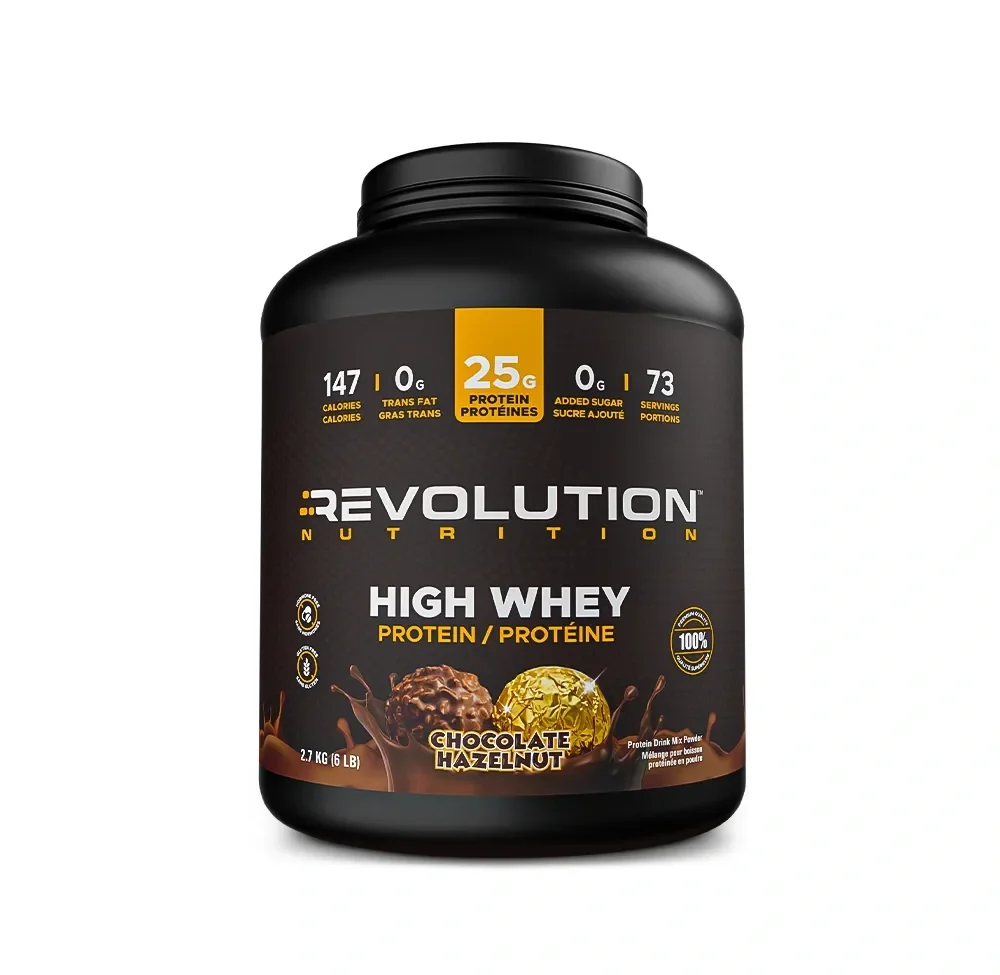
High Whey is a whey protein blend, not an isolate. It delivers 25 g of protein in a 37 g scoop, at 147 calories, and it is gluten free. It carries 1,921 customer reviews at an average of 4.95 out of 5, and the page claims 25,000-plus units sold in the past month.
Now divide. 25 divided by 37 is 67.6%. Just over two thirds of each scoop is protein; the remaining roughly 12 g is carbohydrate, fat, flavouring and whatever else makes a dessert-flavoured powder taste like dessert.
Is that bad? Not on its own — blends are cheaper by design, and 25 g of protein is 25 g of protein. But the company publishes a comparison table on its own product page listing six proteins side by side, and once you run the same division on all of them, the flagship comes last:
- Iso Whey — whey isolate, 28 g in a 33 g serving = 84.8% protein.
- Pure Isolate — whey isolate, 35 g in 42 g = 83.3%.
- Splash Clear Isolate — clear whey isolate, 24 g in 29 g = 82.8%.
- High Whey — whey blend, 25 g in 37 g = 67.6%.
- Pure Vegan and Vegan Smart — 20 g in 35 g = 57.1%.
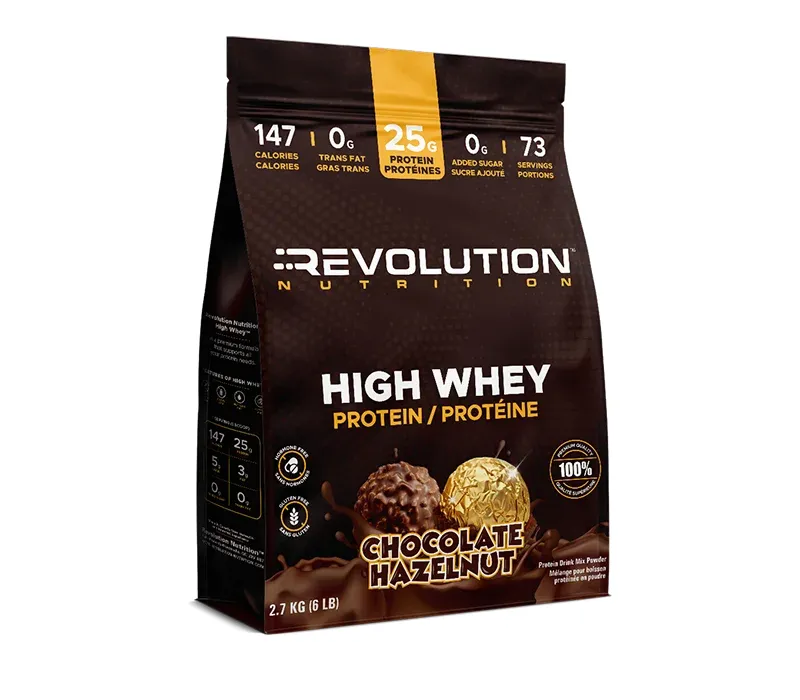
So the best-selling product in the range, the one with four times more reviews than anything else, is the least protein-dense whey the company makes. The table states the serving sizes plainly, to the brand’s credit. It just does not do the division, and almost no shopper will.
The part I could not check, and should have been able to
There is no ingredient list on the product page. No Supplement Facts panel in text either. I searched for the words you would expect in a whey blend — concentrate, isolate, lecithin, sucralose, stevia, lactase — and found none of them in the page’s content.
This matters specifically for a blend. “Whey protein blend” tells you nothing about the ratio of cheap whey concentrate to more expensive isolate, and that ratio is the single biggest driver of both cost and quality in this product category. A buyer cannot see what they are paying for, cannot check the sweetener, and cannot check for allergens or added digestive enzymes.
I flagged the same failure, in a milder form, in my Pure Encapsulations review, where the panel is published as an image rather than text. Here there is no panel at all. Of everything in this review, this is the thing I would most like the company to fix, and it would cost them nothing.
What it costs, and why it wins
Here is the arithmetic that redeems the product. Verified prices, verified serving counts, in Canadian dollars:
- 6 lbs — $99.95, 73 servings. That is $1.37 a shake, or 5.48¢ per gram of protein.
- 6 lbs, buying two or more — $89.95 each. That is $1.23 a shake, or 4.93¢ per gram.
- 2 lbs — $44.95, 24 servings. $1.87 a shake, or 7.49¢ per gram.
- 2 lbs, buying two or more — $39.95 each. $1.66 a shake, or 6.66¢ per gram.
First, a verification I always run and rarely get to praise. Six pounds is 2,722 g; 73 servings at 37 g is 2,701 g. The two-pounder: 907 g against 24 servings at 37 g, or 888 g. Both claims are internally honest to within about 2%, which is normal scoop variance. The serving count is not inflated.
Now put it against everything else I have priced per gram of protein:
- Revolution High Whey, 6 lb, two-tub price — 4.93¢
- LEANFIT at Costco — 5.0¢
- Revolution High Whey, 6 lb, single tub — 5.48¢
- LEANFIT 2 kg direct — 6.5¢ to 6.8¢
- Diesel 5 lb, discounted at a retailer — 9.7¢
- Good Protein — 10.2¢
- Diesel 5 lb at the brand’s own price — 12.5¢
Revolution undercuts a Costco warehouse price. It is less than half the cost of Diesel bought direct. For anyone whose actual problem is hitting a protein target on a budget — which is most people — that is the number that decides it.
The honest caveat: Diesel is a New Zealand whey isolate and this is a concentrate-led blend, so they are not the same product. The fair comparison would be Revolution’s own Iso Whey, and I could not verify its serving count to price it the same way. But 4.93¢ per gram is 4.93¢ per gram, and nothing else I have assessed comes close.
The permanent sale
A note on how that price is presented, because it is relentless. When I loaded the site the page title announced a “LABOUR DAY SALE”. There is a buy-two-or-more discount on both sizes, a free-gift ladder that triggers at $99, $150, $200 and $300 of spend, free creatine and an e-cookbook on all orders, a subscribe-and-save tier, and Fitcoin points.
Search demand confirms the pattern: “revolution nutrition coupon code” alone draws around 720 searches a month in Canada, with advertisers bidding over $8 a click on it. Shoppers have learned that the listed price is not the price.
I am not going to call that dishonest — the discounts are real and the arithmetic above uses them. But treat the headline price as an opening position, never buy a single tub, and if you are near one of the gift thresholds it is worth knowing the ladder exists before you check out.
Is Revolution Nutrition legit? And what about the testing?
I nearly got this wrong, and the correction is worth showing.
The High Whey product page makes no quality or testing claim of any kind. No third-party testing, no laboratory, no certification, no GMP mention. Having just reviewed two brands that put their testing front and centre, I took that as a bad sign.
It is not the whole story. The About Us page states: “Each and every lot of all products are tested by our Quality Assurance department and by a third-party laboratory to ensure maximum quality control.”
Read that carefully, because on one axis it is stronger than what more expensive brands claim. “Each and every lot” is a frequency commitment. Pure Encapsulations, at several times the price per gram of nutrient, says only that products “undergo testing by accredited and cGMP certified laboratories” without committing to every lot.
What is missing here is verifiability, and the same three things are missing as everywhere else:
- The laboratory is not named, and no accreditation standard is given. ISO 17025 is the standard for laboratory competence; brands that hold it usually say so.
- The samples are not described as anonymously purchased. Solaray is the only brand I have reviewed that closes this loophole, and it is why it still holds my highest score.
- No batch certificate of analysis is available, so you cannot look up the tub in your kitchen.
And then the discoverability problem: the claim is on a corporate page almost nobody reads, and absent from the page where people actually decide to buy. If you test every lot, say it next to the Add to Cart button.
On the underlying question — is the company real and regulated? — yes. A Health Canada site licence, FDA registration and a Safe Food for Canadians licence are verifiable regulatory facts about a real manufacturing establishment, not marketing adjectives.
On the “lawsuit” searches
Roughly 210 people a month in Canada search “revolution nutrition lawsuit”, so it deserves a straight answer rather than silence.
I found no verifiable record of one. I searched the Government of Canada’s Recalls and Safety Alerts database and the ClassAction.org case listings, and neither returned anything naming this company. I also tried CanLII, the Canadian case-law database, which blocked automated access, so I cannot claim to have checked Canadian court records directly.
So: no recall, no class action I can document, and one database I was unable to search. I am not going to repeat rumours to fill that gap, and you should be sceptical of any page that does. If something verifiable emerges, I will update this review and say what changed.
The availability problem
This is the finding that will actually affect your order.
The product’s structured data lists 21 flavour-and-size combinations. Thirteen of them — 61.9% — were marked out of stock when I checked. Broken down: 7 of 13 six-pound options unavailable, and 6 of 8 two-pound options unavailable.
For a brand whose central promise is flavour variety, that is a significant gap between the pitch and the shelf. Chocolate Cake and Vanilla Cake in the six-pound size were available; most of the interesting flavours were not, and the two-pound size was almost entirely gone.
There is also a small internal contradiction on the same page: the product description advertises “13 delicious Real Dessert flavors” while the comparison table below it says “17 Delicious Dessert Flavors”. Neither number reflects what you can currently buy.
Practical advice: decide on price and size first, then take whichever of the available flavours you can live with. Do not fall in love with Pistachio Ice Cream.
Who it is for
This is a strong buy if your goal is hitting a daily protein target at the lowest cost per gram in Canada; you are happy to buy two six-pound tubs at once, which is where the real price is; you want dessert-style flavours and are flexible about which one; or you have been paying brand-store prices for isolate you did not specifically need.
Look elsewhere if you want to read the ingredient list before you buy, because you cannot; you need a high protein-per-calorie ratio, where an isolate at 83 to 85% beats this at 67.6%; you are lactose-sensitive, since a concentrate-led blend carries more lactose than an isolate and the label is not published to check; you need a specific flavour reliably in stock; or you want batch-level documentation you can verify yourself.
The verdict
Score: 7.0 out of 10.
The value is not in dispute. At 4.93¢ per gram of protein High Whey beats a Costco warehouse price and less than half the cost of buying Diesel from its own brand store, and the serving count survives the arithmetic check that catches out so many competitors. The company owns its plant, holds real regulatory licences, and commits in writing to testing every lot — a stronger frequency claim than brands charging far more. I did not expect to be writing that.
What keeps it at seven is that almost none of this is where a buyer can see it, and one thing is nowhere at all. Publishing no ingredient list for a protein blend is the most significant transparency failure in anything I have reviewed, because the concentrate-to-isolate ratio is precisely what you are buying and precisely what is hidden. The testing commitment is buried on a corporate page. The flagship is quietly the weakest formula in its own lineup at 67.6% protein. And with 62% of variants out of stock, the flavour range that sells the product largely does not exist.
Buy two six-pound tubs at $89.95 each, in whichever flavour is actually in stock. That is the best protein value I have found in Canada. Go in knowing you cannot see what is in it.
Common questions
Is Revolution Nutrition legit?
Yes. It is a Canadian manufacturer shipping from Montreal that states it holds a Health Canada site licence, FDA registration, GMP compliance and a Safe Food for Canadians licence, and that every lot is tested by its own quality assurance team and by a third-party laboratory. The laboratory is not named and no batch certificates are published, so the claim cannot be independently checked.
Is Revolution Nutrition a Canadian company?
Yes. It operates its own manufacturing facility, ships via Canada Post from Montreal, Quebec, and prices in Canadian dollars. Note that the shop is at revolution-nutrition.com with a hyphen; the unhyphenated .ca domain is a parked landing page.
How much protein is in Revolution Nutrition High Whey?
25 g of protein per 37 g scoop, at 147 calories. That is 67.6% protein by weight, which is normal for a whey blend but lower than the company’s own isolates at 82.8% to 84.8%.
Is High Whey an isolate?
No. It is a whey protein blend. The company sells three separate isolates — Iso Whey, Pure Isolate and Splash Clear Isolate — which are more protein-dense and more expensive. The product page does not disclose the ratio of concentrate to isolate in the blend.
How many servings are in a tub?
24 servings in the 2 lb tub and 73 servings in the 6 lb tub. Both figures check out against the stated 37 g scoop to within about 2%.
What is the best value size?
The 6 lb tub bought two at a time, at $89.95 each, which works out to 4.93¢ per gram of protein. A single 6 lb tub is 5.48¢. The 2 lb tub at 7.49¢ per gram costs 52% more for the same protein.
Is there a Revolution Nutrition lawsuit?
I found no verifiable record. Health Canada’s recalls and safety alerts database and the ClassAction.org listings returned nothing naming the company. CanLII blocked automated access, so Canadian court records were not checked directly.
For how the mainstream US powders compare on price per gram, see my cost-per-gram ranking of six protein powders.
Sources
Everything above was read from these pages. Links are provided so you can check the claims for yourself; none of them is an affiliate link.
- Revolution Nutrition — High Whey — prices, serving counts, scoop weight, the six-product comparison table, review count and stock status for all 21 variants.
- Revolution Nutrition — About Us — the per-lot third-party testing claim, and the Health Canada, FDA, GMP and Safe Food for Canadians licence statements.
- Revolution Nutrition — Whey protein blend category — the range this product sits in.
- Government of Canada — Recalls and Safety Alerts — searched for records naming the company; none returned.
Prices, formulations, stock levels and promotions were checked in September 2026 and can change without notice — always read the label on the product you receive. Stock figures reflect a single point in time. This review is for general information and is not medical or dietary advice. If you are pregnant or breastfeeding, take prescription medication, or have a diagnosed condition including kidney disease, speak to a qualified professional before adding a protein supplement.

Roy Douele founded inareview and writes every review on the site. He is not a medical professional: he sources and buys the products himself, tests them over a meaningful period, and checks each claim against published research before assigning a score out of 10. Brands cannot pay for a review or influence a score.
View All Articles