Pure Encapsulations Magnesium Glycinate Review (2026): Is Pure Encapsulations a Good Brand?

Disclosure & independence
Pure Encapsulations did not pay for this review, did not supply the product, and did not see the article before publication. No brand is given approval over what is written here.
This article contains affiliate links. If you buy through one I may earn a commission, at no additional cost to you. A commission never changes a score, a ranking or a verdict: those are decided before any commercial link is considered.
Full details in my affiliate disclosure, editorial policy and testing methodology.
Pure Encapsulations is the brand that functional medicine practitioners name when a patient asks what to buy. It has the reputation, the clinical positioning and the price tag to match. So the question worth answering is not whether the product is decent — it plainly is — but whether the premium is buying you something you can verify, or something you are being asked to take on trust.
I went through the Pure Encapsulations Magnesium Glycinate label, the company’s own testing policy, and the price of every bottle size. Two findings surprised me, and one of them cuts against the brand.
The verdict in short
8.0 / 10. The cleanest magnesium label I have read: 120 mg of elemental magnesium per capsule and exactly two other ingredients. Dosing is flexible in a way most competitors’ is not. But it is expensive per 100 mg — only Thorne costs more, and Thorne backs its price with certification this brand does not offer — and its finished-product testing claim is vaguer than that of a cheaper brand I reviewed the day before.
Buy the 180-count. Skip the 30-count entirely — it costs 72% more per 100 mg than the 360.
Comparing brands? I put this one head to head with every other brand I have assessed in my comparison of the best magnesium glycinate brands, on cost per 100 mg and on whose testing actually holds up. It has since gained a fourth brand: Doctor’s Best, whose 240-tablet bottle works out at 10.0¢ per 100 mg — half this product’s best bulk price, for a lysinate glycinate chelate rather than a bisglycinate.
How this review was done
I have not taken this product. Nothing below is a personal experience report, and there is no test panel, no trial and no “our testers” — because there were none. What follows is a documentary assessment: the Supplement Facts panel, the stated testing policy, the published prices across all four bottle sizes, and the arithmetic that the label invites but does not do for you.
One process note that turned into a finding. Pure Encapsulations publishes its Supplement Facts on the consumer site only as an image, not as text. Its professional site, where the full clinical documentation lives, returned an access block when I tried to read it. I therefore took the panel from an authorised retailer’s transcription and checked it for internal consistency: 120 mg listed at 29% of the Daily Value is arithmetically correct against the 420 mg DV, and it matches the figure two other sellers print. I am satisfied the numbers are right. I would rather have read them on the manufacturer’s own page.
First, the odd part: finding the product at all
Around 49,500 people a month search Google for “pure encapsulations magnesium glycinate” in the United States alone. Almost none of them can buy it at pureencapsulations.com, because that address does not sell anything. It is a splash page with two doors: one marked I am a healthcare professional or their patient, the other I am a consumer.
The consumer door leads to a differently branded storefront called Purely For You (pureforyou.com). The professional door leads to pureencapsulationspro.com. So the brand name that hundreds of thousands of people search for every month resolves to a site that is a signpost, and the shop they actually need carries a different name above it.
This is not a formulation problem, but it is a real cost to the buyer, and it explains something I noticed in the search results: the first page for this product is almost entirely Amazon, resellers and forum threads. When a manufacturer makes itself hard to buy from directly, intermediaries fill the gap, and the shopper loses the one page where the label and the testing policy are stated by the people responsible for them.
What is actually in the bottle
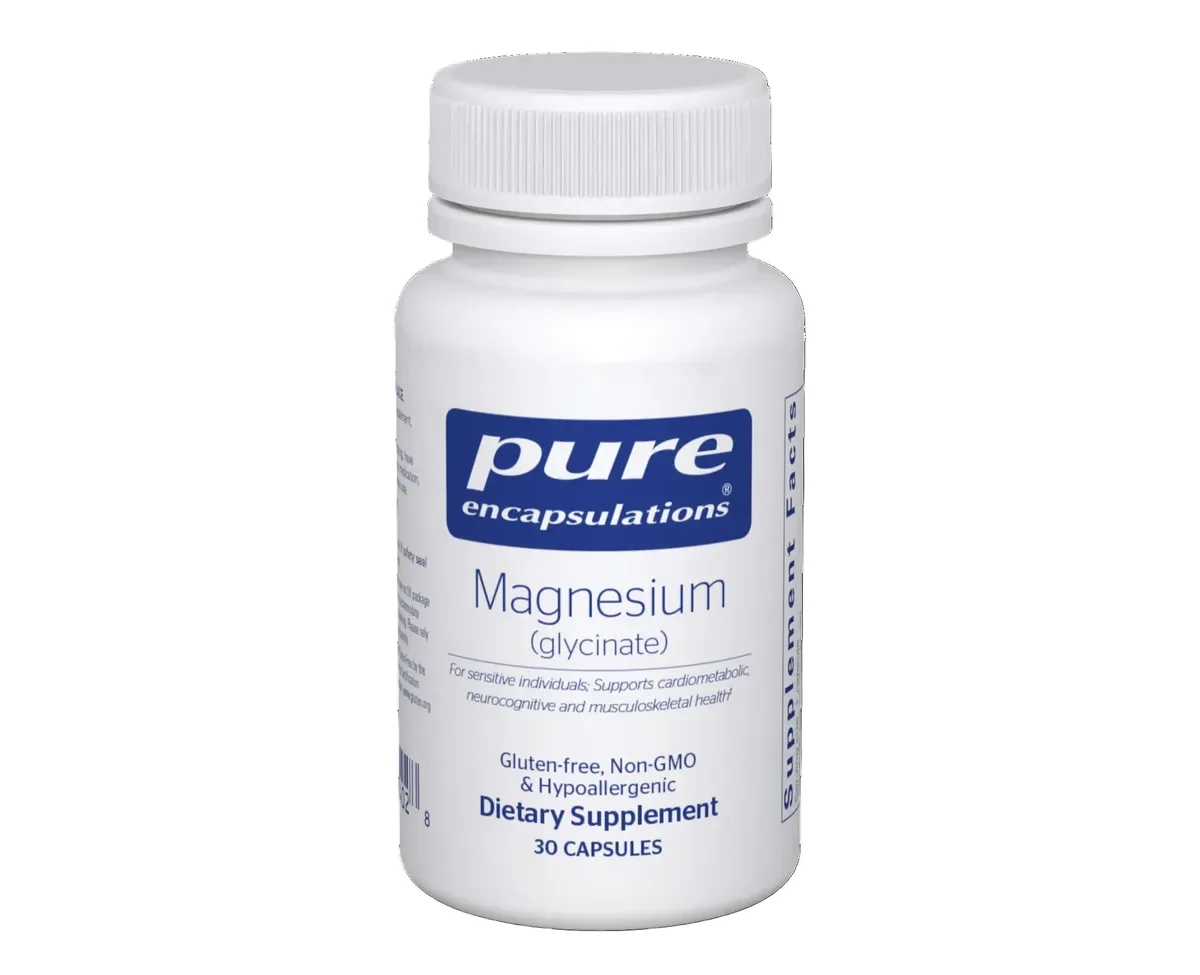
The complete panel, per capsule:
- Magnesium (as magnesium glycinate) — 120 mg, 29% of the Daily Value.
- Other ingredients: vegetarian capsule (cellulose, water), ascorbyl palmitate.
That is the entire list. Two excipients, one of which is the capsule itself.
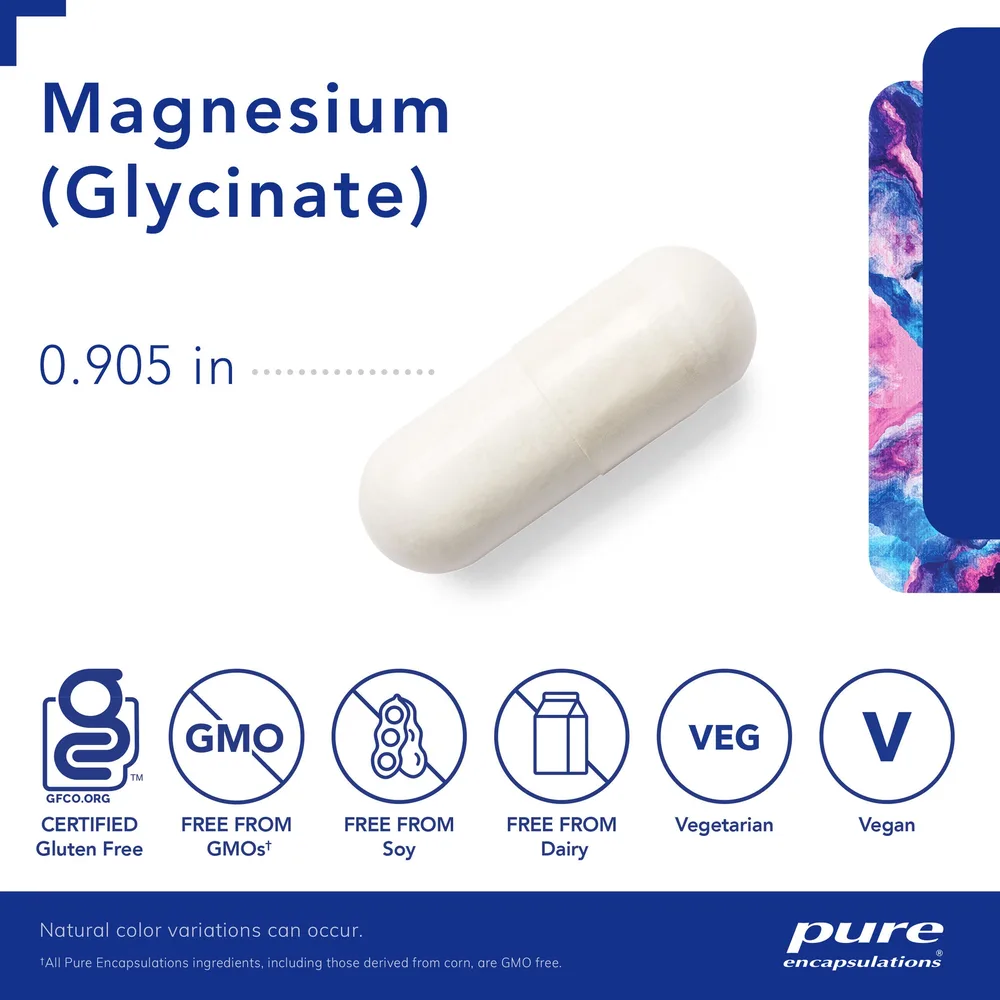
I want to be clear about how unusual that is, because “clean label” is a marketing phrase that usually survives contact with the ingredient panel rather poorly. Here it holds up. There is no magnesium stearate, no silica, no rice flour, no dicalcium phosphate, no titanium dioxide, no bulking agent of any kind. Ascorbyl palmitate is a fat-soluble form of vitamin C used in small amounts as an antioxidant and processing aid; it is the only thing in the capsule that is not magnesium or cellulose.
The company also commits, in writing, to listing every ingredient on the label “even if it’s just a trace amount”, and to flagging anything derived from a possible allergen. Having spent the past week reading labels that hide behind “proprietary blend”, I do not take that for granted.
The stated exclusions are broad and specific: wheat, soy and dairy except where labelled, eggs, tree nuts, peanuts, sesame, gluten, GMOs, artificial colours, flavours and sweeteners, coatings and shellacs, trans fats and hydrogenated oils, unnecessary binders, fillers and preservatives, and magnesium stearate by name.
One point of imprecision, and it matters
The label says magnesium glycinate. It does not say bisglycinate.
Bisglycinate is the fully chelated form, in which each magnesium atom is bound to two glycine molecules. That chelation is what delivers the two properties people buy this form of magnesium for: absorption via amino acid transport pathways rather than in competition with other minerals, and markedly better gut tolerance than oxide or citrate. “Magnesium glycinate” as a bare term does not tell you the ratio, and some products sold under that name are partly buffered with magnesium oxide, which changes both the tolerability and the honest elemental figure.
I have no evidence that this product is buffered, and the excipient list gives oxide nowhere to hide. But here is the reversal worth noting: Solaray’s label, on a product costing substantially less, specifies “Magnesium Bisglycinate” explicitly. On the single chemical detail that determines whether this form works as advertised, the cheaper brand is the more precise one.
One capsule, not four
This is where the product earns real praise, and it is best understood by comparison.
The suggested use is 1 to 4 capsules daily, with food. A single capsule delivers 120 mg of elemental magnesium, which is a genuine dose on its own — enough for someone topping up a modest shortfall, or taking magnesium for sleep without wanting a large mineral load before bed. Four capsules gives 480 mg for anyone who needs it. You choose.
Compare that with Solaray, where the 350 mg on the front of the bottle is delivered in a fixed four-capsule serving of roughly 87.5 mg each. To take a low dose there you are working against the label; here the label anticipates it. And a 90-capsule bottle at one a day is a three-month supply, where Solaray’s 120-count is thirty days.
If you struggle to swallow capsules, this is the more realistic product of the two by a wide margin.
What it costs
Consumer prices, with the arithmetic done per 100 mg of elemental magnesium so the sizes are actually comparable:
- 30 capsules — $12.50. 41.7¢ per capsule, or 34.7¢ per 100 mg.
- 90 capsules — $27.00. 30.0¢ per capsule, or 25.0¢ per 100 mg.
- 180 capsules — $46.50. 25.8¢ per capsule, or 21.5¢ per 100 mg.
- 360 capsules — $87.00. 24.2¢ per capsule, or 20.1¢ per 100 mg.
Two things follow from that table.
First, the 30-count is a bad deal and it is the size the page shows you first. At 34.7¢ per 100 mg it costs 72% more than the 360-count for the same magnesium. It exists to lower the entry price, and it works on exactly the shopper who is least likely to run the numbers. If you want to try the product, the 90-count is the smallest size I would buy.
Second, and less comfortably for the brand: this is among the most expensive magnesium I have priced. Solaray’s 240-count works out at 15.2¢ per 100 mg. Pure Encapsulations at its absolute best bulk price is 20.1¢ — about 32% more — and at the 90-count size most people actually buy, 25.0¢, which is 64% more. Only Thorne, which I added to this comparison later, costs more per 100 mg — and Thorne holds batch-level NSF Certified for Sport, which is precisely the kind of proof this brand does not offer.
A premium is not automatically a problem. The question is what it buys, and that brings us to the part I expected to settle the argument in Pure Encapsulations’ favour.
Is Pure Encapsulations third-party tested?
Partly, and the detail is worth reading carefully, because the answer is better than the marketing page suggests and weaker than the price implies.
On raw materials, the published policy is genuinely specific, and specificity is the only thing that separates a testing claim from a slogan. Raw materials are tested for identity, potency, microbial contaminants, heavy metals including mercury, arsenic, cadmium and lead, 32 solvent residues, and allergens. Herbal ingredients are screened for roughly 70 pesticide compounds. Fish and krill oils are tested for dioxins, furans, PCBs and oxidation. Known adulterants get targeted tests. Probiotics are verified by DNA testing. Manufacturing runs to cGMP at an FDA-inspected plant. Those are numbers, not adjectives, and most of the industry cannot produce them.
On finished product — the bottle that actually reaches you — the claim narrows to this: products “undergo testing by accredited and cGMP certified laboratories to ensure product purity and potency.”
Three things are missing from that sentence, and each of them is the thing a sceptical buyer would want:
- No accreditation standard is named. “Accredited” without a standard is not verifiable. The standard for laboratory competence is ISO 17025, and brands that hold it tend to say so.
- The samples are not described as anonymously purchased. This is the loophole that makes most third-party testing claims close to meaningless: a sample hand-picked from a production run and couriered to a friendly lab tests whatever the manufacturer wants tested. Buying bottles off the shelf like a customer is what closes it.
- No batch-specific certificate of analysis is offered. You cannot look up the bottle in your hand.
There is also a small technical slip that I think is telling rather than damning. “cGMP certified laboratories” mixes two categories: cGMP is a manufacturing standard, while laboratories are accredited, normally to ISO 17025. A company with this much analytical competence knows the difference. The phrasing reads as marketing copy that was not passed back to the quality team.
Put plainly: Solaray states that its finished products are anonymously purchased and independently tested in ISO 17025 accredited laboratories. Pure Encapsulations, at 32% to 64% more per 100 mg, does not make that claim. That is the finding I did not expect, and I am not going to soften it because the brand has the better reputation. It is also a fairer comparison than the one I could make with Qunol, where I could locate no batch-level documentation at all.
The candour that does count
One disclosure moved my score upward. Asked about corn allergens, the company does not reach for reassurance. It explains the manufacturing process, states that it has tested with negative results, and then says outright that it does not routinely test for corn allergens and therefore cannot guarantee the product is safe for someone with a corn allergy.
That is a company choosing to lose a sale rather than fudge an answer, and it is rarer than it should be. It also makes me more inclined to believe the claims it does make.
The same goes for the Drug-Nutrient Interaction Checker the company publishes, letting you look up your prescriptions against supplement ingredients. It is a real resource rather than a badge. I noted in my Solaray review that the black pepper extract in that product inhibits CYP3A4 and P-glycoprotein and can raise blood levels of some prescription medicines, and that Solaray’s product page never mentions it. Pure Encapsulations built a searchable tool for precisely that problem. Credit where it is due.
Who owns Pure Encapsulations?
Worth knowing, because the brand’s positioning is independent, clinical and boutique, and buyers tend to assume the corporate reality matches.
The consumer site discloses only the operating entity, Pure Encapsulations, LLC. Nothing on it names a parent company. When I attempted to read the professional site, however, the access-denied page that came back was served under Nestlé branding — the page title itself reads “This site is temporarily unavailable | Nestlé”.
I am reporting exactly what I observed and no more: the professional domain’s infrastructure is administered under Nestlé. I am not going to reconstruct a corporate family tree from an error page. But if it matters to you whether your practitioner-grade supplement brand sits inside one of the largest food companies in the world, that is a question worth asking, and the consumer site is not where you will find it answered.
Does ownership change the product? Not by itself. Large-parent resources can mean better analytical capability, not worse. It is a transparency point, not a quality one.
Where this beats Solaray, and where it loses
These are the two magnesium bisglycinate-class products I would actually recommend, so the comparison is the useful part of both reviews.
Pure Encapsulations wins on: excipient purity, decisively — two other ingredients against Solaray’s four, and no magnesium stearate; dosing flexibility, one capsule against a fixed four; capsule burden for anyone who finds swallowing difficult; a published drug-interaction resource; and a formula with no bioavailability enhancer to worry about alongside prescription medication.
Solaray wins on: price, by 32% to 64% per 100 mg; the specificity of the chelate on the label, bisglycinate against glycinate; and finished-product verification, anonymous purchase and a named accreditation standard against neither. It also states its own laboratory, its testing volume and its contaminant reporting limit as numbers.
Which you should buy depends on which you are optimising for, and I think that is the honest answer rather than a hedge. If your priority is the cleanest possible capsule and a dose you can control, pay the premium here. If your priority is knowing that the bottle in your hand was verified by a method that cannot be gamed, Solaray currently documents that better and costs less.
Who it is for
This is a strong buy if you react to fillers, or believe you do, and want the shortest excipient list available; you want a single-capsule dose rather than a fixed multi-capsule serving; you find large tablets or four-capsule servings genuinely difficult; you take prescription medication and would rather avoid a formula containing a bioavailability enhancer; or your practitioner recommended this brand and you would rather not argue with them over 5¢ per 100 mg.
Look elsewhere if cost per 100 mg is your main criterion; you want the finished bottle verified by anonymous purchase against a named laboratory standard; you specifically want a label that says bisglycinate; or you are buying magnesium as a laxative, where citrate is cheaper and better suited.
The verdict
Score: 8.0 out of 10.
The formulation is close to faultless. Two other ingredients, a real dose in a single capsule, flexible instructions, no stearate, every trace ingredient disclosed, and a raw-material testing programme described in numbers rather than adjectives. On the corn allergen question the company tells you something that costs it money, which is the kind of thing I weigh heavily.
What holds it below Solaray is the gap between price and proof. It is the second most expensive magnesium per 100 mg I have assessed, and it is the one whose finished-product testing claim is hardest to check: no named accreditation standard, no anonymous purchase, no batch certificate. The 30-count bottle is poor value and is the first thing the page shows you. And a brand this well known should not require a shopper to pass through a splash page into a storefront trading under a different name.
Buy the 180-count at $46.50 — it captures most of the bulk discount without the $87 outlay, and at one capsule a day it lasts six months. Start at one capsule and go up only if you have a reason to.
Where to buy
The 180-count is the size I recommend; the 30-count is poor value whatever it costs.
Check current prices and sizes on AmazonOutside the US? Canada: view on Amazon.caAs an Amazon Associate I earn from qualifying purchases. This never changes a score, a ranking or a verdict — those are decided before any commercial link is considered.
Common questions
Is Pure Encapsulations a good brand?
Yes. The excipient discipline is the best I have seen, every ingredient including trace amounts is disclosed on the label, manufacturing is cGMP at an FDA-inspected plant, and raw-material testing is described in specific numbers: 32 solvent residues, roughly 70 pesticide compounds, named heavy metals. Its weakness is not quality but verifiability of the finished bottle, and price.
Is Pure Encapsulations magnesium glycinate third-party tested?
The company states that finished products undergo testing by “accredited and cGMP certified laboratories”. It does not name the accreditation standard, does not describe samples as anonymously purchased, and does not publish batch-specific certificates of analysis. Raw-material testing is documented in far more detail than finished-product testing.
How much magnesium is in one capsule?
120 mg of elemental magnesium, which is 29% of the Daily Value. The suggested use is 1 to 4 capsules daily with food, so a 90-capsule bottle is anywhere from 22 days to three months depending on your dose.
Does it contain magnesium stearate?
No. Magnesium stearate is named explicitly on the list of things the brand’s products are free from. The only ingredients besides the magnesium are the vegetarian capsule (cellulose, water) and ascorbyl palmitate.
Is it glycinate or bisglycinate?
The label says magnesium glycinate and does not specify bisglycinate. The excipient list leaves no room for oxide buffering, so there is no indication the elemental figure is inflated, but the label is less precise on the chelate form than some cheaper competitors.
Which bottle size is best value?
The 360-count at 20.1¢ per 100 mg, followed closely by the 180-count at 21.5¢. The 30-count at 34.7¢ per 100 mg costs 72% more than the 360 for the same magnesium and is worth avoiding.
Why can’t I buy it on pureencapsulations.com?
That address is a splash page, not a shop. Consumers are directed to pureforyou.com, which trades as Purely For You; healthcare professionals are directed to pureencapsulationspro.com.
Sources
Everything above was read from these pages. Links are provided so you can check the claims for yourself; none of them is an affiliate link.
- Purely For You — Magnesium (glycinate) — the consumer product page: prices for all four bottle sizes and the suggested use.
- Pure Encapsulations — Pure Difference — the “free from” list and the finished-product testing wording quoted above.
- Pure Encapsulations — FAQs — the detailed raw-material testing policy, and the corn-allergen disclosure.
- Pure Encapsulations — Drug-Nutrient Interaction Checker — the interaction resource referred to in the review.
- pureencapsulations.com — the two-door splash page described at the top of this review.
Prices, formulations and availability were checked in September 2026 and can change without notice — always read the label on the product you receive. The Supplement Facts panel is published by the manufacturer as an image only; the figures above were taken from an authorised retailer’s transcription and checked for internal consistency. This review is for general information and is not medical advice. If you are pregnant or breastfeeding, take prescription medication, or have a diagnosed condition including kidney or liver disease, speak to a qualified professional before adding a supplement.

Roy Douele founded inareview and writes every review on the site. He is not a medical professional: he sources and buys the products himself, tests them over a meaningful period, and checks each claim against published research before assigning a score out of 10. Brands cannot pay for a review or influence a score.
View All Articles