5 Small Daily Habits for Calmer, More Energised Days

Disclosure & independence
No brand pays for coverage on inareview, and no brand sees an article before it is published. Products are assessed against published criteria, not against what a company would like to read.
At the time of publication, this article contains no affiliate links. If any are added later they will be clearly marked, they will never cost you anything extra, and they cannot change a score: verdicts are decided before any commercial link is considered.
Full details in my affiliate disclosure, editorial policy and testing methodology.
Feeling calmer and more energised rarely comes from a single big change. It comes from small daily habits that add up. Here are five simple ones you can start today, no special equipment or apps required.
Why small habits beat big overhauls
A habit is a behaviour that has been repeated in a stable context often enough that the context itself triggers it. Once that link forms, the behaviour stops drawing on motivation, which is the whole point: motivation is unreliable and finite, and any plan that depends on having plenty of it is fragile by design.
Two practical consequences follow. First, the cue matters more than the intention, which is why attaching a new habit to something you already do without thinking works better than attaching it to a time of day. Second, size matters in the opposite direction to the one people expect: a habit small enough to feel almost trivial is the one that survives a bad week, and surviving bad weeks is the entire mechanism.
A 2024 meta-analysis of twenty studies put the median at 59 to 66 days, with means of 106 to 154 days and individual results ranging from a few days to well over a year. And the familiar 21-day figure is a myth: it can be traced back to how quickly plastic surgery patients adjusted to their new appearance, which has nothing to do with building a routine. Simple actions anchored to an existing routine sit at the fast end of that range. That is the design brief for everything below.
Start the day without your phone
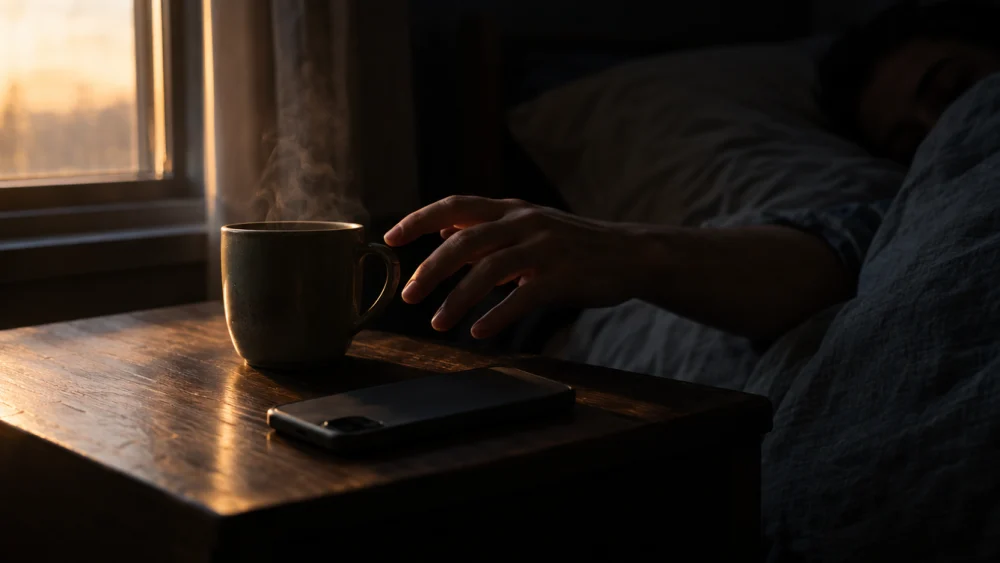
Give yourself the first 15 minutes of the morning screen-free. A glass of water, some daylight, and a few slow breaths set a calmer tone than diving straight into notifications and other people’s demands.
The reason this works is less about the screen than about sequence. Opening a phone hands the first decisions of your day to other people’s priorities, and the alert state that follows tends to persist. Fifteen minutes of your own agenda first does not make the messages go away; it changes who sets the tone before you meet them.
How to make it stick: charge the phone outside the bedroom, or at least out of arm’s reach. Relying on willpower at the moment of waking, which is when you have least of it, is the version of this habit that fails. If you use the phone as an alarm, a cheap clock removes the problem entirely.
Move a little, often
You do not need a workout to feel better. A short walk, a stretch between tasks, or standing up every hour keeps your energy steadier and lowers tension through the day. When you are ready for something more structured, start with my beginner home workout guide.
Short, frequent movement does something a single session cannot: it breaks up the long sedentary blocks that leave you stiff and foggy by the middle of the afternoon. The effect on mood and alertness is often noticeable within minutes, which makes this the habit with the fastest feedback of the five.
How to make it stick: attach it to something that already happens. Stand and stretch whenever you refill your water, or walk the length of the room during every phone call. Cues you cannot forget beat reminders you will eventually swipe away.
Protect your wind-down hour
The hour before bed shapes your sleep. Dim the lights, put screens away, and do something quiet. Better sleep is one of the most powerful, and most underrated, well-being tools there is: see my full guide to restful nights.
Sleep does not start when your head hits the pillow. It starts with a gradual decline in alertness, and bright light and engaging content both interrupt that descent. The hour before bed is not dead time to be optimised; it is part of the sleep itself.
How to make it stick: pick a single, repeatable closing action rather than a list of rules. Putting the kitchen straight, reading a few pages, laying out tomorrow’s clothes. The signal value comes from doing the same thing nightly, which is also what makes it easy on the evenings when you cannot be bothered.
One caveat worth stating plainly: if you regularly lie awake for long stretches, wake repeatedly, or feel unrefreshed for months on end, that is not a habits problem. Persistent insomnia has well-validated treatments, and a doctor is the right next step rather than another evening routine.
Get outside
A few minutes of daylight and fresh air, ideally in the morning, helps regulate your body clock, mood and energy. Even a short step outside counts.
The timing is the active ingredient. Morning light is the strongest signal your circadian system receives, and it anchors the whole day that follows, including how easily you fall asleep that night. Outdoor light is also far brighter than indoor lighting, by a margin most people badly underestimate, which is why sitting near a window is not an equivalent substitute.
How to make it stick: bolt it onto an errand you already run. Take the coffee outside, walk the first part of the commute, step out with the bins. Ten minutes in daylight before nine o’clock is worth more than an hour at lunchtime.
Small resets beat big overhauls
Do not try to fix everything at once. Pick one habit, keep it for a week, then add another. Small, steady changes are what actually last.
There is also a quiet advantage to going one at a time: you find out what actually helps you. Change five things simultaneously and a good fortnight tells you nothing about which of them to keep when life gets busy and something has to give.
What a day with all five looks like
Assembled, these habits take very little time. A realistic version might run: wake and leave the phone where it is, drink a glass of water, step outside for ten minutes with a coffee, then start the day. Stand and stretch at each water refill through the morning and afternoon. Walk while taking calls. An hour before bed, dim the lights, tidy the kitchen, read something undemanding.
Total additional time: roughly twenty minutes, most of it displacing something else rather than adding to the day. That is deliberate. A routine that needs an extra hour is a routine that competes with your life, and it loses.
What to do when you fall off
You will. Illness, a deadline, travel, a rough patch. The research on habit formation is genuinely reassuring here. In the study behind the 66-day figure, missing an occasional opportunity did not seriously impair the process — automaticity gains resumed after a single missed performance. What derails a habit is abandoning the pattern, not breaking it once. What breaks the process is a long interruption, and long interruptions usually start with treating one lapse as proof the whole thing has failed.
The useful rule is to restart smaller rather than to restart harder. After a difficult fortnight, reinstate one habit, not five, and pick the one with the fastest payoff so the return feels worth it. For most people that is movement or morning light.
Common questions
How long until I feel a difference?
Some of it is immediate: movement and daylight change how you feel within the same day. Sleep changes typically take one to two weeks of consistency before the pattern shifts. The habits themselves, in the sense of running without effort, usually take longer than that, which is why the first fortnight asks for patience rather than results.
Which one should I start with?
Whichever has the clearest existing cue in your day. If you already make coffee every morning, morning light attaches to it almost for free. The best first habit is the one with the least friction, not the one with the biggest theoretical benefit.
Do I need an app to track these?
No, and for the first habit an app can work against you, since checking it is one more reason to open the phone. A mark on a paper calendar does the same job. Track only while the habit still needs thought; once it is automatic, tracking is just admin.
Can supplements help with energy and calm?
Sometimes, at the margin, and much less than the labels imply. Nothing here requires one. If you are considering something for stress in particular, my guide to the supplements that actually lower cortisol goes through the evidence and the doses, including where it is thinner than the marketing suggests.
Note: this guide is for general information and is not a substitute for professional support. If you are struggling, please reach out to a qualified professional.
Sources
The claims above about habit formation and activity are drawn from these, so you can check the numbers yourself.
- Time to Form a Habit: A Systematic Review and Meta-Analysis (2024) — twenty studies and 2,601 participants, and the median and mean times to automaticity. The review itself rates most of the underlying studies as at high risk of bias, which is worth knowing before treating any single number as settled.
- Making health habitual: the psychology of habit-formation and general practice — the 66-day plateau, the finding that one missed day does not undo the process, and the origin of the 21-day myth.
- World Health Organization — Physical activity recommendations — the weekly activity targets behind the move-a-little-often habit.

Roy Douele founded inareview and writes every review on the site. He is not a medical professional. Each review is built from the product's label, the brand's own testing documents, public certification registers and the published clinical research, then scored out of 10. Brands cannot pay for a review or influence a score.
View All Articles