Best Supplements for Muscle Soreness: What the Trials Actually Show

Disclosure & independence
No brand pays for coverage on inareview, and no brand sees an article before it is published. Products are assessed against published criteria, not against what a company would like to read.
This article contains affiliate links. If you buy through one I may earn a commission, at no additional cost to you. A commission never changes a score, a ranking or a verdict: those are decided before any commercial link is considered.
Full details in my affiliate disclosure, editorial policy and testing methodology.
The best supplements for muscle soreness, on current evidence, are tart cherry, omega-3 fish oil, curcumin and BCAAs, in roughly that order of confidence. None of them makes soreness disappear. In pooled trials, each one shaved a small-to-moderate amount off the ache you feel one to four days after a hard or unfamiliar workout, and tart cherry also helped strength come back faster.
That is useful if you train hard, play a sport on consecutive days, or simply hate walking downstairs after leg day. It is less useful if you expect a pill to replace sleep, protein and sensible progression, which still do more. Here is what each supplement actually did in the research, how much to take, and which products match the doses that were studied.
The short version
1. Tart cherry: best overall. Small effect on soreness, moderate effect on strength recovery. Take it for a few days before and after hard sessions.
2. Omega-3: moderate effect, but only at about 2 g of EPA plus DHA a day for six weeks or more.
3. Curcumin: modest effect in small, mixed trials. Use an absorbable form.
4. BCAAs: reduced soreness in trials against a placebo, but probably add little if you already eat enough protein.
Not worth buying for soreness: creatine, magnesium, vitamin C megadoses.
How this article was put together
I read the most recent meta-analyses for each supplement, which pool many randomised trials, plus the key individual trials behind the doses, and noted who funded them. All are listed under Sources. I have not taken these products for this article and nobody here “tested” them. Products were chosen because they match the forms and doses used in the research and carry independent certification where available. This is general information, not medical advice.
First, what muscle soreness is
The ache that arrives the day after a hard workout is called delayed onset muscle soreness, or DOMS. It typically starts 12 to 24 hours after exercise, peaks around 24 to 72 hours, and fades within about a week. It is caused by small-scale damage to muscle fibres and the inflammation that follows, and it is worst after unfamiliar exercise and eccentric work: lowering weights slowly, running downhill, deep squats.
Two things follow. Soreness is not a measure of a good workout, and it shrinks on its own as your muscles adapt to a routine (the “repeated bout effect”). And because inflammation is part of how muscles adapt, there is a reasonable concern that blunting it too hard, all the time, could slightly reduce training gains. That is one reason to use these supplements around demanding periods rather than every day of the year.
1. Tart cherry: the best-supported option
Montmorency tart cherries are rich in anthocyanins and other polyphenols with antioxidant and anti-inflammatory effects. A 2021 meta-analysis by Hill and colleagues in the International Journal of Sport Nutrition and Exercise Metabolism pooled 14 studies of tart cherry juice, concentrate or powder after strenuous exercise:
- Soreness: a small reduction (effect size −0.44).
- Strength recovery: a moderate benefit (effect size −0.78), which is arguably the more useful result.
- Jump performance: recovered faster; markers such as creatine kinase did not change significantly.
A 2026 network meta-analysis comparing plant-based polyphenol supplements found the picture inconsistent across outcomes, but tart cherry and pomegranate showed the most promising effects on pain-related recovery.
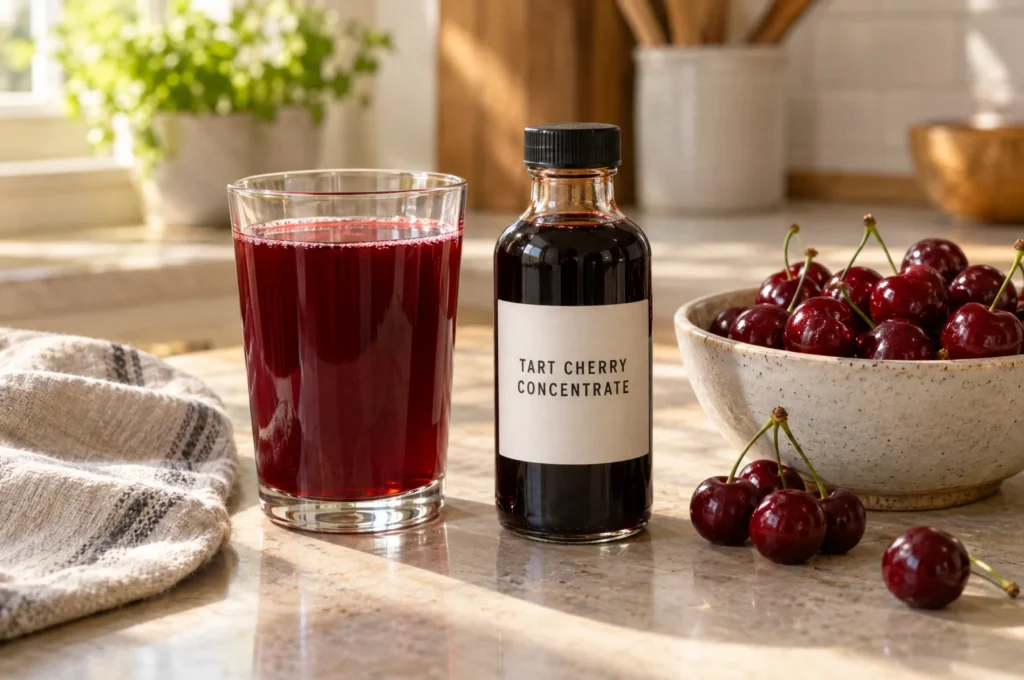
How the studies used it: one to two servings a day, typically 30 ml of concentrate diluted in water or the equivalent juice or powder, for about 4–5 days before a hard session or event and 2–3 days after. Most trials used juice or concentrate, so capsules are a reasonable convenience but less directly tested. Tart cherry juice contains a fair amount of natural sugar, which matters if you are watching calories.
What to look for: a concentrate or extract made specifically from Montmorency tart cherries, with the serving size stated.
See Montmorency tart cherry concentrates on Amazon
2. Omega-3 fish oil: works, but slowly and at a real dose
A 2026 meta-analysis in The FASEB Journal pooled 41 randomised trials of omega-3 in athletes and active people. It found moderate reductions in soreness, creatine kinase and two inflammatory markers (standardised effect sizes of roughly −0.4 to −0.7). The catch is in the subgroups: the clearest benefit came from 2 g a day or more of combined EPA and DHA, taken for at least six weeks, and it was stronger in recreational exercisers than in elite athletes. Short courses showed little effect.
So fish oil is not something to take the night before a race. It is a daily background supplement, and most standard capsules provide only 300–600 mg of EPA and DHA, which is a fraction of the studied dose. Check the label for the EPA plus DHA figure, not the “fish oil” figure.
A product that matches the dose: Thorne Super EPA provides 425 mg EPA and 270 mg DHA per gelcap, so three gelcaps a day give about 2.1 g, and it is NSF Certified for Sport. If you take blood thinners, talk to your doctor before taking omega-3 at this dose.
Check Thorne Super EPA on Amazon
3. Curcumin: modest, and the form matters
Curcumin is the main active compound in turmeric. A 2022 dose-response meta-analysis by Beba and colleagues in Phytotherapy Research pooled ten randomised trials and found that curcumin reduced muscle soreness and creatine kinase after exercise, with a modest effect on soreness and a lot of variation between studies. Doses in the trials ranged widely, from 150 mg to several grams a day.
Plain curcumin is poorly absorbed, so most trials used enhanced forms. One of the best known, a 2014 trial in 20 men by Drobnic and colleagues, used Meriva, a curcumin phytosome, at 200 mg of curcumin twice a day starting two days before a downhill run. The curcumin group reported less thigh pain and fewer MRI signs of muscle injury. It was a small, single-blind pilot, and three of its authors worked for or consulted for the company that makes Meriva.
A product that matches the research: Thorne Curcumin Phytosome is made with Meriva and is NSF Certified for Sport. Curcumin can interact with blood thinners and is not advised with gallstones; ask a pharmacist if you take regular medication.
Check Thorne Curcumin Phytosome on Amazon
4. BCAAs: real in trials, less useful in real life
A 2024 meta-analysis in Sports Medicine – Open pooled 18 randomised, placebo-controlled trials and found that branched-chain amino acids reduced soreness at 24, 48, 72 and 96 hours after damaging exercise, with the largest effect at 72 hours. Higher daily doses and longer supplementation were linked to bigger benefits.
The limitation is the comparison. Those trials compared BCAAs with a placebo, not with a protein shake or a protein-rich meal, which also supply BCAAs along with the other amino acids muscles need. If you already eat enough protein, the extra benefit of a BCAA product is probably small. I go through this in detail in creatine vs BCAA; for most people, a good protein powder is the better buy.
Popular, but not for soreness
- Creatine. Excellent for strength and muscle over time, but trials on soreness itself are mixed. Take it for performance, not for aches; see the best creatine.
- Magnesium. Often marketed for sore muscles and cramps, with little trial evidence for exercise soreness in people who are not deficient.
- High-dose vitamin C and E. Some studies suggest large antioxidant doses can blunt training adaptations, which is the opposite of what you want.
- Painkillers taken routinely. Not a supplement, but worth saying: regular anti-inflammatory drugs around training are not a good long-term recovery plan. Use them when you need them, not by habit.
What helps more than any supplement
- Progress gradually. The single best way to avoid severe soreness is not to jump into a new exercise, volume or eccentric load all at once.
- Sleep. Recovery happens overnight; short sleep makes everything feel worse.
- Enough protein across the day, roughly 1.6 g per kg of body weight if you are training for muscle.
- Light movement. An easy walk, cycle or session with the same muscles often eases soreness more than rest.
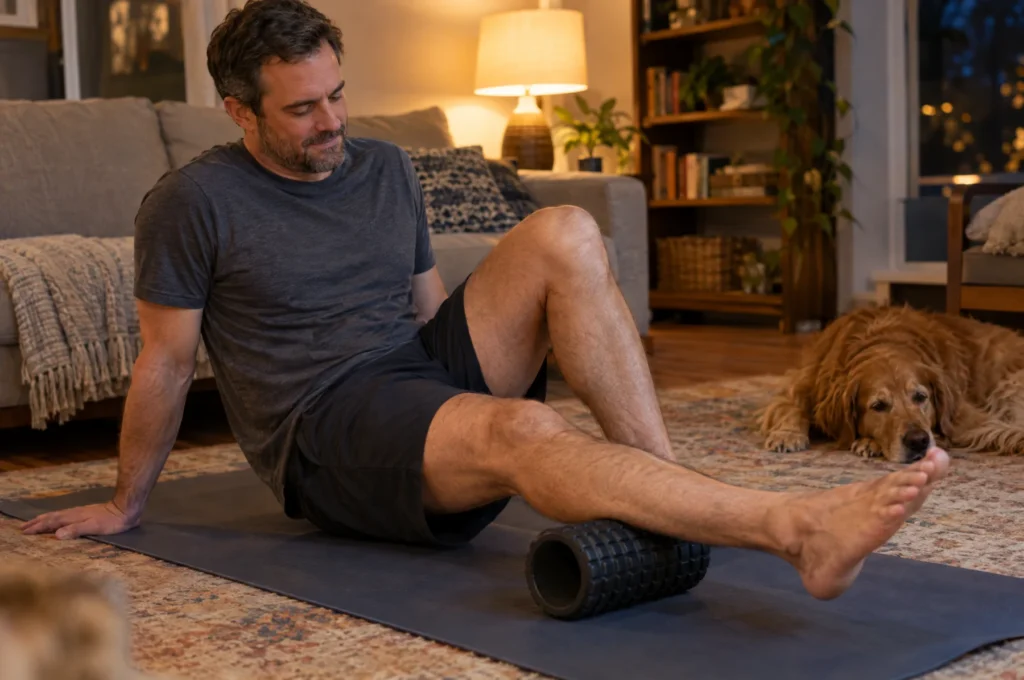
- Massage or foam rolling can reduce how sore you feel in the short term.
If soreness is severe, lasts more than a week, comes with swelling, weakness or dark urine, see a doctor: that is not ordinary DOMS.
As an Amazon Associate I earn from qualifying purchases. This never changes a score, a ranking or a verdict — those are decided before any commercial link is considered.
Common questions
What is the best supplement for muscle soreness?
Tart cherry has the most consistent evidence, with a small effect on soreness and a moderate effect on how fast strength recovers. Omega-3 also works, but only at about 2 g of EPA and DHA a day for six weeks or more.
Which supplement works fastest for sore muscles?
Tart cherry and curcumin were studied over days, usually starting before a hard session. Omega-3 needs weeks. None of them works like a painkiller after the soreness has already started.
Do BCAAs help muscle soreness?
In trials against a placebo, yes. Whether they add anything when you already eat enough protein has not been shown, so protein is usually the better buy.
Does magnesium help sore muscles?
There is little evidence that it reduces exercise soreness in people who are not low in magnesium.
Should I take recovery supplements every day?
Omega-3 is a daily supplement by nature. Tart cherry and curcumin are better used around demanding sessions, competitions or training camps, partly because some inflammation is part of how muscles adapt.
Is muscle soreness a sign of a good workout?
No. It mostly reflects how unfamiliar the exercise was. As your body adapts, soreness fades even when the workout is just as effective.
Sources
- Hill JA et al. Tart cherry supplementation and recovery from strenuous exercise: a systematic review and meta-analysis. Int J Sport Nutr Exerc Metab. 2021;31(2):154–167.
- Comparative effects of plant-derived anthocyanin- and flavanol-rich supplements on recovery after exercise-induced muscle damage: a systematic review and network meta-analysis. 2026.
- Li and Zhang. Effects of omega-3 supplementation on inflammation and recovery in sports: a meta-analysis. The FASEB Journal. 2026.
- Beba M et al. The effects of curcumin supplementation on delayed-onset muscle soreness, inflammation, muscle strength and joint flexibility: a systematic review and dose-response meta-analysis. Phytotherapy Research. 2022.
- Drobnic F et al. Reduction of delayed onset muscle soreness by a novel curcumin delivery system (Meriva): a randomised, placebo-controlled trial. J Int Soc Sports Nutr. 2014.
- Attenuating muscle damage biomarkers and muscle soreness after exercise-induced muscle damage with BCAA supplementation: a systematic review and meta-analysis with meta-regression. Sports Medicine – Open. 2024.

Roy Douele founded inareview and writes every review on the site. He is not a medical professional. Each review is built from the product's label, the brand's own testing documents, public certification registers and the published clinical research, then scored out of 10. Brands cannot pay for a review or influence a score.
View All Articles